Beyond GenZ: Why Bhāratvarsh Must Reject Western Generational Labels and Reclaim Its Civilizational Identity
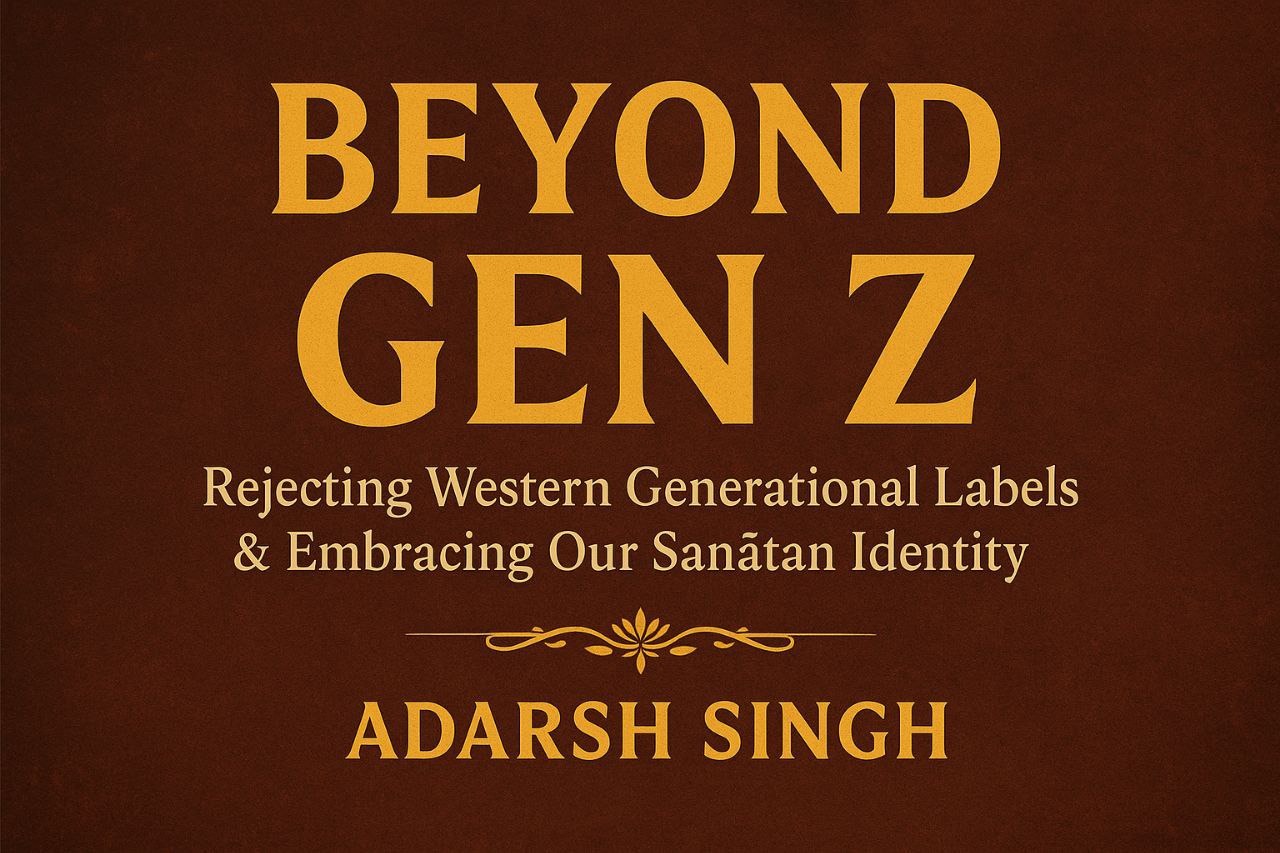
“A civilization declines not when it loses wealth, but when it begins borrowing lenses to see itself.” ~ Adarsh Singh
Western societies love categorizing people into neatly packaged groups, Baby Boomers, GenX, Millennials, GenZ, Gen Alpha, and so on. With every two decades, they feel compelled to redefine an entire generation because their cultural foundations keep shifting, their family systems keep breaking, and their societal values keep dissolving.
⚞ But what happens when these terms, created for Western fragmentation, are exported into a civilization rooted in continuity?
⚞ What happens when a culture with thousands of years of unbroken lineage starts identifying itself through ideas barely a few decades old?
⚞ What happens when Bhāratvarsh, a civilization older than history itself, begins calling its children “GenZ”?
In reality, these labels do not describe us, they distort us.
Bhāratvarsh is not a generational civilization. India is a civilizational continuum.
Sanātan Dharma does not begin with Gen Alpha and does not end with GenZ.
It does not shift every 20 years. It does not fracture every generation.
It does not reinvent values based on pop culture trends.
Instead, it cultivates a timeless flow of knowledge, values, ethics, spirituality, family systems, and social responsibilities, all woven into a framework that has outlived empires, ideologies, invasions, and even attempts at colonial re-engineering.
This is the essence of our civilizational strength. And it is precisely why terminology like “GenZ” does not fit us.
“The West may name its generations after letters, but we name our lineage after light. We are not GenZ, We are the unbroken flame of Sanātan.” ~ Adarsh Singh
The Western Lens: A Culture Defined by Fragmentation
To understand why “GenZ” is misaligned with Bhāratvarsh, we must understand its origins.
Western generational labels are products of:
⚞ Rapid cultural breakdown
⚞ Disconnected family structures
⚞ Declining religiosity
⚞ Social alienation
⚞ Consumerist identity
⚞ Technologically induced attention collapse
These labels arise because Western societies cannot rely on a continuous transmission of values across generations. Each generation feels like a new experiment, a reset button, a fresh psychological cohort with different behaviors, fears, aspirations, and cultural markers.
The West uses generational terms because:
⚞ They have no civilizational continuity left.
⚞ When everything changes, you need labels to track the damage.
“When society loses its roots, it starts measuring itself by its branches.” ~ Adarsh Singh
Their identity is not built on tradition but trend cycles. So they create new names for every twenty-year block, because each block behaves differently.
But Bhāratvarsh is not a society built on trends; it is built on Dharma.
Bhāratvarsh: A Civilization, Not a Generation
Bhāratvarsh does not have “generations” in the Western sense.
It has paramparā, a sacred tradition of knowledge handed down steadily through families, gurus, teachers, communities, and āśram stages.
Sanātan Dharma is eternal not because it is old, but because it is continually renewed through living practice.
We don’t have:
⚞ Broken lineage
⚞ Distrust between age groups
⚞ Combat between “Boomers” and “Gen Z”
⚞ Cultural suspicion between parents and children
⚞ Fragmented cultural identities
Instead, we have:
⚞ Joint or integrated families
⚞ Intergenerational respect
⚞ Cultural transmission
⚞ Shared rituals
⚞ Shared scriptures
⚞ Shared festivals
⚞ Shared spiritual aspirations
Our idea of society has always been collective and continuous, not fractured and redefined every two decades.
⚞ Where the West has generational conflict, Bhāratvarsh has generational harmony.
⚞ Where the West has cultural burnout, Bhāratvarsh has cultural rejuvenation.
⚞ Where the West has an identity breakdown, Bhāratvarsh has identity continuity.
And the backbone of this continuity is the four āśram system, a human development framework far more sophisticated than anything modern sociology has ever produced.
“Sanātan Dharma does not divide life into generations; it integrates life into evolution.” ~ Adarsh Singh
The Four Āśrams: Bhāratvarsh’s Eternal Generational Blueprint
Western generational names like GenZ are simplistic sociological tags.
But Bhāratvarsh already perfected a life structure thousands of years ago:
1. Brahmacharya (The Learning Phase)
A period of discipline, curiosity, learning, and character-building.
2. Gṛhastha (The Responsibility Phase)
A period of marriage, work, productivity, contribution, and dharmic living.
3. Vānaprastha (The Withdrawal Phase)
A graceful detachment from material responsibilities and a shift to spiritual maturity.
4. Sannyāsa (The Liberation Phase)
A life dedicated to spiritual liberation, wisdom, and teaching.
This is the real Bhartiya generational cycle. It is not based on the birth year. It is based on growth, responsibility, wisdom, and consciousness.
⚞ GenZ and Gen Alpha reflect chronology. The four Āśrams reflect inner evolution.
⚞ GenZ is a demographic. Āśrams are a life philosophy.
⚞ GenZ is accidental. Āśrams are intentional.
This is why Bhartiya civilization did not splinter into behaviors every 20 years. People across ages shared similar values, goals, and ethics, not because of social engineering, but because of spiritual engineering.
⚞ The West changes generations when fashion trends and slang change.
⚞ Bhāratvarsh evolves generations when consciousness changes.
“Where the West measures life in decades, Sanātan measures it in yugās.” ~ Adarsh Singh
The Problem With Importing Western Terminology
When we start using Western generational labels, we unconsciously import their problems:
1. Generational Conflict
Labels create conflict:
⚞ “Boomers are outdated.”
⚞ “Gen Z is lazy.”
⚞ “Millennials ruined everything.”
These labels are Western social anxieties we don’t need.
2. Fragmentation of Society
Bhartiya culture thrives on collective identity. Generational labels create isolated identities.
3. Breakdown of Family Systems
Western societies have full-blown generational mistrust. Using their terminology seeds the same division.
4. Loss of Cultural Context
Western terms reflect Western behavior patterns, none of which describe Bhartiya families or culture.
5. Psychological Manipulation by Media and Corporations
Generational labels are also marketing tools. Industries use them to influence behavior, consumption, and identity.
6. Civilizational Self-Mistrust
Most dangerously, these labels make us see ourselves through Western lenses.
And that is how civilizations lose themselves.
“A borrowed vocabulary slowly becomes a borrowed identity.” ~ Adarsh Singh
Sanātan Civilization Cannot Be Shrunk Into GenZ
In the Western worldview, GenZ is a generation floating without roots. In Bhāratvarsh, no generation is ever rootless.
Sanātan Dharma provides:
⚞ Psychological grounding
⚞ Ethical direction
⚞ Spiritual purpose
⚞ Cultural belonging
⚞ Family anchoring
⚞ Intergenerational mentoring
Everything that defines a generation in the West: technology, music, slang, and behavior, means nothing here.
Because in Bhāratvarsh:
⚞ Generations do not reinvent morality. They inherit it.
⚞ They don’t reinvent family. They live it.
⚞ They don’t reinvent identity. They embody it.
⚞ They don’t reinvent culture. They continue it.
We are not a society that dissolves values with every new trend. We are a civilization that refines values with every new era.
Bhāratvarsh’s Civilizational Memory Is Older Than Western Timekeeping
The West counts generations for 80-100 years. Bhāratvarsh counts a legacy for 10,000+ years. Western generational labels last for two decades. Sanātan categories last for yugās.
A civilization that remembers:
⚞ Ṛṣis
⚞ Upanishads
⚞ Vedas
⚞ Purāṇas
⚞ Itihāās
⚞ Gurukuls
⚞ Āśrams
⚞ Paramparā
We do not need terms like “GenZ.” These labels do not expand us. They shrink us.
“When you come from eternity, you don’t need titles designed for a century.” ~ Adarsh Singh
The Danger: Psychological Westernization Through Language
The first stage of cultural colonization is linguistic colonization.
Once you begin calling yourself “GenZ,” you start absorbing everything GenZ represents in the West:
⚞ Ultra-individualism
⚞ Anti-family ideology
⚞ Cultural rebellion
⚞ Consumerist identity
⚞ Hyper-sexualised content
⚞ Influencer-driven morality
⚞ Attention-deficit habits
⚞ Anti-spiritual narratives
Most of these patterns do not emerge naturally in Bhāratvarsh. They emerge because labels create expectations, and expectations create behavior.
⚞ If Bhartiya youth call themselves “GenZ,” they will gradually act like Western GenZ.
⚞ This is how cultures collapse, not through invasions, but through vocabulary.
“The ship sinks only when the water enters, not when it floats on the sea.” ~ Adarsh Singh
Reclaiming Our Civilizational Language
Bhāratvarsh does not need a new vocabulary. Bhāratvarsh needs to reclaim its original vocabulary.
Instead of:
⚞ GenZ
⚞ Millennials
⚞ Gen Alpha
we should speak in the language of:
⚞ Yugās
⚞ Paramparā
⚞ Āśrams
⚞ Samskārs
⚞ Dharma
⚞ Kul
⚞ Guru-Śiśya tradition
These words are not sociological labels. They are civilizational frameworks.
⚞ They do not divide us. They unify us.
⚞ They do not confuse us. They guide us.
⚞ They do not break relationships. They nurture them.
⚞ Instead of “GenZ youth,” we must speak of Bharatiya yuva.
⚞ Instead of “Gen Alpha kids,” we must speak of Sanātani children.
⚞ Instead of “Millennial parents,” we must speak of Gṛhastha Āśramīs.
This language reconnects us with our civilizational foundations.
Bhāratvarsh Must Not Become a Consumer of Western Social Templates
Every society exports something.
The West exports ideas and vocabularies that shape behavior globally:
⚞ Feminism waves
⚞ Environmental narratives
⚞ Social justice terminology
⚞ Gender ideologies
⚞ Generational labels
If we blindly import their vocabulary, we will import their worldview. Bhartiya society is strong because it has always been self-defined, not externally defined.
But now, with digital globalization, our youth is bombarded with Western identity frameworks every day. Without conscious effort, they may start believing:
⚞ “I am GenZ, so I must behave like GenZ.”
That is psychological colonization.
“No civilization was ever destroyed from outside; they all collapsed from the inside when they stopped defining themselves.” ~ Adarsh Singh
The Way Forward: A New Cultural Narrative for Bhartiya Youth
Bhāratvarsh must build a narrative grounded in:
1. Civilizational Pride
We must teach the youth that they belong to a civilization that is older than most countries combined.
2. Dharmic Education
Not dogma, wisdom. The Upanishadic thinking that nurtures inquiry, dignity, and clarity.
3. Family Continuity
Strengthening joint families, mentorship, elders’ roles, and intergenerational bonds.
4. Bhartiya Lenses for Bhartiya Realities
We must evaluate Indian society through dharmic frameworks, not Western sociology.
5. Conscious Abandonment of Imported Labels
Let Bhāratvarsh create its own sociological vocabulary aligned with its civilizational essence.
6. Reinforcement of the Four Āśrams
Teaching individuals the natural progression from learning → responsibility → wisdom → liberation.
7. Digital Consciousness
Training youth to navigate technology without losing cultural grounding.
If we do this, Bhāratvarsh will not only protect itself from cultural dilution, it will inspire the world with a civilizational model that the West is desperately searching for.
We Are Not GenZ. We Are Sanātanis.
⚞ Bhāratvarsh does not exist in fragments. Bhāratvarsh exists in continuity.
⚞ Bhāratvarsh does not reinvent identity every two decades. Bhāratvarsh refines identity every era.
⚞ Bhāratvarsh does not suffer generational wars. Bhāratvarsh thrives on generational harmony.
⚞ Gen Z is a term created for a society struggling to understand itself. But Bhāratvarsh already knows itself.
⚞ We are not a generation defined by the alphabet. We are a civilization defined by eternity.
“We are the children of Sanātan, not the subjects of sociological templates.” ~ Adarsh Singh
{{DATE}}
 Launch your Graphy