Equality Cannot Be Legislated by Division
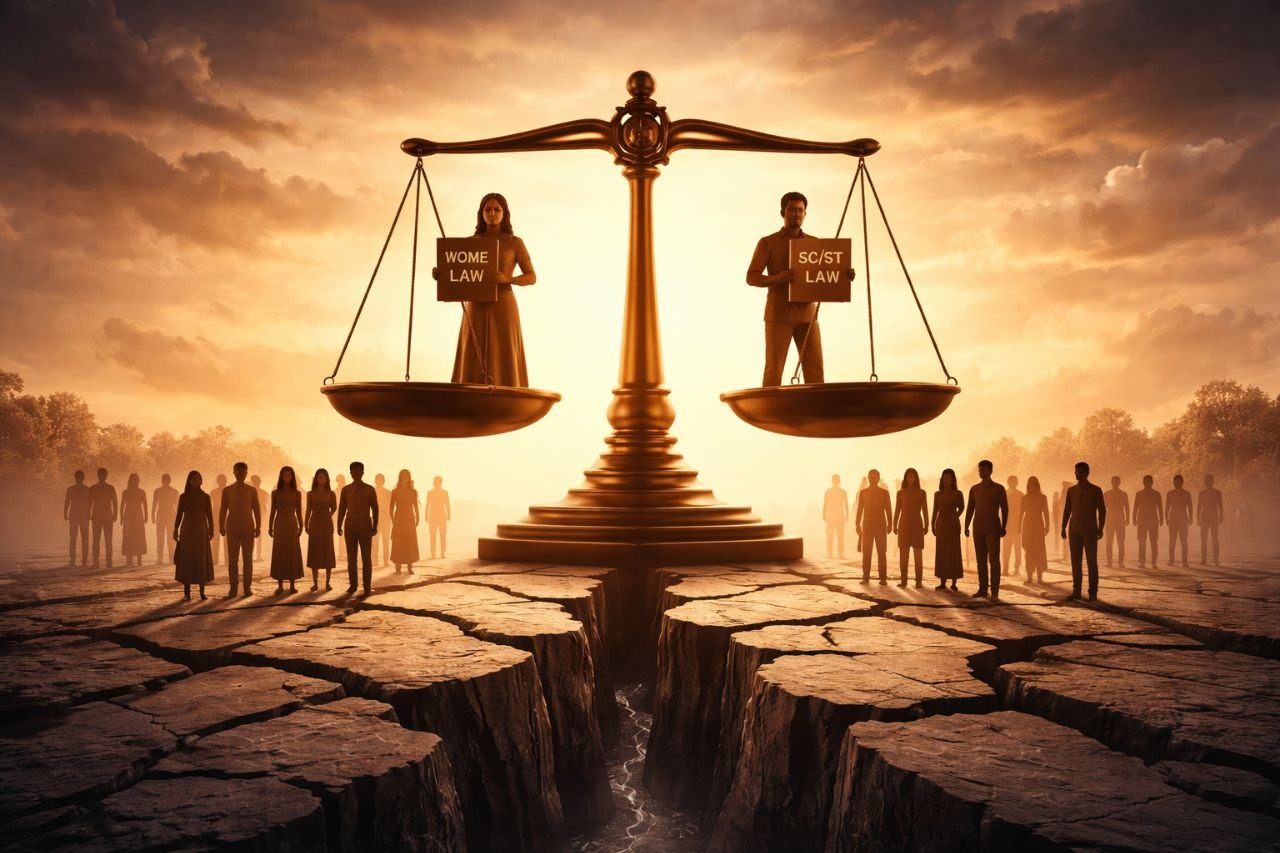
The Illusion of Justice Through Fragmentation
A society’s moral maturity is not measured by the number of laws it creates, but by the quality of justice it delivers. When laws multiply in response to social failures, it is often not a sign of progress but of institutional weakness. India today stands at such a crossroads, where the intent of justice is repeatedly undermined by the method of its implementation.
We are increasingly told that equality can be achieved by carving society into narrower identities and then legislating separately for each. Women need special laws. Certain castes need special laws. Certain classes need exceptional legal protection. The assumption is that justice can be manufactured by differentiation.
But justice, by its very nature, is indivisible.
“When law begins to favor identity over humanity, justice quietly exits through the back door.” ~ Adarsh Singh
This blog is not an argument against protection. It is an argument against selective justice, institutional laziness, and the dangerous belief that social harmony can be engineered through legal compartmentalization.
Law Was Meant to Unite, Not Segment
The original purpose of law was simple yet profound: to establish fairness, order, and accountability in human interactions.
Law was never meant to become a political instrument to balance vote banks or compensate for administrative failure.
When a state begins to rely on identity-based legislation, it implicitly admits that:
➤ Its governance has failed
➤ Its administration is inefficient
➤ Its justice delivery mechanisms are slow or biased or corrupt
Instead of fixing these foundational pillars, we choose the easier route: create a new law.
But fragmented law does not heal society; it hardens fault lines.
A just system does not ask who you are before asking what happened.
Women’s Rights Laws and the Question of True Equality
No civilized society can deny the historical oppression of women. Patriarchy is real. Exploitation has existed. Abuse must be punished. Protection is necessary.
But here lies the uncomfortable truth: a law framed in the name of empowerment must not become an instrument of reverse discrimination.
In practice, several women-centric laws operate on presumption rather than proof. The accused often begins as guilty until proven innocent. This violates one of the most sacred principles of justice.
Equality cannot exist where:
➤ Gender replaces evidence
➤ Allegation replaces investigation
➤ Identity replaces due process
“Equality does not mean changing the direction of injustice; it means ending injustice altogether.” ~ Adarsh Singh
When a law protects one gender by weakening another, it does not create equality, it merely inverts power imbalance.
True women’s empowerment lies in:
➤ Speedy and impartial trials
➤ Strong enforcement
➤ Fair investigation
➤ Accountability for misuse
Justice should empower the victim without demonizing an entire gender.
SC/ST Laws and the Dilemma of Social Balance
The historical injustice against marginalized communities in India is undeniable. Centuries of exclusion, humiliation, and deprivation demanded correction. Legal safeguards were necessary.
But correction must not become permanent separation.
When protective laws begin to:
➤ Discourage fair inquiry
➤ Enable misuse
➤ Create fear instead of trust
➤ Divide society into “protected” and “suspect”
…then the law stops being a shield and starts becoming a wedge.
“A law that protects without accountability eventually destroys the very harmony it was meant to preserve.” ~ Adarsh Singh
Social justice is not achieved by institutionalizing difference forever. It is achieved when difference becomes irrelevant.
The goal of reformative law should be integration, not perpetual categorization.
The Core Failure: Governance, Not Society
Blaming society is convenient. Reforming governance is difficult.
Every time a new identity-specific law is introduced, it silently admits:
➤ Police reforms are incomplete
➤ Judiciary is overburdened & inefficient
➤ Administrative accountability is weak
➤ Justice is delayed and diluted
Instead of strengthening:
➤ Police training
➤ Investigation standards
➤ Judicial capacity
➤ Fast-track courts
➤ Accountability mechanisms
We pass another law.
“When systems fail, laws multiply. When systems work, laws become invisible.” ~ Adarsh Singh
No number of laws can compensate for bad implementation.
The Psychological Cost of Identity-Based Justice
Laws do not just regulate behavior; they shape psychology.
When people begin to see each other through the lens of:
➤ Gender
➤ Caste
➤ Class
➤ Category
Trust erodes. Fear replaces cooperation. Suspicion replaces empathy.
Society becomes a legal minefield rather than a shared moral space.
➤ A man fears accusation.
➤ A community fears implication.
➤ An institution fears decision-making.
This is not justice. This is social paralysis.
Equality Is a Principle, Not a Privilege
Equality before law does not mean ignoring reality. It means responding to reality without prejudice.
A strong justice system does not ask:
➤ Are you a man or a woman?
➤ Are you from this caste or that class?
It asks:
➤ What happened?
➤ Who is responsible?
➤ What evidence exists?
➤ What is the fair consequence?
“Justice that needs labels has already lost its moral authority.” ~ Adarsh Singh
The Ghalib Metaphor: Cleaning the Mirror While the Face Remains Dirty
The situation of modern India mirrors Mirza Ghalib’s timeless insight:
“Ta umr Ghalib ye bhool karta raha, dhool chehre pe thi aur aaina saaf karta raha.”
We keep cleaning the mirror:
➤ Passing new laws,
➤ Forming new categories,
➤ Creating new protections
While the real dust remains on our face:
➤ Inefficient governance
➤ Slow justice
➤ Corruption
➤ Poor enforcement
➤ Political opportunism
Until we clean the face, no mirror will show us the truth.
What True Reform Looks Like
True reform is difficult because it threatens entrenched interests.
It requires:
➤ Police neutrality and training
➤ Judicial expansion and modernization
➤ Time-bound justice
➤ Harsh punishment for false cases
➤ Zero tolerance for misuse
➤ Equal accountability for all citizens
➤ Most importantly, it requires political courage.
“A nation does not collapse due to lack of laws; it collapses due to lack of fairness.” ~ Adarsh Singh
Beyond Caste, Beyond Gender, Beyond Class
A mature civilization does not deny identity, but it does not worship it either.
India’s greatness has always lied in its ability to integrate diversity into unity, not fragment unity into diversity.
➤ Justice must heal.
➤ Law must unite.
➤ Governance must serve.
➤ Administration must execute.
➤ Judiciary must protect truth, not identity.
Only then can equality stop being a slogan and start becoming a lived reality.
Justice Is One, or It Is None
➤ Selective justice is injustice with better branding.
➤ If equality changes based on who stands in front of the law, then the law itself has failed.
➤ A nation cannot rise when its legal system divides its people more than it protects them.
“Justice is not about who you are; it is about what is right. The day we forget this, law becomes oppression in disguise.” ~ Adarsh Singh
{{DATE}}
 Launch your Graphy