From Enterprise to Employment: How Western Ideologies Eroded the Soul of Humanity
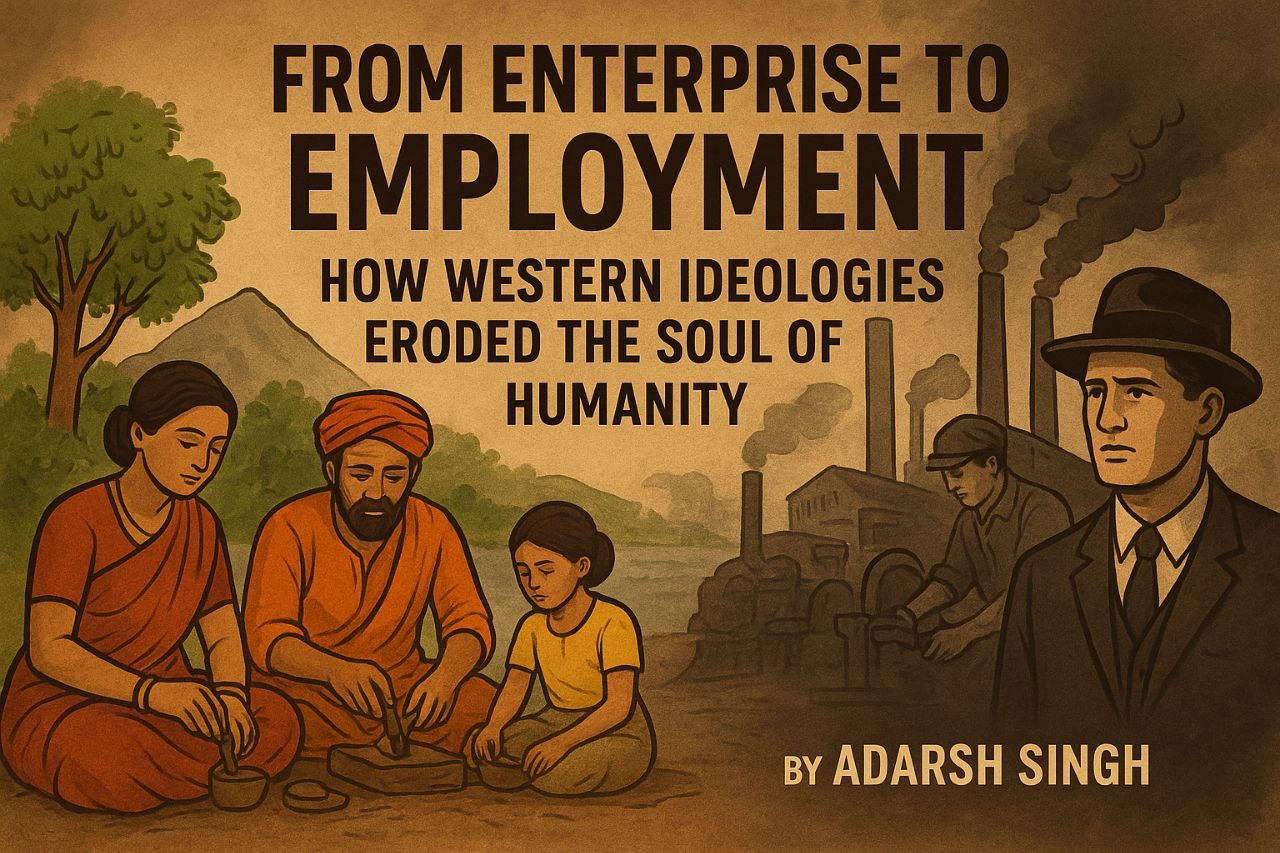
The story of humanity is often told as a tale of progress, of discoveries, innovations, and the relentless pursuit of wealth and comfort. But beneath this glossy surface lies a deeper, often unspoken truth: the systems we embrace, the models we follow, and the philosophies we adopt shape not only our economies but the very essence of our existence. In particular, the Western model of progress, industrial, mechanistic, and profit-driven, has left indelible imprints not just on its own societies but across the entire globe.
In the context of Bharatvarsh, a land that once thrived on self-sustaining enterprises, community cohesion, and a delicate balance between personal life and livelihood, the imposition of Western education and employment models represents a fundamental rupture. To understand this transformation, we must travel back in time, examine the mechanisms of modern economic systems, and reflect on the profound cultural and spiritual consequences that followed.
The Era of Enterprise in Ancient Bharatvarsh
Long before the industrial revolution and the colonial imposition of foreign systems, the people of Bharatvarsh lived in an ecosystem that balanced work, family, and community. There were no “jobs” in the sense we understand today; there were enterprises, family-run, collaborative, and holistic.
Husbands and wives worked side by side, not merely to earn wages but to sustain life, nurture the next generation, and maintain harmony with nature and society. The family was both an economic and emotional unit, where work and domestic life coexisted seamlessly.
“In the rhythm of shared labor, the soul of the family found its heartbeat.” ~ Adarsh Singh
Every craft, trade, or profession was more than a means to survive; it was a practice of skill, knowledge, and creativity passed through generations. This system fostered balance, men and women shared responsibilities without external pressure, ensuring that economic output, family growth, and cultural continuity coexisted in harmony.
The Arrival of Western Education and the Erosion of Enterprise
The turning point came with the colonial educational policies, famously represented by Macaulay’s system, designed not to educate but to create a compliant workforce.
The Macaulay school of education replaced indigenous knowledge with Western ideals, devaluing self-sufficient enterprises and promoting the notion of employment under a hierarchical system. Suddenly, families that once thrived as self-sufficient economic units were coerced into producing labor for others.
Women, who were partners in enterprise rather than wage earners, were gradually pushed into the same labor markets as men. At first glance, this seemed like progress. But the economic consequences were immediate and predictable: an increase in labor supply led to a reduction in wages. Families, which once enjoyed prosperity through collaborative work, now found that double the effort resulted in little to no net gain.
“The machinery of progress often consumes the very hands that drive it.” ~ Adarsh Singh
The impact extended beyond economics. Women, as exhausted as men from the double burden of work, were less able to nurture family growth and sustain domestic harmony. The traditional rhythms of life, caregiving, child-rearing, and community involvement, were disrupted.
Feminism and the Distorted Quest for Equality
In parallel with economic changes, Western social philosophies, particularly the modern, consumerist interpretation of feminism, began to influence societal norms. While genuine feminism seeks equality, respect, and choice, the distortion of the philosophy in industrial societies often emphasizes competition over collaboration.
The mantra of “My Life, My Choice” became a slogan of liberation, but in many cases, it detached women from the natural interdependence that once defined family life. Both men and women now operate in an exhaustive cycle of labor, consumption, and social performance, often leaving little room for emotional or spiritual growth.
Freedom, which should have been empowering, frequently became a source of isolation. The family, once a crucible of emotional and cultural continuity, began to erode under the pressures of modern employment and flawed societal ideals.
Economics of Labor Supply and the Wage Paradox
From an economic perspective, the shift from enterprise to employment illustrates a fundamental principle: salaries are governed by supply and demand. When the labor supply increases, as it did when women entered the workforce en masse, wages tend to fall.
Yet, the economic outcome for families was often neutral at best. While both partners earned incomes, the combined effort rarely improved economic stability, and the toll on physical and emotional health was severe. Families became producers of labor but consumers of stress, trapped in a system where growth in work did not translate into growth in life.
“The measure of prosperity is not the weight of currency but the lightness of life.” ~ Adarsh Singh
This wage paradox was compounded by societal expectations, industrial work hours, and competitive pressures. Families that had once been centers of production and nurturing became units of consumption, with their energy and creativity drained by the demands of a mechanized economy.
The Global Impact of Western Industrialization
The effects of Western industrial and social models were not confined to India. Across the globe, indigenous systems of life, labor, and learning were displaced by imported ideologies of employment, competition, and consumption.
From Africa to the Americas, communities once self-sufficient and culturally coherent were absorbed into a global economic system that prioritized profit over well-being. Traditional knowledge systems, sustainable practices, and family-based enterprises were devalued or eradicated, leaving societies vulnerable to the pressures of industrial modernity.
“The Western model promised abundance but delivered exhaustion; it traded wisdom for convenience and purpose for profit.” ~ Adarsh Singh
Even in Western countries themselves, the cost was apparent. Industrialization brought wealth, yes, but also alienation, environmental degradation, and the slow erosion of family and community structures. The Western experiment, in its quest to dominate and modernize, produced more discontent than fulfillment.
Population Decline and the Exhaustion of Life
One of the most profound consequences of this shift is population decline in previously vibrant societies. As women and men are equally exhausted by industrial labor and societal pressures, the energy and time for family growth diminish. Birth rates fall, not necessarily because of choice, but because the very capacity to nurture life has been compromised.
Furthermore, the glorification of individual choice over communal responsibility, often framed as freedom or empowerment, exacerbates the trend. The result is a society that grows richer in material terms but poorer in human continuity and emotional wealth.
“Exhaustion is the silent killer of civilization; when hands are weary, the soul of the family fades.” ~ Adarsh Singh
The Civilizational Consequences
The shift from enterprise to employment, coupled with Western ideologies, has had civilizational implications. The family, once the nucleus of culture, education, and emotional health, has been weakened. Community bonds have loosened. Spiritual continuity and moral anchoring have eroded.
In effect, humanity has traded depth for breadth: a wider spread of labor, production, and consumption at the cost of emotional richness, cultural stability, and spiritual coherence.
The tragedy is not merely economic; it is existential. Societies may appear prosperous on the surface, but beneath lies a slow depletion of meaning, purpose, and intergenerational harmony.
Rethinking Progress: The Path Back to Balance
To address these profound challenges, it is essential to redefine progress. True development is not measured solely in GDP, salaries, or industrial output, but in the quality of human life, the health of families, and the resilience of culture.
This begins with recognizing the value of enterprise, collaboration, and shared responsibility. Families and communities must be reimagined as economic as well as emotional units, where men and women share labor without succumbing to exhaustion, and where reproduction, nurturing, and cultural continuity are treated as essential outcomes of work, not distractions from it.
It also requires discernment in adopting foreign models. Blind imitation of Western systems may yield material gains but often erodes indigenous wisdom. The revival of self-sufficient practices, combined with selective integration of global innovations, can create a holistic model of prosperity, one that sustains families, nurtures communities, and respects the rhythm of human life.
Spiritual and Philosophical Dimensions
At a deeper level, the crisis is not merely social or economic; it is spiritual. The Western pursuit of material wealth, industrial efficiency, and individualistic freedom often neglects the inner dimensions of life, reflection, meditation, ethical conduct, and purpose.
True empowerment arises when labor, learning, and life are aligned with higher consciousness and shared responsibility. This is not anti-progress, but pro-humanity. The challenge for modern societies, especially those influenced by Western industrial models, is to reintegrate purpose with work, family with enterprise, and freedom with responsibility.
“Humanity thrives not when it conquers the world, but when it conquers the restlessness within itself.” ~ Adarsh Singh
A Call to Reclaim the Soul of Humanity
The Western model, in its quest for domination and modernization, has left a complex legacy: technological marvels, industrial efficiency, and global networks, alongside exhaustion, cultural erosion, and spiritual alienation.
The way forward is not blind rejection, but conscious integration. Societies must reclaim the wisdom of family enterprises, balanced labor, and community-centered growth, while selectively adopting innovations that serve life rather than consume it.
In essence, the reclamation of humanity requires a return to balance, where work nourishes life, not drains it; where families thrive, not merely survive; and where progress includes the soul, not only the pocketbook.
“The measure of a civilization is not its wealth, but the vitality of its families, the health of its culture, and the depth of its humanity.” ~ Adarsh Singh
From the heart of Bharatvarsh to the far corners of the globe, history demonstrates that how we work defines how we live. The transition from enterprise to employment, accelerated by Western education, industrialization, and flawed social ideologies, reshaped the economy, exhausted families, and fractured societies.
Yet, within this challenge lies an opportunity: to reimagine progress as holistic, inclusive, and humane; to integrate the wisdom of the past with the innovations of the present; and to cultivate societies where labor, family, culture, and spirituality are not at odds, but in harmony.
By reclaiming the soul of humanity, we can ensure that future generations inherit not only material abundance but the richness of life itself.
“Civilizations fall not by invasion, but by the quiet erosion of the soul; reclaim the soul, and humanity rises again.” ~ Adarsh Singh
{{DATE}}
 Launch your Graphy