India: The Geography of Intelligence
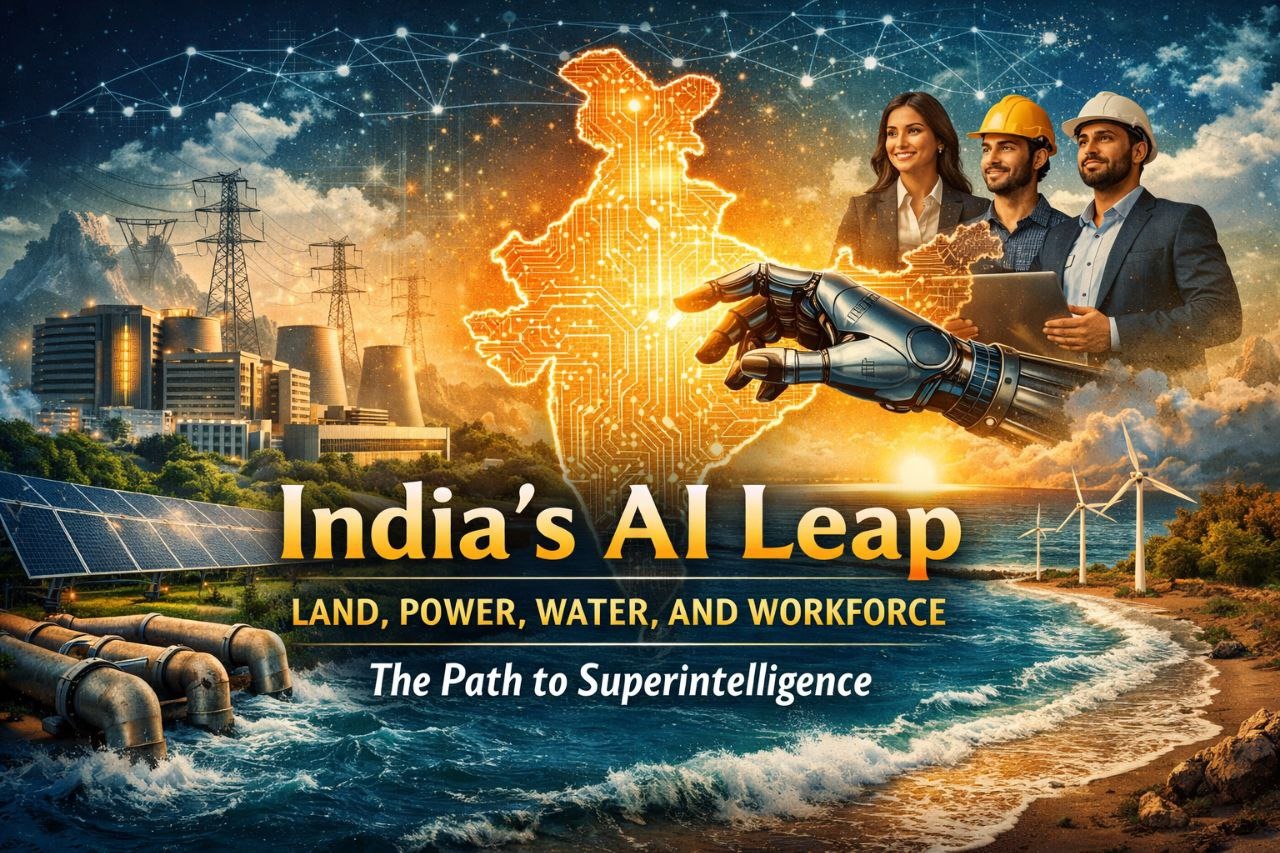
Artificial Intelligence is often spoken about as software, algorithms, neural networks, and code. But beneath the abstraction lies something profoundly physical. AI is not merely mathematics running in the cloud; it is electricity flowing through processors, water circulating through cooling systems, land hosting vast data halls, and human intelligence orchestrating it all.
The digital future rests on deeply material foundations.
If we strip away the glamour and examine the core infrastructural requirements of advanced AI ecosystems, four elements emerge with unmistakable clarity:
➤ Vast parcels of land
➤ Continuous and massive power supply
➤ Abundant and sustainable water
➤ Skilled and affordable human capital
When viewed through this lens, an extraordinary question emerges:
Is India structurally positioned to become one of the world’s primary AI infrastructure hubs?
The answer requires both optimism and realism. It demands strategic thinking, systems analysis, and long‑term civilizational perspective.
AI Is Physical Before It Is Digital
Modern AI models require hyperscale data centers, facilities spanning dozens or even hundreds of acres. Inside these campuses sit thousands of high-performance GPUs, networking clusters, cooling systems, backup energy modules, and storage arrays. Each of these components draws power relentlessly and generates intense heat.
Training frontier AI models is comparable, in energy terms, to powering a medium-sized city. Running inference at global scale demands uninterrupted electrical stability. Cooling systems must function continuously. Infrastructure redundancy is not optional; it is existential.
AI, therefore, is not just software innovation. It is infrastructure engineering at planetary scale.
And infrastructure has geography.
Land: The Silent Foundation
Advanced AI data centers require scale. A single hyperscale campus can span 50 to 100 acres or more. As models grow larger and compute density increases, these footprints expand.
India possesses a structural advantage here. Outside Tier-1 metropolitan cores, large tracts of land remain available for industrial development. Emerging technology corridors and special economic zones provide regulatory frameworks for such expansion.
However, availability alone is insufficient.
Land must be:
➤ Legally clear with undisputed title
➤ Connected to fiber backbones
➤ Geologically stable
➤ Located in politically predictable environments
➤ Close to transportation and logistics infrastructure
The transformation of raw land into AI-ready infrastructure requires long-term planning. Yet the raw input exists.
“Civilizations rise not merely on ideas, but on the land that supports those ideas.” ~ Adarsh Singh
India’s demographic scale and geographic breadth allow for distributed data center clusters rather than hyper-concentration in one region. This geographic diversification can enhance resilience, reduce systemic risk, and enable balanced development.
Power: The True Strategic Lever
If land is the foundation, power is the bloodstream.
AI infrastructure consumes enormous amounts of electricity. Large-scale GPU clusters may demand hundreds of megawatts continuously. Unlike conventional industrial loads, AI workloads are steady, high-density, and sensitive to even minor voltage fluctuations.
India today stands among the world’s largest electricity producers. Solar expansion, wind corridors, and thermal capacity form a diverse energy mix. The growth of renewable energy capacity has accelerated significantly over the last decade.
But energy production alone does not define readiness.
Critical considerations include:
➤ Grid reliability
➤ Transmission efficiency
➤ Baseline availability versus peak shortages
➤ Integration of renewables with storage
➤ ESG compliance expectations from global AI firms
AI data centers require 24/7 stable baseload power. Renewable energy can supply capacity, but storage systems and smart grid integration must complement generation.
Energy independence is not merely economic; it is strategic sovereignty.
If India can align renewable expansion with AI infrastructure planning, particularly near coastal and industrial corridors, it could create energy-secured AI ecosystems.
“The future belongs not to the nation that produces the most data, but to the one that powers it reliably.” ~ Adarsh Singh
Water: The Overlooked Variable
Few people realize how central water is to AI infrastructure.
High-performance processors generate intense heat. Cooling systems rely on water for thermal management, particularly in large evaporative or liquid cooling configurations.
India faces regional water stress in several inland urban centers. Industrial water competition with agriculture and domestic needs is already visible in some regions.
Yet India is a peninsula nation, surrounded on three sides by the sea.
With approximately 7,500 kilometers of coastline, India is bordered by the Arabian Sea to the west, the Bay of Bengal to the east, and the Indian Ocean to the south.
At first glance, this appears to eliminate water scarcity concerns for AI infrastructure.
But seawater is not directly usable for data center cooling. Its salinity causes corrosion, scaling, and biofouling. Systems must incorporate desalination or closed-loop cooling designs.
Desalination, however, is energy-intensive.
This creates a fascinating strategic intersection:
➤ AI requires electricity.
➤ Desalination requires electricity.
➤ Renewable expansion can power both.
Coastal AI clusters could integrate:
➤ Solar and wind energy generation
➤ Desalination plants
➤ Water recycling systems
➤ Advanced liquid immersion cooling
If designed intelligently, India’s coastline becomes not just a geographic boundary, but a technological frontier.
Water abundance exists in raw form. The challenge is economic conversion.
“The ocean is not scarcity; it is potentially waiting for intelligent conversion.” ~ Adarsh Singh
Environmental safeguards must accompany expansion. Marine ecosystems, coastal regulation zones, and sustainability frameworks must be integrated from inception. Done responsibly, coastal AI corridors can reduce pressure on freshwater basins while enabling high-density computing.
Human Capital: India’s Strongest Edge
If infrastructure is the body of AI, human intelligence is its nervous system.
India produces over a million engineering graduates annually. Its IT services sector has matured over decades, building global credibility in software development, systems integration, cybersecurity, and enterprise solutions.
Three core advantages stand out:
1. English proficiency
2. STEM educational scale
3. Competitive cost-to-talent ratio
India’s startup ecosystem has expanded rapidly, with innovation hubs fostering AI research, machine learning applications, and deep tech ventures.
While cutting-edge AI research still sees significant concentration in certain global regions, India’s demographic dividend provides a pipeline for scaling talent at unprecedented volume.
The next stage requires:
➤ Strengthening AI-focused curricula
➤ Encouraging semiconductor design expertise
➤ Supporting research institutions
➤ Creating incentives for reverse brain drain
Talent abundance, when aligned with infrastructure, becomes exponential.
“Technology evolves through hardware, but civilizations advance through human insight.” ~ Adarsh Singh
Semiconductor Sovereignty: The Missing Piece
No AI ecosystem can function without advanced chips.
While India has announced semiconductor initiatives and fabrication ambitions, large-scale advanced-node manufacturing remains under development.
Hardware dependency introduces geopolitical vulnerability.
True AI sovereignty requires:
➤ Indigenous chip fabrication
➤ GPU supply chain access
➤ Advanced packaging and assembly
➤ High-performance computing clusters
This is capital-intensive and technologically complex. Yet without it, infrastructure leadership remains partial.
India’s policy momentum indicates awareness of this gap. The timeline for execution will determine strategic positioning.
The Coastal AI Corridor Vision
Imagine a network of integrated coastal AI corridors along India’s western and eastern shores.
Each corridor integrates:
➤ Renewable energy farms
➤ Desalination plants
➤ Hyperscale data centers
➤ Smart grid storage
➤ Fiber connectivity to inland hubs
➤ Research institutions and AI parks
Such ecosystems would reduce inland water stress, leverage maritime logistics, and align energy with computing demand.
This would transform geography into advantage.
AI clusters positioned along coasts could also serve global markets with low-latency connectivity across continents.
Strategic foresight lies in ecosystem design rather than isolated projects.
The Economic Multiplier
AI infrastructure expansion would stimulate multiple sectors:
➤ Power generation
➤ Renewable energy manufacturing
➤ Grid modernization
➤ Water treatment technologies
➤ Real estate and industrial development
➤ Fiber optic and telecom infrastructure
➤ Construction and engineering services
For investors and policymakers, AI infrastructure is not a single industry, it is a macroeconomic catalyst.
Every hyperscale facility triggers supply chain demand, employment generation, and regional economic uplift.
India’s scale amplifies this multiplier effect.
Environmental and Ethical Responsibility
Large-scale AI expansion must remain aligned with sustainability.
Unregulated expansion risks:
➤ Water overuse
➤ Carbon footprint escalation
➤ Urban congestion
➤ Ecological damage
Sustainable AI requires:
➤ Renewable integration
➤ Carbon-neutral targets
➤ Water recycling systems
➤ Transparent environmental governance
The goal should not merely be AI leadership, but responsible AI leadership.
“Progress without conscience is speed without direction.” ~ Adarsh Singh
The Global Context
Globally, AI leadership today is concentrated in a few dominant economies. Hardware supply chains, chip fabrication, and advanced compute clusters remain strategically clustered.
However, the next wave of AI growth will require distributed infrastructure.
Energy costs, land constraints, water stress, and geopolitical fragmentation are reshaping the map.
India’s demographic scale, geographic diversity, and policy alignment position it uniquely in this evolving landscape.
It may not yet dominate every layer of the stack, but it holds the foundational ingredients.
Abundance and Execution
India has:
➤ Land
➤ Expanding power capacity
➤ Coastal access to seawater
➤ Growing renewable energy
➤ Massive engineering talent pool
➤ Policy momentum toward semiconductors and digital infrastructure
But abundance alone does not guarantee dominance. Execution determines destiny.
Infrastructure must be planned decades ahead. Policy must remain stable across political cycles. Environmental safeguards must align with industrial ambition.
When land, power, water, and talent converge intelligently, transformation becomes inevitable.
A Civilizational Perspective
AI is not just an industry shift; it is a civilizational pivot.
Nations that host AI infrastructure shape data governance, innovation velocity, economic growth, and geopolitical influence.
India’s civilizational history has always been rooted in knowledge: mathematics, astronomy, philosophy, logic.
The digital age demands a new synthesis: ancient intellectual heritage combined with modern computational power.
If India aligns geography with strategy and abundance with foresight, it can evolve from a service provider to an infrastructure anchor of the AI age.
The opportunity is not temporary. It is structural.
“The age of intelligence will not be led by those who speak the loudest, but by those who build the deepest foundations.” ~ Adarsh Singh
The Strategic Conclusion
Artificial Intelligence requires more than algorithms:
➤ It requires land vast enough to host hyperscale facilities.
➤ It requires electricity to be stable enough to power relentless computation.
➤ It requires water sufficient to cool digital engines.
➤ It requires human capital capable of innovation.
➤ It requires hardware sovereignty.
➤ It requires vision.
India possesses the raw ingredients in remarkable abundance.
Its peninsular geography offers maritime and desalination advantages. Its renewable expansion can power coastal AI corridors. Its talent pool provides scale. Its demographic strength ensures longevity.
The remaining variable is disciplined, long-term execution.
If executed intelligently, India does not merely participate in the AI revolution. It anchors it. And in doing so, it reshapes the global balance of digital power.
“Abundance is a gift of geography. Greatness is a result of execution.” ~ Adarsh Singh
{{DATE}}
 Launch your Graphy