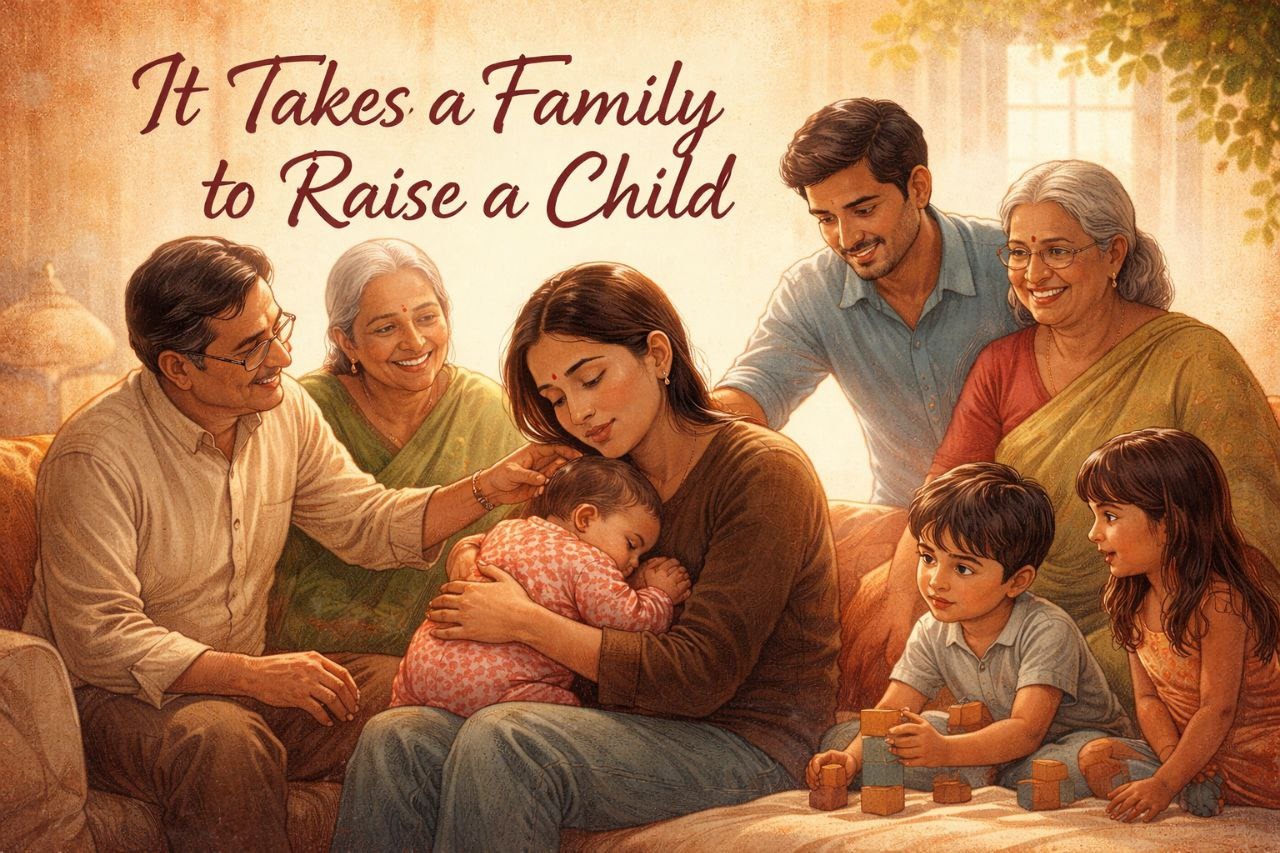
It Takes a Family to Raise a Child
A Silent Truth Hidden in Plain Sight
There are moments in life when a single image, a fleeting video, or a trembling voice says more than volumes of academic research or sociological debate ever could.
One such moment surfaced recently in a viral video where a young mother, holding her baby, speaks with quiet honesty about exhaustion, so deep that her legs tremble, her energy drains, and her spirit feels stretched thin in the absence of her husband and family support.
➤ This was not drama.
➤ This was not a complaint.
➤ This was the truth: raw, lived, and undeniable.
Behind the modern narratives of empowerment, independence, and “doing it all,” there exists a reality that most societies are reluctant to confront: raising a child in isolation is not natural to the human design.
“Human strength does not lie in standing alone; it lies in standing supported.” ~ Adarsh Singh
This blog is not a critique of modern life, nor a glorification of the past. It is an exploration, deep, honest, and compassionate, of why joint families mattered, why collective caregiving worked, and why the modern world is rediscovering an ancient truth through exhaustion, burnout, and silent tears.
Motherhood Is Not a Role, It Is a Full-Body Experience
Motherhood is often romanticized as an emotional journey filled with love, bonding, and fulfillment.
While all of that is true, it is only half the picture. The other half is physiological, neurological, and deeply biological.
A mother’s body does not simply “care” for a child, it becomes the ecosystem in which the child survives.
Sleep deprivation, hormonal fluctuations, continuous alertness, and physical exertion combine to place the mother in a state of sustained stress. When this state is prolonged without relief, the body responds, not with weakness, but with warning signals.
➤ Shaking legs.
➤ Sudden fatigue.
➤ Emotional overwhelm.
➤ Mental fog.
These are not signs of incapacity. They are signals of overload.
“The body never betrays us; it only reports the cost of carrying too much alone.” ~ Adarsh Singh
Historically, societies understood this intuitively. That is why motherhood was never meant to be a solitary act.
The Joint Family: A Functional System, Not a Sentimental Idea
The joint family system is often dismissed today as outdated, restrictive, or incompatible with modern aspirations.
But such judgments overlook one essential fact: the joint family was never designed as a moral structure, it was a functional one.
Its purpose was simple and profoundly intelligent:
➤ To distribute responsibility
➤ To preserve energy
➤ To protect the vulnerable
➤ To ensure continuity of care
In a joint family, a mother was never alone with her exhaustion.
➤ Someone else could hold the baby.
➤ Someone else could cook.
➤ Someone else could simply sit beside her.
This was not charity. This was a design.
Children were not “easier” in earlier generations. Life was not simpler. Medicine was limited. Resources were scarce. Yet children grew, families survived, and societies endured, because care was collective.
Why Children Were Raised “More Easily” in the Past
It is a common observation:
➤ “Children were easier to raise earlier.”
➤ This statement, while widely repeated, is deeply misunderstood.
➤ Children were not easy. The system was stronger.
A child once belonged to:
➤ Grandparents who provided wisdom and patience
➤ Aunts and uncles who offered variety and affection
➤ Siblings and cousins who ensured companionship
➤ Neighbors who formed an extended safety net
This ecosystem absorbed stress before it reached breaking point.
“When responsibility is shared, pressure dissolves; when it is isolated, pressure multiplies.” ~ Adarsh Singh
Modern parenting, in contrast, often places the entire emotional, physical, and psychological load on one or two individuals: usually the mother.
The Illusion of Empowerment in Isolation
Raising a child alone is frequently portrayed as empowering.
➤ Independence is celebrated.
➤ Self-sufficiency is applauded.
Yet empowerment must be examined not as an idea, but as an outcome.
If empowerment results in:
➤ Chronic exhaustion
➤ Emotional isolation
➤ Physical burnout
➤ Suppressed vulnerability
Then we must ask: what exactly are we empowering?
True empowerment does not mean refusing help. It means having access to help without shame.
“Empowerment is not the absence of support; it is the freedom to receive it.” ~ Adarsh Singh
Human beings evolved in tribes. Our nervous systems are wired for connection, cooperation, and shared survival. Isolation is not a badge of strength, it is a deviation from nature.
The Psychological Cost of Raising a Child Alone
Beyond physical exhaustion lies a quieter, more dangerous terrain: psychological depletion.
When a mother carries the entire emotional weight of caregiving, her mind remains in a constant state of vigilance. There is little room for rest, reflection, or emotional processing.
Over time, this can lead to:
➤ Anxiety and hyper-alertness
➤ Guilt and self-doubt
➤ Emotional numbness
➤ Loss of personal identity
Joint families acted as psychological shock absorbers. Conversations, shared laughter, and emotional validation occurred naturally.
Isolation, however, magnifies every fear.
Fathers, Families, and the Myth of Substitution
Modern systems often attempt to replace extended family support with paid services-nannies, daycare, housekeeping. While helpful, these are substitutes, not equivalents.
Why?
Because emotional presence cannot be outsourced.
➤ A grandmother’s reassurance.
➤ A sibling’s casual involvement.
➤ A family member’s intuitive understanding.
These are not services. They are relationships.
“Support that comes from love heals differently than support that comes from obligation.” ~ Adarsh Singh
The Child’s Perspective: Growing Within a Collective
Children raised within joint families benefit not only materially, but psychologically.
They learn:
➤ Emotional regulation by observing multiple adults
➤ Social adaptability through diverse interactions
➤ Security through constant presence
A child who grows within a collective environment does not attach survival to one individual. This creates emotional resilience.
Modern children, while loved deeply, often grow within narrow emotional ecosystems, making separation anxiety and emotional dependency more likely.Modern Life Is Not the Enemy, Disconnection Is
This discussion is not an argument against modernity. Technology, careers, mobility, and autonomy have brought undeniable progress.
The issue lies not in advancement, but in what was abandoned without replacement.
When joint families dissolved, no parallel support structures were consciously built.
➤ Communities weakened.
➤ Neighborly bonds eroded.
➤ Extended kinship fragmented.
The result?
Lonely strength, a contradiction in terms.
Reimagining Support in the Modern World
If traditional joint families are no longer feasible for everyone, the principle behind them must still be honored.
This means:
➤ Creating intentional support networks
➤ Normalizing shared caregiving
➤ Removing stigma around asking for help
➤ Designing workplaces that respect caregiving realities
The future of parenting lies not in reverting to the past, but in reintegrating its wisdom.
“Evolution does not discard truth; it only demands that we adapt it.” ~ Adarsh Singh
A Return to Human Sense
At its core, this conversation is not cultural, it is human.
➤ No mother was meant to tremble alone.
➤ No child was meant to be raised in emotional scarcity.
➤ No family was meant to function as an island.
We must stop glorifying survival and start valuing sustainability.
Strength Was Never Meant to Be Lonely
The viral video that sparked this reflection is not an isolated story. It is the echo of millions of silent experiences across the world.
It reminds us of a truth older than civilization itself:
“The strongest societies were not built on individual endurance, but on shared responsibility.” ~ Adarsh Singh
And perhaps the most profound lesson of all is this:
“When families stood together, mothers rested, children thrived, and humanity moved forward, not faster, but wiser.” ~ Adarsh Singh
{{DATE}}
 Launch your Graphy