Neither Constitution Nor Judiciary Sustains a Nation or Civilization
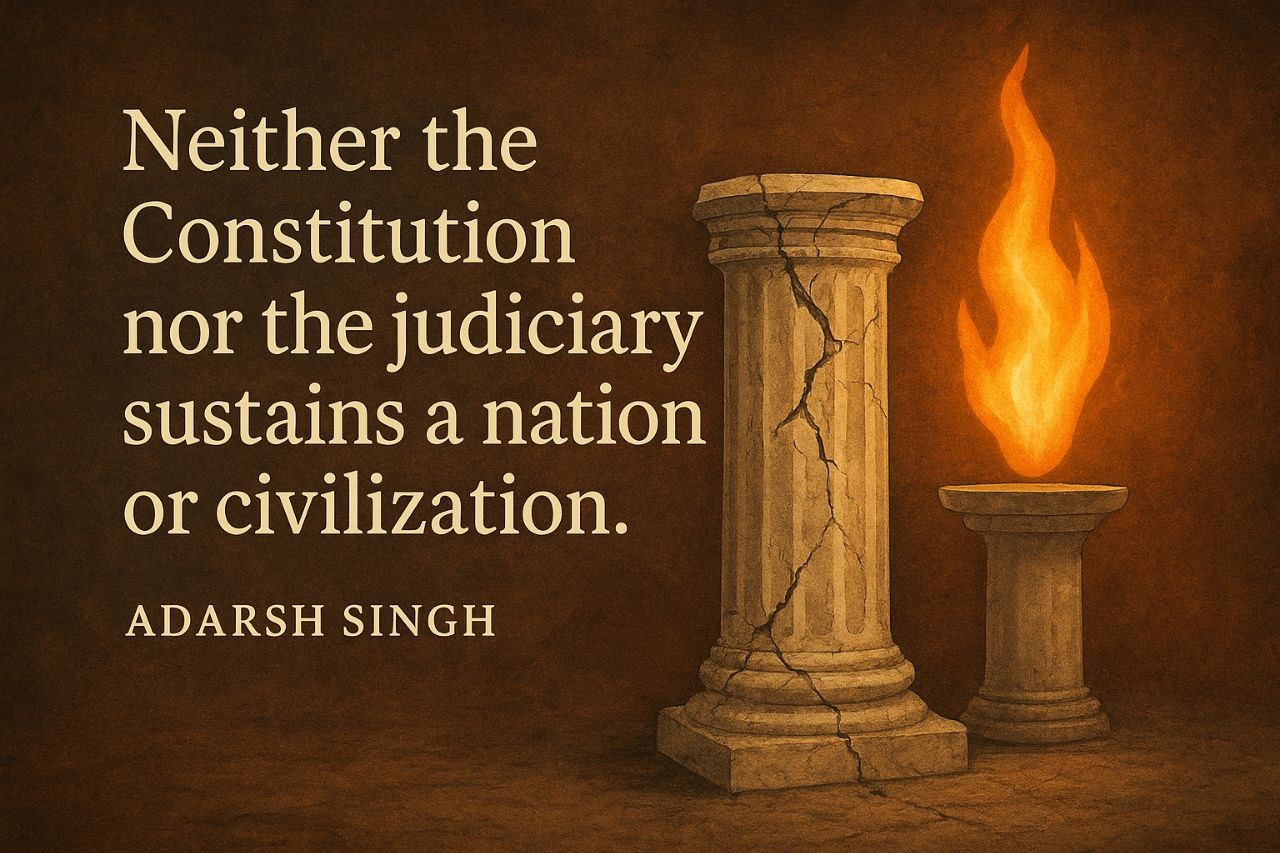
Civilizations are not born from the ink of constitutions or the verdicts of courts.
They are born from Dharma, the invisible rhythm that aligns human conduct with cosmic order.
And when that rhythm weakens, no paper, however sacred, can prevent decay.
In modern times, we often worship institutions as if they were eternal. We believe that the Constitution holds the moral compass of the nation and that the judiciary guards its soul. But these are, at best, reflections, not sources, of civilizational strength.
The truth, uncomfortable yet timeless, is that a civilization survives not through legality but through morality.
Not through governance but through self-governance.
Not through judgment but through inner justice.
“Neither the Constitution nor the judiciary sustains a nation or civilization; it is sustained by the collective character, culture, and conscience of its people.” ~ Adarsh Singh
The Myth of Institutional Permanence
Every empire, every civilization, and every nation has created its own version of “the rule of law.”
Rome had its Senate, Greece its assemblies, China its imperial codes, and Bhāratvarsh its Dharma Shastras. Yet, none of these lasted simply because of their institutions. They lasted because of the value systems that animated them.
When those values decayed, the institutions, however mighty, turned hollow.
“Institutions are like lamps; they can illuminate only when the oil of integrity burns within.” ~ Adarsh Singh
A constitution is only as sacred as the citizens who honor it.
A judiciary is only as impartial as the moral soil from which its judges arise.
"When society forgets virtue, words lose meaning, and laws lose life." ~ Adarsh Singh
The Sanātani Vision of Order
In Sanātan Dharma, the foundation of civilization is Rita, a cosmic order. From Rita arises Dharma, the human expression of that cosmic balance. It is this Dharma that sustains kings, kingdoms, and courts.
Manu, Yājñavalkya, Chanakya, all emphasized that the strength of a state lies not in its written code but in the moral fiber of its rulers and subjects.
“A nation rooted in Dharma has no need to fear lawlessness, for its people live by inner law.” ~ Adarsh Singh
When Dharma declines, the Constitution becomes a crutch for the crippled conscience.
And when the conscience itself dies, no judiciary can resurrect justice.
The Fragile Sanctity of Paper and Gavel
Modern republics often treat their Constitutions as holy scripture. Yet, a piece of paper cannot command obedience; it can only symbolize it.
The American Constitution, the British Common Law, the Indian Constitution, all these are, in essence, agreements among men. They are not divine revelations. They can guide behavior but cannot transform it.
If the citizenry loses moral discipline, the most eloquent Constitution turns into mere decoration.
If judges become ideological, verdicts lose sanctity and justice becomes theater.
And if society itself becomes corrupt, the system of checks and balances collapses under the weight of collective hypocrisy.
“When corruption becomes culture, the Constitution becomes a costume.” ~ Adarsh Singh
The Lost Idea of Duty
Every Constitution speaks of rights. Few remind citizens of duties.
Yet, history shows that civilizations perish not because of denied rights but because of abandoned duties.
In Bhagavad Gita, Krishna reminds Arjuna that his duty (Swadharma) is higher than comfort, reputation, or even outcome.
In contrast, modern democracy often encourages comfort over conscience, expression over examination, and rights over responsibility.
When duty fades, the citizen becomes a consumer, not a contributor.
And no nation can survive long on consumption of its own ideals.
“Civilization declines when rights grow louder than duties.” ~ Adarsh Singh
The Judiciary and the Illusion of Justice
Judiciary is not synonymous with justice. Courts can interpret law, but only conscience can interpret truth.
When judgments get influenced by ideology, political patronage, or public emotion, they lose moral legitimacy.
When judges begin to legislate instead of interpreting, they cross from justice into activism.
In ancient Bhāratvarsh, justice was not a matter of litigation but reconciliation.
Kings were advised to ensure harmony, not headlines.
Courts were meant to restore balance, not settle scores.
The Sanātani concept of Nyaya (justice) was broader than punishment; it was about restoring Rita, the universal balance.
But modern courts often confuse legality with morality.
“A verdict may satisfy the law, but not always justice.” ~ Adarsh Singh
The Death of Dharma and the Rise of Disorder
When civilizations lose Dharma, they begin to glorify cleverness over character and comfort over conscience.
Corruption is not the disease, it is the symptom of moral anemia.
When society ceases to feel shame, it ceases to feel responsibility.
When people celebrate manipulation as intelligence, decadence begins.
History stands as witness:
Rome fell not for lack of senators, but for lack of virtue.
Greece fell not for lack of philosophy, but for lack of discipline.
Bhāratvarsh suffered invasions not for lack of bravery, but for the lack of unity born of Dharma.
“A civilization dies long before its monuments crumble, it dies when its people stop living by truth.” ~ Adarsh Singh
Constitution as Reflection, Not Foundation
A Constitution reflects who we are; it does not create who we are.
⚞ If we are fragmented, the Constitution mirrors fragmentation.
⚞ If we are corrupt, the Constitution reflects corruption.
⚞ If we are united in Dharma, it reflects balance and order.
The Preamble of any Constitution can inspire only when the people embody its spirit. Otherwise, it becomes a recitation, not realization.
“A written law cannot rescue an unwritten conscience.” ~ Adarsh Singh
Cultural Amnesia and the False God of Modernity
Modern civilization, obsessed with legality, has forgotten morality.
We look to courts for every conflict and to governments for every failure. In doing so, we have outsourced our moral responsibilities.
But when people stop governing themselves, institutions start governing them, often harshly.
The more a nation depends on regulation, the less it trusts its own reason.
Sanātan wisdom teaches that the best governance is self-governance (Swayam Niyantran).
⚟⚞ When individuals live by Dharma, they need no policing.
⚟⚞ When families live by Dharma, society flourishes naturally.
⚟⚞ When rulers live by Dharma, justice becomes organic.
“Where Dharma governs, law rests.” ~ Adarsh Singh
The Rebirth of Civilization Through Dharma
Every civilization that forgets its source must rediscover it or perish.
For Bhāratvarsh, that source has always been Sanātan Dharma, the eternal principle of balance, truth, and compassion.
We can modernize without westernizing, reform without rejecting tradition, and evolve without erasing roots.
But we must return to inner strength, Atma Shakti, if we wish to sustain our national life.
“The strength of a nation is not measured by its armies or its laws, but by its adherence to Dharma.” ~ Adarsh Singh
From Law to Life: The Inner Constitution
Every individual carries an invisible constitution, written not in ink, but in conscience.
It is the set of values, instincts, and principles that guide us even when no one watches.
When the inner constitution collapses, the outer one cannot save the society.
Hence, to sustain a civilization, reform must begin within, in thoughts, emotions, and intentions.
Families must be re-rooted in values.
Education must teach ethics, not just employment.
Leaders must embody sacrifice, not entitlement.
A civilization is reborn not through revolutions but through realization.
“When conscience awakens, the Constitution is fulfilled.” ~ Adarsh Singh
The Nation as a Living Soul
A nation is not geography; it is a spirit.
Constitutions define its structure. Courts define its procedure. But only culture defines its soul.
India’s soul is Sanātani, eternal, self-renewing, and inclusive.
Its continuity is not due to governance but because of its Paramparā, the unbroken transmission of Dharma across ages.
If Bhāratvarsh remains Bhāratvarsh, it will not be because of its judiciary or constitution, but because of its consciousness.
“What sustains Bhāratvarsh is not governance, but godliness, not authority, but awareness.” ~ Adarsh Singh
The Call for Inner Renaissance
Our age demands not new laws but new lives; not new systems but new sincerity.
We must recover the lost art of self-governance, the ability to be disciplined without dictatorship, moral without moral policing, spiritual without sermonizing.
The civilization that birthed the concept of Dharma cannot afford to forget it now.
Let the Constitution remain sacred. Let the judiciary remain vigilant.
But let Dharma reign supreme, for only Dharma binds the seen and the unseen, the written and the unwritten, the human and the divine.
“Civilizations endure not through enforcement but through enlightenment.” ~ Adarsh Singh
Essence over Structure
Neither the Constitution nor the judiciary can sustain a nation or civilization if its people abandon the truth.
A society that needs constant supervision has already lost its freedom.
A civilization that depends solely on systems has already lost its soul.
When Dharma lives in hearts, no external law is required.
When Dharma dies in hearts, no external law can suffice.
“What sustains a civilization is not the structure of its state, but the sanctity of its spirit.” ~ Adarsh Singh
The Eternal Lamp
In the end, civilizations are like lamps.
Their oil is Dharma, their wick is culture, and their flame is consciousness.
As long as we protect that flame, no darkness, political, judicial, or moral, can extinguish us.
“Institutions may crumble, laws may fade, but Dharma endures: silently, eternally, sovereignly.” ~ Adarsh Singh
{{DATE}}
 Launch your Graphy