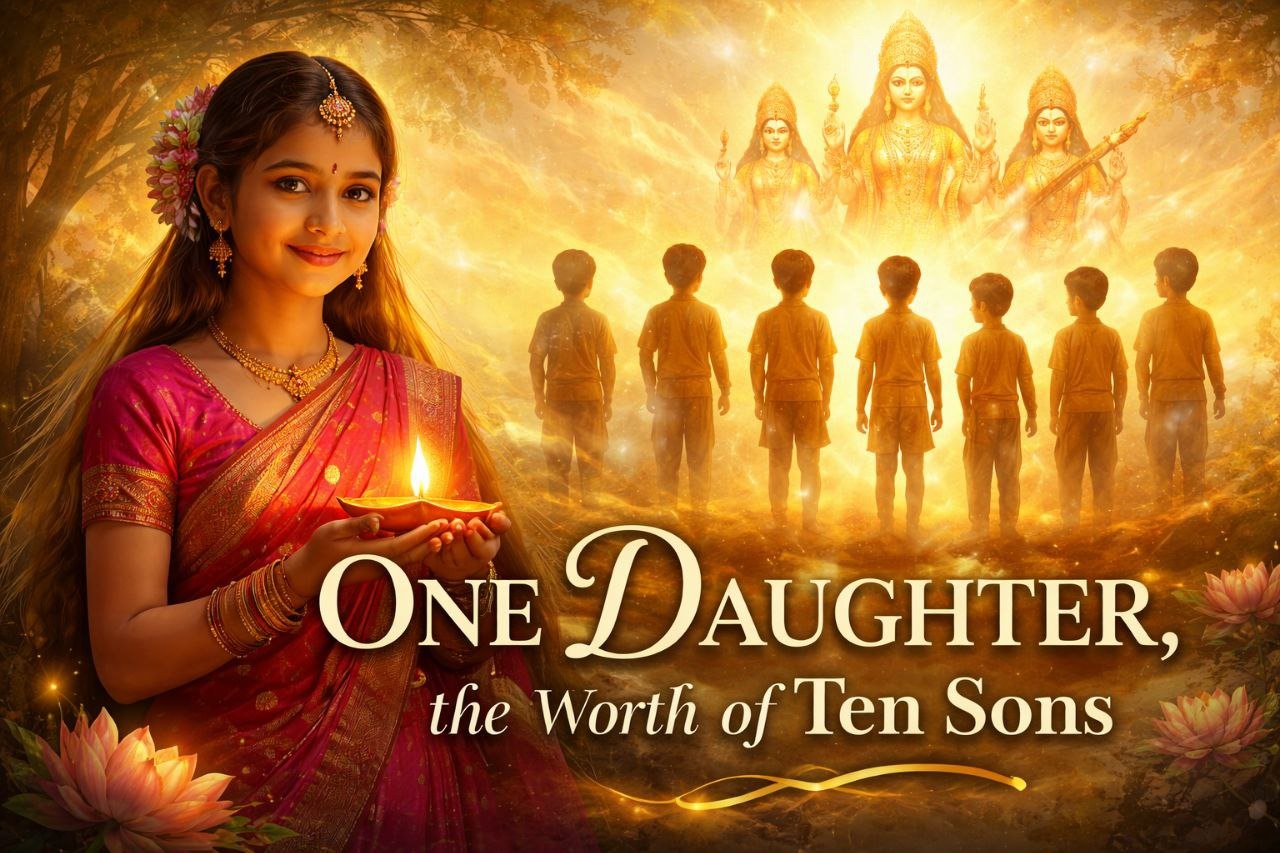
One Daughter, the Worth of Ten Sons!!!
A Verse That Rewrites Consciousness
Some verses are not merely recited; they are meant to recalibrate the moral compass of civilization. They do not belong to a specific century, nor are they confined to religious ritual. They function as ethical revelations.
One such Sanskrit verse offers a profound civilizational correction:
Dashaputra-samā kanyā dashaputrān pravardhayan
Yat phalam labhate martyas tallabhyam kanyayaikayā
दशपुत्रसमा कन्या दशपुत्रान् प्रवर्धयन्।
यत् फलम् लभते मर्त्यस्तल्लभ्यं कन्ययैकया॥
Its meaning is striking:
One daughter is equal to ten sons.
The merit gained by nurturing ten sons is attained by nurturing a single daughter.
This is not hyperbole. It is philosophical precision.
“The greatest wisdom in history has often been corrective, not decorative.” ~ Adarsh Singh
Not Comparison, but Restoration
At first reading, the verse appears to compare daughters and sons. In truth, it restores balance to a social perception that had tilted disproportionately.
Across many civilizations, sons were historically linked with lineage, inheritance, ritual continuity, and economic security. Daughters, unjustly, were often perceived through the lens of dependency or departure. This verse does not diminish sons. It elevates daughters to their rightful philosophical stature.
It asserts that the spiritual, ethical, and societal merit embodied in one daughter equals what society traditionally expected from ten sons combined.
This is not sentiment. It is recalibration.
The Symbolism of “Ten”
In classical Indian thought, numbers are rarely used in a merely arithmetic sense; they are symbolic containers of philosophy. Among them, ten signifies wholeness, structural completion, and cosmic fullness.
Ten directions ~ the four cardinal (North, South, East, West), the four intercardinal (Northeast, Northwest, Southeast, Southwest), plus Zenith and Nadir, together describe total spatial awareness. Nothing lies outside this frame. It represents total orientation in existence.
Ten senses ~ five organs of perception (sight, sound, smell, taste, touch) and five organs of action (speech, hands, feet, excretion, reproduction), represent the complete interface between the individual and the world. Through these ten gateways, experience unfolds and karma is generated.
Ten manifestations of divine intervention , often symbolized through the Dashavatara, represent the full spectrum of evolutionary correction, from aquatic life to fully realized consciousness. It is not mythology; it is a metaphysical map of progressive refinement.
Ten Mahavidyas in Tantra reflect the complete spectrum of divine feminine power, from nurturing compassion to fierce transformation, showing that wholeness includes both creation and destruction.
Ten disciplines of Dharma, as described in various texts, represent the complete ethical framework necessary for social harmony and personal evolution.
In this symbolic language, ten is not quantity, it is totality.
It implies nothing missing, nothing excessive.
When something is compared to “ten,” it is being equated with fullness, sufficiency, and systemic completeness.
In this context, ten becomes less a number and more a declaration: this is whole in itself.
“Where ten stands, completeness stands. Where completeness stands, nothing needs to be added.” ~ Adarsh Singh
Thus, “ten sons” represents total worldly effort and responsibility. The verse declares that the fullness of merit expected from that totality resides within a single daughter.
“When a culture encodes truth in symbolism, it speaks to generations beyond language.” ~ Adarsh Singh
The Daughter as Civilizational Anchor
Civilizations endure not by force but by continuity of values. That continuity is cultivated in homes before it manifests in institutions.
Daughters historically and quietly:
➤ Preserve language and relational warmth
➤ Carry emotional intelligence across generations
➤ Adapt tradition without abandoning it
➤ Transform households into ecosystems of care
A son may extend lineage. A daughter sustains civilization.
Merit Beyond Ritual
The verse speaks of Phala, fruit or consequence. In dharmic philosophy, merit is not transactional reward; it is alignment with moral order.
To nurture a daughter with dignity, education, and freedom is to align with:
➤ Justice
➤ Balance
➤ Compassion
➤ Sustainability
Such alignment naturally generates merit.
“True merit is not accumulated in temples alone; it is reflected in how society treats its most powerful yet vulnerable members.” ~ Adarsh Singh
Intrinsic Worth, Not Conditional Value
A daughter is often defined relationally, as someone’s child, sister, wife, or mother. Yet this verse recognizes her intrinsic worth independent of roles.
She is valuable before she becomes anything.
She represents:
➤ Potential
➤ Renewal
➤ Relational intelligence
➤ Moral clarity
Civilizations fracture not because of resource scarcity, but because of relational collapse. Daughters cultivate relational intelligence naturally.
Historical Reflections of the Same Insight
Throughout history, daughters have demonstrated this expansive worth.
Gargi debated metaphysics in royal assemblies.
Maitreyi sought spiritual truth over material inheritance.
Sita embodied strength through restraint.
Draupadi transformed humiliation into moral reckoning.
These were not anomalies; they were embodiments of possibility.
“When history remembers its women, it remembers its integrity.” ~ Adarsh Singh
Modern Advancement, Ancient Blindness
Humanity has achieved technological wonders. Yet in many regions, daughters still encounter:
➤ Gender discrimination
➤ Unequal education access
➤ Safety concerns
➤ Cultural conditioning toward limitation
This contradiction reveals a sobering truth: progress without consciousness remains incomplete.
The verse becomes not nostalgia, but necessity.
Education as Fulfillment of the Verse
To nurture a daughter is not to confine her in protection; it is to prepare her for participation.
Education equips daughters to:
➤ Make independent decisions
➤ Break dependency cycles
➤ Contribute economically
➤ Lead ethically
An educated daughter alters not only her trajectory but the vocabulary of her environment.
“Educate a daughter, and you illuminate futures beyond your imagination.” ~ Adarsh Singh
From Protection to Participation
Society often emphasizes safety for daughters. Safety is essential, but agency is transformative.
A daughter does not need controlled protection; she needs empowered participation.
True nurturing includes:
➤ Freedom of thought
➤ Respect for choice
➤ Space to experiment
➤ Opportunity to lead
When daughters participate fully, systems stabilize organically.
The Economic Intelligence of Inclusion
Empirical evidence across nations confirms that empowering women leads to:
➤ Reduced poverty
➤ Improved health metrics
➤ Stronger educational outcomes
➤ Sustainable development
Thus, a daughter is not a liability. She is a long-term social capital.
“The wealth of a nation is measured not by its reserves, but by its respect.” ~ Adarsh Singh
Spiritual Balance: Compassion with Strength
In spiritual symbolism, the feminine principle represents balance.
➤ Strength without compassion becomes domination.
➤ Compassion without strength becomes fragility.
A daughter integrates both dimensions.
This is why Wisdom(Saraswati), Prosperity(Lakshmi), and Power(Durga/Kali/Parvati) were personified in feminine forms. Not as ornamentation, but as an acknowledgment of balance.
Redefining Legacy
Legacy is often confused with lineage. True legacy is value transmitted across time.
A daughter who lives with dignity, courage, and intelligence becomes a living inheritance of principles.
“Legacy is not what carries your surname; it is what carries your conscience forward.” ~ Adarsh Singh
The Ethical Responsibility of Our Time
The verse does not demand rhetoric. It demands alignment.
It asks us to:
➤ Examine unconscious bias
➤ Replace control with trust
➤ Replace fear with respect
➤ Replace the tradition of limitation with the tradition of empowerment
When culture internalizes this wisdom, legislation becomes reinforcement rather than correction.
A Civilizational Mirror
How a society treats its daughters reveals its philosophical maturity.
➤ A civilization that honors daughters ensures continuity of empathy, intelligence, and balance.
➤ A civilization that suppresses them accelerates its own fragmentation.
“A society that truly understands the worth of one daughter never fears the future.” ~ Adarsh Singh
The Sacred Completeness of a Daughter: Strength, Continuity, and Civilizational Balance
The verse declaring one daughter equal to ten sons is not a slogan of equality. It is a recognition of completeness.
It acknowledges that daughters embody relational intelligence, moral sensitivity, adaptive strength, and generational continuity in a manner that sustains civilization itself.
➤ To honor a daughter is not charity. It is wisdom.
➤ To empower a daughter is not progress alone. It is preservation.
And
➤ To internalize this truth is not tradition. It is a transformation.
“When a daughter walks with dignity, civilization walks with stability.” ~ Adarsh Singh
{{DATE}}
 Launch your Graphy