Steadfast in a Shifting World: How Narendra Modi Remains the Only Constant at the G20
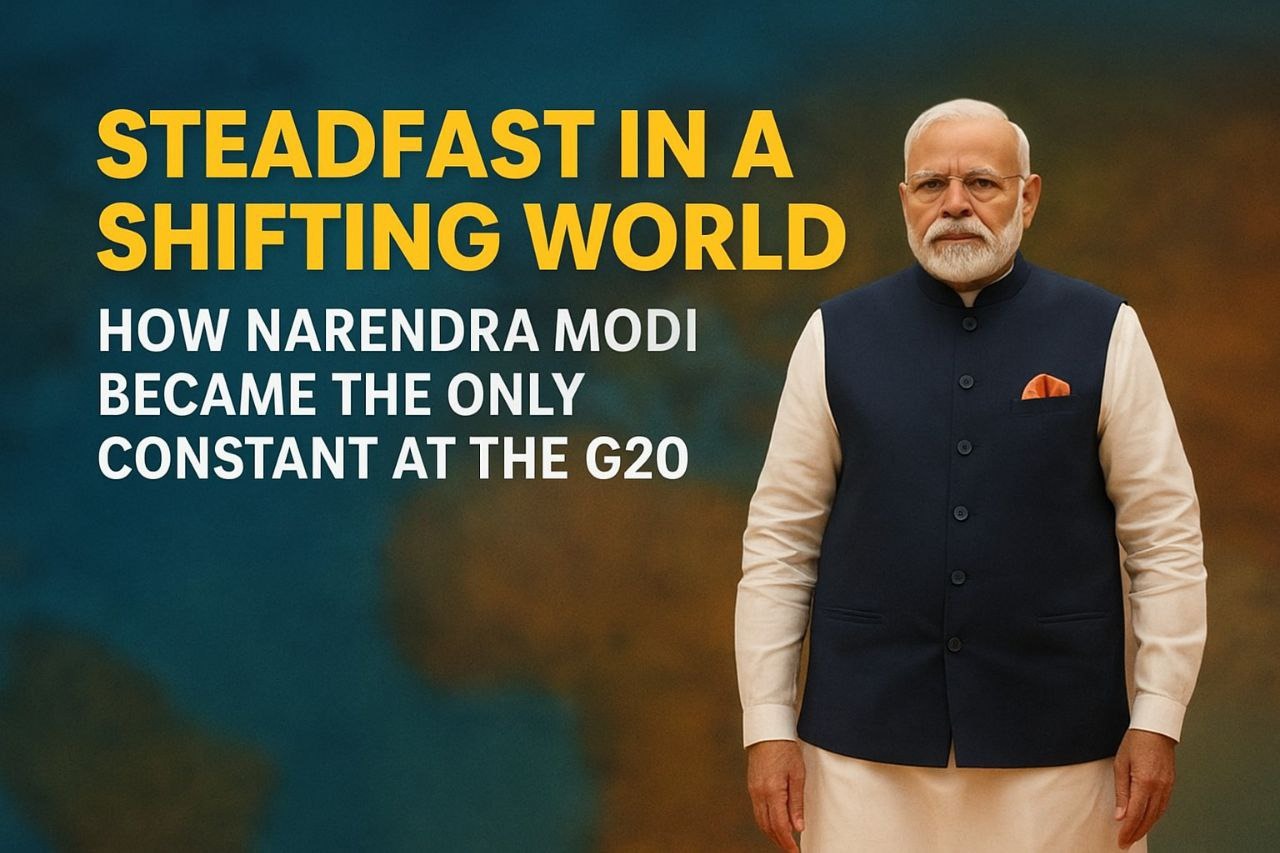
In an era marked by political uncertainty and rapid leadership turnover, one fact stands out: from 2014 through 2025, Narendra Modi has been the only leader to represent India at every G20 summit.
Twelve summits across different continents, a world transformed by pandemics, climate crises, and digital revolutions, and through it all, Modi’s presence has been unwavering.
This remarkable continuity is not just a testament to his political longevity. It has become a diplomatic asset for India, giving the country a consistent voice in high-stakes multilateral negotiations.
“A single steady presence at the global table becomes a beacon of trust, not just for one’s own nation, but for the world.” ~ Adarsh Singh
Let's understand why this continuity matters, contrast it with the frequent changes in other G20 nations, and reflect on the transformative role India has played under Modi’s long-standing leadership.
{1} A World of Change: Leadership Dynamics in the G20 (2014–2025)
To appreciate the magnitude of Modi’s uninterrupted leadership, it helps to look at how the rest of the G20 has evolved.
Many member nations have experienced multiple changes in leadership during this period, even as India has stayed the course.
As of 2025, here are the current heads of government / state (or their representatives) for G20 countries, according to summit participation:
Argentina ~ President Javier Milei
Australia ~ Prime Minister Anthony Albanese
Brazil ~ President Luiz Inácio Lula da Silva
Canada ~ Prime Minister Mark Carney (as per sources for the 2025 summit)
China ~ President Xi Jinping or Premier Li Qiang (the latter representing the 2025 summit)
France ~ President Emmanuel Macron
Germany ~ Chancellor Friedrich Merz
India ~ Prime Minister Narendra Modi (the only constant)
Indonesia ~ President Prabowo Subianto (as per lists)
Italy ~ Prime Minister Giorgia Meloni
Japan ~ Prime Minister Sanae Takaichi, per attendance list
Mexico ~ President Claudia Sheinbaum
Russia ~ Represented by Foreign Minister Sergei Lavrov, rather than the President, in the 2025 summit
Saudi Arabia ~ Crown Prince & Prime Minister Mohammed bin Salman
South Africa ~ President Cyril Ramaphosa, as host of the 2025 summit
South Korea ~ President Lee Jae-Myung
Turkey ~ President Recep Tayyip Erdoğan
United Kingdom ~ Prime Minister Keir Starmer
United States ~ Notably absent in the 2025 summit; according to reports, no U.S. government officials will attend.
European Union ~ Represented by António Costa (President of the European Council) and Ursula von der Leyen (President of the European Commission)
{2} Why Modi’s Continuity Is More Than Symbolic
{A} Diplomatic Trust Built on Consistency
In multilateral diplomacy, trust is not built overnight. When a country sends a different leader every couple of years, it can hamper the deep relationships necessary for high-stakes negotiations. Modi’s steady presence means that other leaders, and their teams, know exactly whom they are dealing with. There is institutional memory, continuity of policy, and a clear long-term vision.
{B} Strength in Long-Term Agenda-Setting
From the very first G20 summit in Brisbane (2014) to Johannesburg (2025), India has consistently pushed forward a strategic agenda: financial transparency, sustainable development, digital infrastructure, climate leadership, and a stronger role for the Global South.
Over time, these are no longer just proposals, they have become central to G20 priorities.
{C} Amplifying India’s Global Voice
With frequent turnover in other G20 nations, Australia, the UK, Brazil, Canada, Italy, and more, India’s voice has grown more authoritative.
While other countries repeatedly retrain their diplomatic relationships with new leadership, India’s global voice remains coherent and steady. That amplifies India’s influence in multilateral decision-making.
{D} Institutionalizing Reform
Modi’s long-term presence has allowed India to institutionalize many of its G20 ideas: digital public infrastructure (DPI), the Global Biofuels Alliance, Mission LiFE, and global health security initiatives.
These aren’t fleeting commitments, they are long-term frameworks that survive summit to summit.
{3} The Global Leadership Mosaic: A Symphony of Change
While Modi has remained constant, the world around him has been in flux.
Consider some of the leadership stories across key G20 nations between 2014 and 2025:
Australia saw four different prime ministers (Abbott → Turnbull → Morrison → Albanese), reflecting domestic political instability.
United Kingdom went through a carousel of leaders: Cameron, May, Johnson, Truss, Rishi Sunak and Starmer.
Japan shifted from Shinzo Abe to Yoshihide Suga, and then to Sanae Takaichi.
Germany transitioned from Angela Merkel to Friedrich Merz, representing a generational shift in European power.
Italy, a country no stranger to political turnover, witnessed multiple prime ministers, ending with Giorgia Meloni in 2025.
United States, perhaps the most powerful G20 member, has seen its own dramatic leadership swings and, notably in 2025, made the controversial choice not to send a head-of-state delegation to the summit.
Amid this widespread change, India’s mission has remained remarkably consistent: to promote equitable growth, sustainable development, and a voice for the Global South.
{4} India’s Evolving G20 Agenda: From Participant to Architect
Let’s travel through the key G20 summits under Modi, and see how India’s role evolved, not just in attendance, but in agenda-setting and global influence.
Brisbane, Australia (2014)
India’s inaugural participation marked by the bold call for financial transparency and a crackdown on black money. These ideas resonated globally, especially with emerging conversations around tax havens and international tax justice.
Antalya, Turkey (2015)
A focus on security. India urged for a robust global mechanism to fight terror financing, emphasizing that economic tools are as crucial as military ones.
Hangzhou, China (2016)
Modi articulated a vision of innovation, sustainability, and cooperation: from structural economic reforms to calls for equity in climate responsibility.
Hamburg, Germany (2017)
Health security took center stage. India proposed a global coalition on technology to democratize access and advocated stronger systems for pandemic preparedness, long before COVID-19 would engulf the world.
Buenos Aires, Argentina (2018)
A historic moment: India’s Nine-Point Agenda on Fugitive Economic Offenders, aimed at strengthening extradition, asset recovery, and global legal cooperation. Alongside, India highlighted sustainable infrastructure financing.
Osaka, Japan (2019)
Digital governance came to the fore. India’s vision for cross-border data flows, trust frameworks, and digital inclusion found traction.
Riyadh (Virtual, 2020)
At a time when the world grappled with a pandemic, India shifted focus to quality of life, not just GDP growth. “Ease of Living” emerged as a development metric.
Rome, Italy (2021)
Modi introduced “One Earth, One Health”, a holistic view of planetary and human well-being. He announced net zero goals for Indian Railways, pushed for green hydrogen standards, and proposed a clean energy fund.
Bali, Indonesia (2022)
This summit saw the formal launch of Mission LiFE, encouraging sustainable lifestyles globally. The Agaroa Maitri Project further strengthened ties through environment and development partnerships.
New Delhi, India (2023)
A watershed moment. India achieved permanent African Union membership in the G20, exported its Digital Public Infrastructure (DPI) model, launched a Social Impact Fund, and proposed a G20 Talent Visa and G20 Satellite Mission for Climate.
Rio de Janeiro, Brazil (2024)
India emphasized implementation, pushing for follow-through on the New Delhi summit’s commitments, while advocating for greater representation of the Global South.
Johannesburg, South Africa (2025)
Under the theme of Solidarity, Equality, Sustainability, India championed AI governance for development and meaningful debt relief for vulnerable countries, continuing its role as a thought leader and moral voice in global affairs.
{5} The Strategic Advantage of Continuity
Why exactly does having a single long-term leader matter so much in multilateral forums like the G20?
Here are some key advantages:
1. Transactional Efficiency
Diplomatic negotiations often depend on personal relationships. With consistent leadership, India negotiators don’t need to re-introduce themselves every year. They build on trust, institutional memory, and prior agreements.
2. Policy Coherence
Frequent leadership change can derail long-term strategies. But under Modi, India could push cross-summit agendas such as climate, digital infrastructure, and financial transparency without abrupt shifts.
3. Soft Power and Moral Authority
A stable presence at the global table enhances credibility. India’s consistency makes its voice a moral compass in discussions about equity, sustainability, and the Global South’s rightful place in global governance.
4. Legacy Building
By repeatedly proposing bold ideas, and being present to follow through, India is not just taking part in international diplomacy. It is shaping history, contributing institutional IP (intellectual property), and leaving a legacy that extends beyond one summit.
{6} Looking Ahead: What India’s Continuity Could Mean for the Future
As the world enters an era of complex crises, climate emergencies, artificial intelligence regulation, global debt distress, and rising inequality, stable leadership may become even more valuable.
Digital & AI Governance: Modi’s long-term engagement can help India anchor global governance mechanisms on data, AI, and digital infrastructure, especially for low- and middle-income countries.
Green and Equity-focused Development: With decades of consistent policy advocacy, India is well-poised to shape climate financing, transition funding, and sustainable growth models.
Global South Empowerment: India’s voice can help ensure that G20 reforms do not just favor the richest nations, but also uplift vulnerable economies.
Institutional Reform: With continuity, India can drive structural reform in global institutions, pushing for debt architecture, financial regulation, and governance frameworks that are more inclusive.
{7} When One Leader Becomes a Global Constant
In a world where governments reshuffle, policies pivot, and alliances shift, Narendra Modi’s unbroken attendance at every G20 summit from 2014 to 2025 stands out as a rare feat of political and diplomatic continuity.
His steady presence has not been passive. India has moved from being a rising economic giant to a thought leader on issues ranging from data governance, climate justice, sustainable development, and multilateral reform. Through a decade of summits, India under Modi has shaped not just its own narrative, but the world’s.
“When a leader stays the course, a nation’s global voice does not waver, it deepens, strengthens, and inspires.” ~ Adarsh Singh
{{DATE}}
 Launch your Graphy