Taxing Together, Growing Together
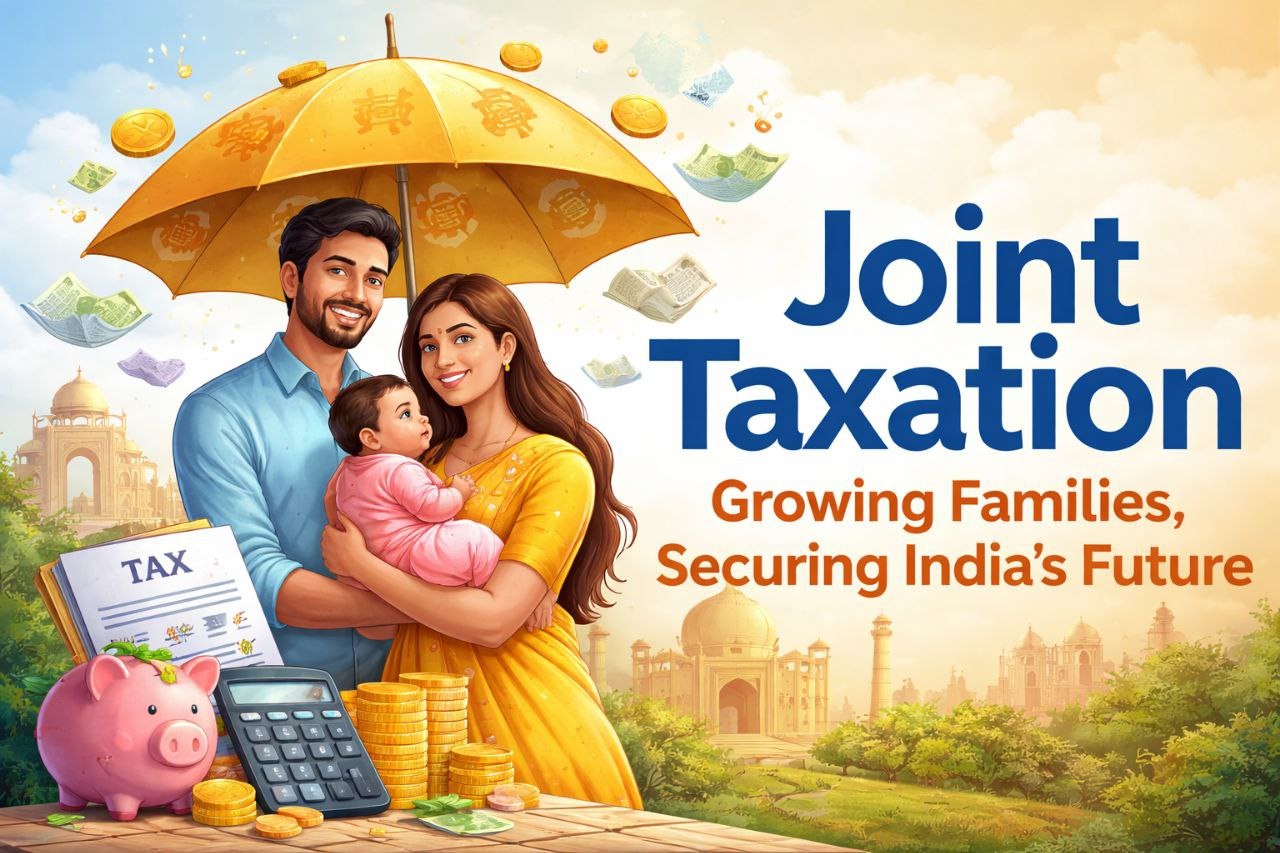
A Silent Demographic Shift
India is often spoken of as a young nation, a country overflowing with people, energy, and potential. Yet beneath this popular narrative lies a quieter, more consequential shift, India’s birth rate is steadily declining. In many states, the Total Fertility Rate has already fallen below the replacement level. This is not merely a statistical curiosity; it is a structural warning.
Demography is not an abstract concept. It shapes labor markets, economic growth, social stability, innovation, national security, and cultural continuity. A nation that fails to replenish itself gradually mortgages its future.
Among the many levers available to policymakers, taxation is one of the most powerful yet underutilized instruments to influence social behavior. In this context, the idea of joint taxation for married couples emerges not as a technical tax reform, but as a civilizational policy choice, one that can subtly yet decisively encourage family formation and childbearing.
“A nation does not decline in a single generation; it declines when raising the next generation becomes unaffordable.” ~ Adarsh Singh
Understanding the Real Crisis: It Is Not Population, It Is Parenthood
India’s challenge today is not the excess population, it is the growing reluctance to become parents.
Urbanization, rising living costs, education expenses, housing pressures, healthcare inflation, and career uncertainty have transformed children from a natural life progression into a calculated financial decision. Marriage itself is increasingly delayed; childbirth, even more so.
The question many young couples silently ask is not “Do we want children?” but “Can we afford them without compromising our dignity, stability, and future?”
Public policy must engage with this reality honestly.
The Economics of Birth: Why Financial Security Comes First
Childbearing has an economic dimension that cannot be ignored. While emotional and cultural factors matter, financial security is the foundation upon which family decisions are built.
Key cost pressures include:
➤ Long-term education expenses
➤ Healthcare and nutrition
➤ Housing adequacy
➤ Opportunity cost of reduced workforce participation (especially for women)
➤ Uncertainty about future income and savings
When taxation treats married individuals as isolated economic units, it penalizes the very structure that produces children and the family.
Joint taxation directly addresses this imbalance by:
➤ Lowering the effective tax burden on households
➤ Increasing disposable income during early family-building years
➤ Providing predictability and confidence in long-term planning
“Children are not born from optimism alone; they are born from security.” ~ Adarsh Singh
What Is Joint Taxation, Really?
Joint taxation allows a married couple to combine their incomes for tax assessment, often resulting in lower overall tax liability, especially when income distribution between spouses is uneven.
This system recognizes three fundamental truths:
➤ Marriage is an economic partnership
➤ Income within a family is often pooled
➤ Caregiving and household labor have real economic value
Rather than viewing adults as isolated units, joint taxation views the family as the basic economic entity.
Correcting a Structural Bias in the Current System
India’s current individual taxation model is rooted in administrative convenience, not social reality.
It assumes:
➤ Continuous individual earning
➤ No caregiving interruptions
➤ Equal market participation
This assumption collapses the moment a child is born.
When one spouse, most often the woman, steps back from paid employment for pregnancy, childbirth, or childcare, the family’s tax burden remains unchanged while income reduces. This creates a hidden motherhood penalty, discouraging larger families and even first births.
Joint taxation corrects this distortion by:
➤ Absorbing income volatility within the household
➤ Reducing financial shock during caregiving phases
➤ Acknowledging unpaid labor as socially productive
Women, Choice, and Dignity: A Crucial Clarification
It is essential to address a common misunderstanding. Joint taxation is not regressive, anti-women, or anti-work.
On the contrary, it expands choice.
A system that forces women to return to work prematurely due to financial pressure is not empowerment, it is coercion.
Joint taxation:
➤ Allows women to choose caregiving without economic punishment
➤ Supports flexible life trajectories
➤ Encourages shared responsibility rather than individual burnout
“Empowerment is not about forcing sameness; it is about honoring choice.” ~ Adarsh Singh
True gender equity respects both professional ambition and nurturing roles, without assigning moral superiority to either.
Marriage as a Public Good, Not a Private Burden
Modern policy discourse often treats marriage as a purely private arrangement. This is economically inaccurate.
Marriage produces:
➤ Children (future taxpayers and workers)
➤ Stable caregiving environments
➤ Reduced dependency on state welfare systems
In effect, married families performing child-rearing are subsidizing the future of the nation.
Joint taxation is not a favor; it is fair compensation for a public service rendered quietly within homes.
Global Lessons: Demography Responds to Policy Signals
Countries facing demographic decline have learned a difficult lesson: culture alone cannot sustain birth rates when economics discourages families.
Examples across the world show:
➤ Family-based tax systems soften fertility decline
➤ Combined tax and childcare policies outperform isolated incentives
➤ Consistency matters more than one-time bonuses
While India need not replicate any model blindly, the principle is universal, when the state aligns incentives with family life, people respond.
India’s Demographic Window: Narrow and Closing
India still enjoys a demographic advantage, but it is not permanent.
A declining birth rate leads to:
➤ An aging population
➤ A shrinking workforce
➤ Increased pressure on pensions and healthcare
➤ Slower economic dynamism
Once fertility falls sharply, recovery becomes extremely difficult, as seen globally.
Joint taxation is a preventive policy, not an emergency response. It must be implemented before the decline hardens into demographic inertia.
“Demography forgives no delay; it compounds silently.” ~ Adarsh Singh
Cultural Compatibility: Why This Reform Fits India Naturally
Unlike highly individualistic societies, India remains deeply family-oriented. Financial decisions are typically made at the household level, not the individual level.
Joint taxation:
➤ Resonates with Indian social structure
➤ Strengthens marriage as a stable institution
➤ Encourages long-term commitment and planned parenthood
Policy success increases dramatically when it aligns with cultural reality rather than fighting it.
Addressing Common Objections
“This Will Discourage Dual-Income Families”
Not necessarily. Properly designed slabs can ensure neutrality or benefits across income combinations.
“It Will Reduce Tax Revenue”
Short-term adjustments may occur, but long-term gains from a stable population, expanded workforce, and reduced welfare burden far outweigh immediate costs.
“It Is Social Engineering”
All taxation influences behavior. The question is not whether policy shapes society, but whether it does so wisely.
Joint Taxation as a Signal, Not Just a Subsidy
Beyond numbers, taxation sends signals.
Joint taxation tells citizens:
➤ Family formation is valued
➤ Parenthood is respected
➤ Caregiving is recognized
In an era of uncertainty and anxiety, signals matter as much as subsidies.
“When policy respects families, families reciprocate with continuity.” ~ Adarsh Singh
A Broader Vision: Integrating Family-Centric Policy
Joint taxation should not stand alone. It works best when integrated with:
➤ Affordable education
➤ Healthcare security
➤ Childcare infrastructure
➤ Flexible work environments
But without tax reform, these measures operate on a weak foundation.
Investing in the Unseen Future
India stands at a crossroads. It can continue treating families as private choices with public consequences, or it can consciously support those who shoulder the responsibility of creating the next generation.
Joint taxation for married couples is not about ideology. It is about long-term national survival, economic resilience, and social continuity.
A nation that makes family life economically viable does not beg for births, it earns them.
“The future is not built in factories or parliaments alone; it is built quietly in homes that feel secure enough to welcome life.” ~ Adarsh Singh
{{DATE}}
 Launch your Graphy