 Launch your Graphy
There are no items in your cart
Add More
Add More
| Item Details | Price | ||
|---|---|---|---|

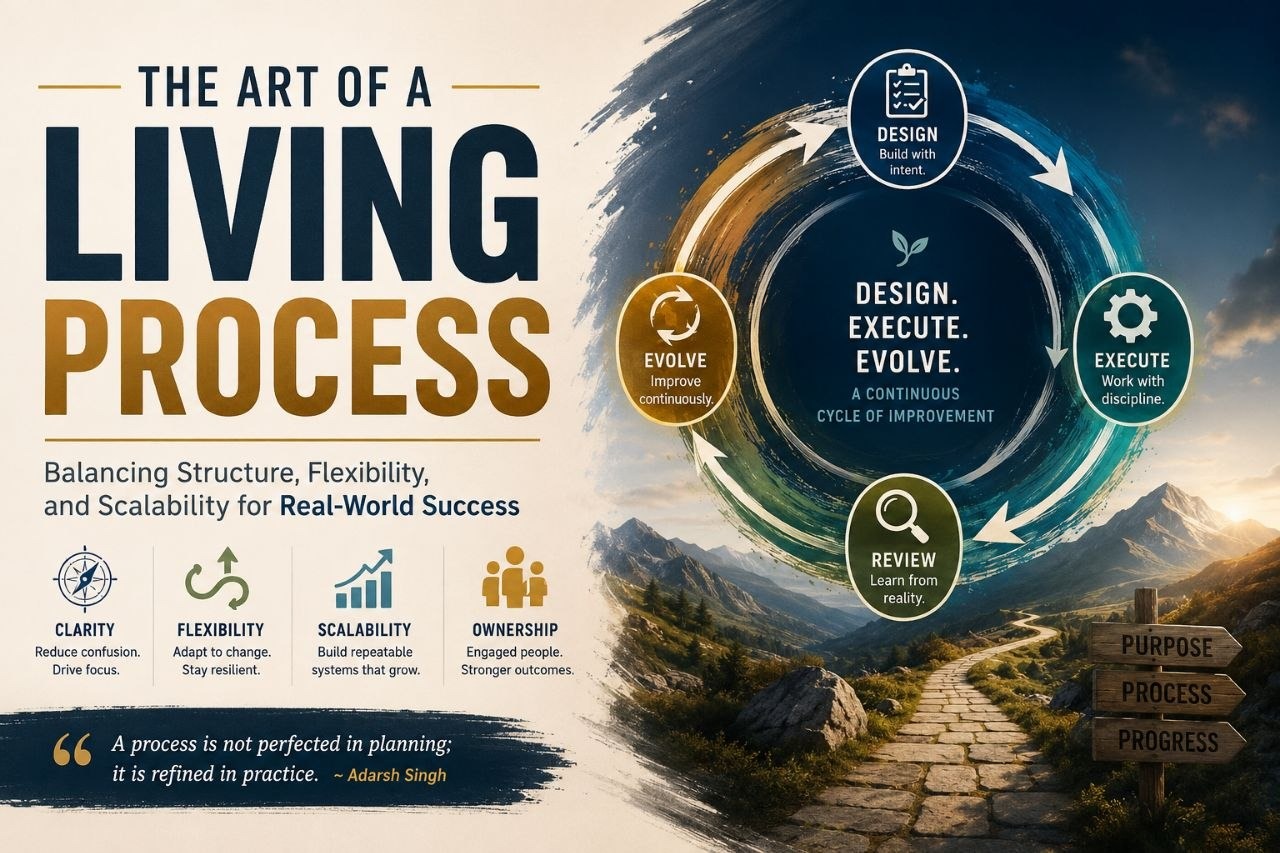
Frankly, most people have a complicated relationship with processes. There is an unspoken tension, an almost paradoxical coexistence of dependence and resistance.
On one hand, processes promise structure, clarity, and efficiency.
On the other, they often feel suffocating, rigid, or painfully irrelevant.
A bad process is not just inefficient, it is emotionally exhausting.
When a process is too vague and high-level, it resembles walking through a stranger’s living room in complete darkness. Every step is uncertain. You reach out, hoping for direction, but instead collide with unseen obstacles. Each misstep bruises, not just your shins, but your confidence in the system itself.
“Ambiguity does not create freedom; it creates hesitation disguised as autonomy.” ~ Adarsh Singh
At the opposite end lies the over-engineered process. Tight. Restrictive. Unforgiving. It dictates every move with such rigidity that execution becomes mechanical rather than meaningful. You stop thinking. You stop engaging. You simply comply, reluctantly choosing the least bad option available.
And in that compliance, something critical is lost: OWNERSHIP.
What makes poorly designed processes particularly dangerous is that their cost is rarely visible at first glance.
They do not always result in immediate failure. Instead, they create a slow erosion:
✓ Decision fatigue builds quietly
✓ Workarounds become normalized
✓ Accountability becomes diluted
✓ Engagement declines without obvious cause
People stop questioning the system, not because it works, but because resisting it feels more exhausting than enduring it.
“A broken process doesn’t collapse loudly, it decays silently through the people forced to use it.” ~ Adarsh Singh
Organizations often misdiagnose these symptoms as performance issues, capability gaps, or lack of discipline. In reality, the root cause is frequently structural. The system itself is misaligned with how humans think, act, and adapt.
A good process is not just functional, it is elegant.
It operates in a narrow but powerful bandwidth between chaos and control. It does not attempt to eliminate variability; instead, it channels it. It does not suppress human judgment; it sharpens and directs it.
A well-designed process has three defining characteristics:
1. It Reduces Decision Fatigue Without Removing Agency
Humans are not built to make an endless stream of decisions with consistent quality. Every additional decision drains cognitive resources. Over time, even highly capable individuals begin to default to shortcuts, biases, or avoidance.
A good process intervenes here, not by eliminating decisions entirely, but by structuring them. It standardizes what must remain consistent while preserving flexibility where nuance matters.
For example:
✓ Non-negotiables are clearly defined
✓ Critical steps are sequenced logically
✓ Variables are acknowledged rather than ignored
This balance creates a powerful effect. Individuals feel guided, not controlled. Supported, not restricted.
“The goal of a process is not to think for you, but to ensure you think where it matters.” ~ Adarsh Singh
2. It Encodes Intent, Not Just Instruction
Weak processes tell people what to do. Strong processes explain why it matters. This distinction is subtle but transformative.
When individuals understand intent, they do not just execute, they interpret, adapt, and improve. They make better decisions in situations the process did not explicitly anticipate.
Without intent, compliance becomes fragile. The moment reality deviates from expectation, execution breaks down.
With intent, the process becomes resilient. It evolves in real time, guided by informed human judgment.
“Instruction controls behavior. Intent shapes judgment. Only one of them scales.” ~ Adarsh Singh
3. It Survives Contact with Reality
Many processes are designed in ideal conditions, clean assumptions, predictable inputs, and cooperative environments. But reality is rarely ideal.
Customers behave unpredictably. Constraints shift without warning. People interpret instructions differently.
A process that cannot withstand these variables is not robust, it is theoretical.
A good process anticipates deviation. It builds in buffers, feedback loops, and recovery mechanisms.
It does not aim for perfection. It aims for continuity.
“If your process only works when nothing goes wrong, it does not work at all.” ~ Adarsh Singh
Every process exists on a spectrum between two extremes:
✓ Chaos (too loose)
✓ Control (too tight)
The challenge is not choosing one over the other, but identifying the optimal point where both forces coexist productively.
Too loose, and the process becomes guidance at best, ignored at worst.
Too tight, and it becomes compliance theatre, followed superficially, bypassed practically.
The sweet spot is where:
✓ Structure provides clarity
✓ Flexibility enables adaptation
✓ Boundaries are respected but not suffocating
This balance is dynamic. It shifts based on context, team maturity, and operational complexity.
Which means a process is never truly finished.
It must evolve.
One of the most persistent misconceptions is the belief that a perfect process can be designed upfront.
It cannot.
Processes are not static artifacts. They are living systems.
They improve through use, not design alone.
Even a well-thought-out process will encounter gaps when exposed to real-world execution. Edge cases will emerge. Assumptions will break. Friction points will surface.
This is not failure, it is feedback.
“A process is not perfected in planning; it is refined in practice.” ~ Adarsh Singh
The organizations that excel are not those that design flawless systems, but those that iterate relentlessly.
A process is only as valuable as its ability to scale.
But scalability is often misunderstood as simple repeatability.
In reality, a scalable process must satisfy four conditions simultaneously:
It Must Be Learnable
If a process requires excessive explanation, supervision, or interpretation, it creates dependency.
A scalable process is intuitive. It reduces onboarding friction. It allows new participants to reach competence quickly.
It Must Be Executable Consistently
Different individuals should produce comparable outcomes when following the same process.
Consistency is not about uniformity, it is about reliability.
It Must Be Adaptable
A rigid process breaks under pressure. A scalable one flexes without losing structure.
It allows for contextual adjustments while preserving core principles.
It Must Be Transferable
If a process only works under a specific individual, it is not a process, it is a dependency.
True scalability means the process can move across teams, locations, and contexts without collapsing.
“Scalability is not about repetition; it is about resilience across variation.” ~ Adarsh Singh
A process does not exist on paper. It exists in execution.
This is where many systems fail, not because they are poorly designed, but because they are poorly engaged with.
A process is inert by default. It has no power until someone applies it with intention.
The same process can produce radically different outcomes depending on how it is used:
✓ One person follows it mechanically
✓ Another interprets it intelligently
✓ A third ignores it entirely
The difference is not in the process, but in the participant.
“A process does not create excellence; it creates the conditions where excellence becomes possible.” ~ Adarsh Singh
This places responsibility back where it belongs, on both the system and the individual.
Many organizations attempt to solve process failures through stricter enforcement.
More checks. More approvals. More oversight.
This approach treats symptoms, not causes.
Compliance increases temporarily, but engagement decreases permanently.
A better approach is to design processes that invite participation.
When people understand the purpose, see the benefit, and feel ownership, compliance becomes natural.
“You can force adherence, but you cannot force belief. And without belief, processes decay.” ~ Adarsh Singh
A truly effective process is not static, it is adaptive.
This requires intentional design choices:
✓ Feedback loops must be embedded
✓ Failures must be analyzed, not punished
✓ Iteration must be encouraged, not resisted
Every execution becomes data. Every deviation becomes an insight.
Over time, the process matures, not through control, but through learning.
The gap between theory and practice is where most processes collapse.
A process that looks elegant on paper may fail in execution due to:
✓ Environmental constraints
✓ Human variability
✓ Time pressures
✓ Resource limitations
Bridging this gap requires humility in design.
It means acknowledging that no process is immune to friction.
It means designing not for perfection, but for practicality.
“A process that ignores reality will eventually be ignored by reality.” ~ Adarsh Singh
There is a fundamental truth that cannot be bypassed:
✓ A process is only a process if it is being worked.
✓ Without engagement, it is documentation.
✓ Without consistency, it is a suggestion.
✓ Without intent, it is noise.
To extract value from any process, three things are required:
✓ Commitment to follow it
✓ Awareness to question it
✓ Discipline to improve it
This is where ambition intersects with structure.
The process provides the path. The individual provides the drive.
Ultimately, the effectiveness of a process is determined by ownership.
When individuals take responsibility for both execution and improvement, processes evolve rapidly.
When they do not, even the best-designed systems stagnate.
Ownership transforms a process from an obligation into a tool.
From a constraint into an enabler.
From a system into a capability.
“The moment you take ownership of a process, it stops being a rule and starts becoming a resource.” ~ Adarsh Singh
A good process is not loud. It does not demand attention. It integrates seamlessly into work, guiding decisions, reducing friction, and enabling progress.
✓ It is simple, but not simplistic.
✓ Structured, but not rigid.
✓ Flexible, but not chaotic.
It respects both theory and reality. It evolves with use. And most importantly, it requires participation.
Because in the end, a process is not something you follow. It is something you work on/with.
“A process will never build your ambition, but it will determine whether your ambition compounds or collapses.” ~ Adarsh Singh
{{DATE}}
{{AUTHOR}}
A Lifelong Seeker/believer of......
Sanatan Dharma | Spirituality | Numerology | Energy Healing, Ayurveda, Meditation |Mind & Motivation | Money & Markets | Perennial Optimist | Politics & Geopolitics
Founder of iSOUL ~ Ideal School of Ultimate Life
Adarsh Singh empowers individuals to live purposefully by integrating timeless wisdom with practical tools. With 20+ years in finance and a deep connection to spirituality, his teachings blend Mind, Matter, Money and Meaning to help people create a truly fulfilling life.