The Blue Civilization: How India Dyed the World, Fed the World, and Enlightened the World
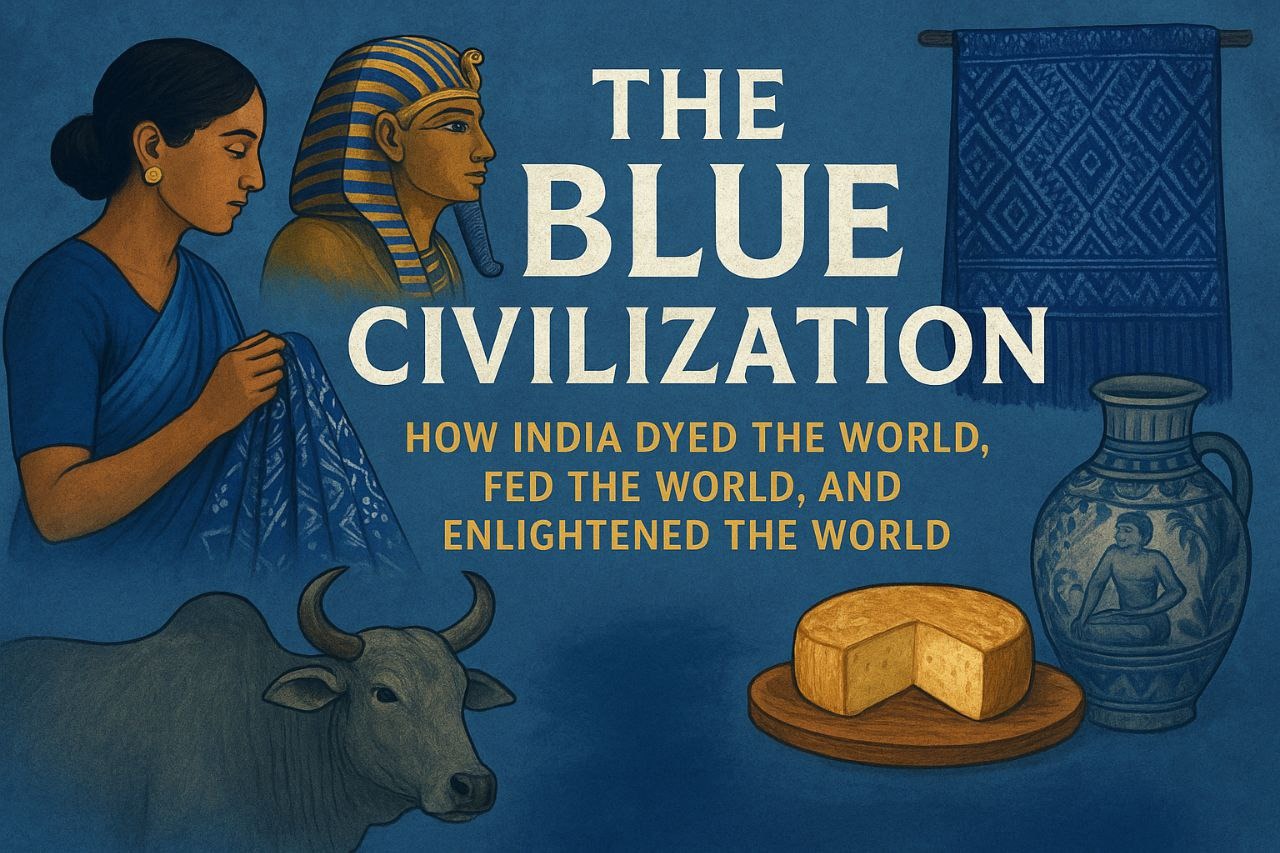
“India is not a chapter in world history; it is the ink with which world history was written.” ~ Adarsh Singh
Civilizations are remembered for the colors they created, the foods they cultivated, the sciences they discovered, and the values they carried across continents.
If we look closely across the vast canvas of human history, from Egyptian tombs, Roman frescoes, Greek ceramics, Japanese kimonos, European cheese, medieval trade routes, and Renaissance art,....
a single thread connects them all:
✽ Indian Indigo.
✽ Indian Cattle.
✽ Indian Chemistry.
✽ Indian Knowledge.
✽ Indian Civilization.
This is the story of how ancient India painted the world blue, fed continents with its cattle genetics, revolutionized global textiles, influenced global art, transformed European food, and shaped the scientific foundations of dyeing, mathematics, astronomy, and material science, long before these terms existed.
This is not just a story of color. It is the story of civilizational contribution. It is the story of India’s shared heritage with humanity.
{A} When the World First Wore Blue - And It Came from Bharat
Long before the world knew denim, long before “Indigo blue” became a symbol of fashion, class, and cultural identity, the people of Bharat were cultivating Neeli, the Indigo plant, mastering the chemistry of extracting its color, and exporting it in forms unimaginable for that age.
From Neeli’s humble leaves emerged a dye so mesmerizing, so stable, and so vibrant that entire civilizations, Egypt, Rome, Greece, Persia, China, Japan, built trade relationships with India just to secure it.
India did not stop at extraction. Indians engineered a revolution.
They developed formulations that turned Indigo into transportable bars and powders. This made shipping easier, prevented spoilage, and allowed merchants from Persia, Arabia, Southeast Asia, and the Mediterranean to carry Indigo across oceans and deserts.
India industrialized Indigo 3,500 years before Europe industrialized anything.
“Civilizations rise when they learn to color their world. India rose because it learned to cooler the world of others.” ~ Adarsh Singh
{B} The Blue That Pharaohs Worshipped
Egyptian royalty did not simply buy Indigo, they collected it. They revered it.
The Ikkat patterns of Sindh, Kutchh, and Barmer, dyed in deep Indigo, were so beloved by Egyptian Pharaohs that they paid extravagant sums to acquire Gujarati textiles.
Indigo-dyed Indian fabrics were found in:
✽ Pharaohs’ garments
✽ Funerary wrappings
✽ Temple textiles
✽ Palace decorations
The Egyptians believed the color blue carried cosmic, protective, and divine significance. And no culture produced blue like India.
Women from Gujarat, especially communities in Sindh, Kutchh, and Barmer, held a worldwide monopoly on Indigo dyeing. Their expertise travelled with Gujarati families who migrated to India’s east coast, spreading the craft and creating new trade hubs.
This was possibly the first global, women-led industrial enterprise.
{C} When Indigo Became India’s Global Identity
Long before “Made in India” became a slogan, Indigo made India a brand.
Chinese traders from Fujian, Japanese merchants from Okinawa, and textile guilds in Kyoto all cherished Indian Indigo. It was known not only for its color but also its superior stability, it did not wash off, fade, or dull easily.
India became the world capital of blue.
But what the world admired most was something they did not understand for centuries:
How did India make Indigo stick so perfectly to fabric?
The answer lies in Indian chemistry.
{D} Indus Valley - The Chemistry Laboratory of the Ancient World
The Indus Valley Civilization was not just a trading hub, it was a scientific powerhouse.
Archaeologists have discovered:
✽ Indigo-dyed cotton
✽ Dye vats
✽ Specialized fermentation pits
✽ Chemical workshops
The Indus people cracked one of the most complex problems in chemistry:
✽ Indigo doesn’t naturally bind to cloth.
So how do you make it bond permanently?
The solution was brilliant:
✽ They used cow urine to ferment Indigo and convert it to Leucoindigo, the water-soluble form that attaches to fabric.
This is science thousands of years ahead of its time.
Cow urine acted as:
✽ A natural ammonia source
✽ A reducing agent
✽ A disinfectant
✽ A stabilizer
✽ A mordant enhancer
Modern chemistry textbooks say that Indigo becomes usable only when reduced into its “leuco” form. Ancient Indians had already done it at the textile-industry scale.
This was not just chemistry, it was biochemical engineering.
“Where the world saw a plant, India saw a pigment. Where the world saw a liquid, India saw a laboratory.” ~ Adarsh Singh
{E} The West Learns Indigo from India - and Pays in Gold
Roman merchants, traveling through the Red Sea and Arabian Sea, traded huge quantities of gold for Indian Indigo.
India’s balance of trade with Rome was so positive that Roman senators panicked over gold flowing out to India.
Roman writing, including Pliny the Elder, clearly acknowledges:
✽ India’s dominance in textiles
✽ India’s mastery over dyes
✽ Indian Indigo as a premium import
Greek commerce, too, relied on India for pigments.
Whenever you stroll through ancient Greek ruins or Roman baths and see murals, frescoes, or ceramics glowing with blue pigments, remember:
Those blues were born in India.
{F} When India Used Cow Urine… and Rome Used Human Urine
Romans were fascinated by Indian dyeing, but they lacked one crucial resource India had in abundance:
Cattle.
So the Romans improvised, they used human urine for its ammonia content.
Human urine became so critical that:
✽ Public vessels were placed in city squares.
✽ Urine was collected, stored, fermented, and sold to industries.
✽ Emperor Vespasian imposed a “urine tax”.
✽ His son Titus objected, disgusted.
✽ Vespasian held a coin to his nose and said, “Money does not smell.”
Indians valued cow urine for cleaning, bleaching, dyeing, and medicinal uses.
Romans valued human urine for tanning, dyeing, and laundering.
The chemical principle was the same. The cultural context was not.
{G} The Cattle of India - The Ancestors of the World’s Cattle
India’s civilizational influence was not limited to dyes. Indian cattle, especially Zebu breeds, spread across continents and redefined global agriculture.
Today, some of the world’s most productive cattle breeds trace their ancestry to Indian lines:
✽ Brahman - Americas
✽ Nelore & Gyr - Brazil
✽ Kankrej & Sahiwal - Australia, Kenya
Between the 12th-13th centuries, Arab and Indian traders transported large numbers of Zebu cattle to:
✽ Iberian Peninsula
✽ Southern Italy
✽ North Africa
Soon after, Indian water buffalo also entered Europe. This migration changed Europe’s dairy landscape forever.
How Europe’s Cheese Revolution Happened Because of Indian Animals. Before Indian cattle arrived, Europe’s dairy was dominated by sheep.
After the arrival of Indian Zebu and buffalo:
✽ Cow-milk cheese increased
✽ New varieties emerged
✽ Buffalo-milk cheeses like mozzarella expanded
✽ Dairy production scaled massively
The celebrated diversity of modern European cheeses, from asiago to provolone to mozzarella, owes a quiet debt to Indian breeds.
{H} Indian Mathematics, Astronomy & Knowledge Followed the Cattle
Just as cattle and dyes travelled from India to Arabia and Europe, so did Indian knowledge.
Arab scholars absorbed:
✽ Indian numerals
✽ Indian astronomy
✽ Indian planetary models
✽ Indian trigonometric methods
✽ Indian philosophical texts
This later entered Europe through translations. The Fibonacci sequence itself was influenced by Indian mathematics and Indian methods of cow-and-buffalo breeding.
Thus:
The Indigo-stained walls of Europe and the golden cheeses of Europe share a common Indian origin.
{I} Indian Yellow - Another Color India Gave the World
Cow urine also created another pigment that mesmerized the globe:
Indian Yellow.
A radiant, glowing hue, used extensively by European painters.
It became a favourite of Vincent Van Gogh, whose sunflowers and landscapes often relied on Indian Yellow’s warmth.
This was yet another case where Indian chemistry blended with Indian cattle culture to produce a pigment of global influence.
{J} India’s Blue Legacy Is Really India’s Civilizational Legacy
What began with a plant, Neeli, expanded into:
✽ Global maritime trade
✽ Complex chemistry
✽ Textile engineering
✽ Cattle genetics
✽ Dairy evolution
✽ Artistic revolutions
✽ Mathematical transmission
✽ Cultural influence
Indigo is more than a dye. It is a symbol of India’s scientific temperament, cultural depth, and economic power.
It connects:
✽ The Indus Valley to Egypt,
✽ Gujarat to Rome,
✽ Bharat to Japan,
✽ Indian cattle to European cheese,
✽ Indian chemistry to Van Gogh,
✽ Indian numerals to Fibonacci,
✽ Indian pigments to Renaissance art.
The world wore India’s colors. The world drank India’s milk. The world learned from India’s mind.
“India did not conquer the world with armies; it did it with ideas, colors, knowledge, and life-giving animals.” ~ Adarsh Singh
The Civilizational Debt the World Owes to India
Every time you admire:
✽ A blue-stained cathedral window,
✽ A Roman fresco,
✽ A Greek vase,
✽ A Japanese kimono,
✽ A cheese platter in Europe,
✽ A Van Gogh painting,
you are in the presence of India’s legacy.
This is the real history, not taught enough, not acknowledged enough, but embedded across centuries and continents.
✽ India colored the world.
✽ India fed the world.
✽ India enlightened the world.
“Civilizations fade. Contributions don’t. And India’s contributions are woven into the very fabric of humanity.” ~ Adarsh Singh
{{DATE}}
 Launch your Graphy