THE FIVE TYPES OF POLITICAL LEADERS IN INDIA: A DEFINITIVE ANALYSIS
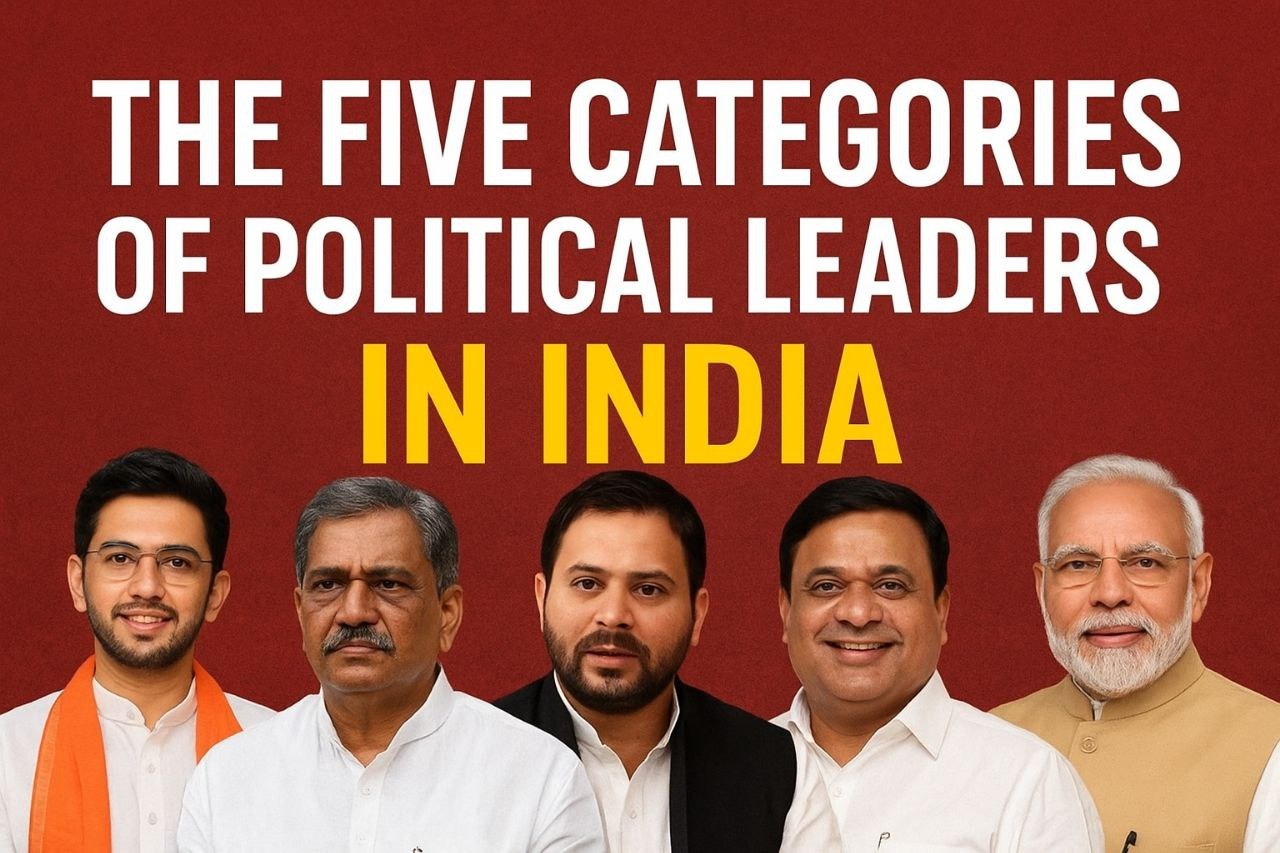
Indian politics is a living, breathing organism. It shifts, evolves, adapts, collapses, resurrects, and reshapes itself with every election, every movement, every leader.
Behind every political outcome lies a deeper truth: leaders shape the direction of democracy far more than parties or ideologies.
Some leaders rise through adversity.
Some are born into power but struggle to retain relevance.
Some shoot up like rockets and disappear like smoke.
And a rare few, just a handful, become eras in themselves.
Over years of observing Indian politics, these leaders broadly fall into five clear categories based on capability, conviction, clarity, and charisma.
“Leadership is not what you inherit or what you receive; it is what you can repeatedly deliver under fire.” ~ Adarsh Singh
Let us journey into these five categories.
CATEGORY 1: THE INEXPERIENCED BUT CONFIDENT LEADERS
They have little experience, but plenty of confidence.
This category includes leaders who jump into politics without extensive ground exposure but compensate with strong self-belief, clear communication, and boldness.
Their political strength lies in:
⚞ Freshness
⚞ Youth appeal
⚞ Strong digital influence
⚞ Willingness to challenge status quo
⚞ Emotional conviction
Their confidence becomes both their driving force and their teacher.
Examples
Tejasvi Surya ~ Fiery, articulate, unapologetic, and confident. Still young in politics, but clear in conviction.
K. Annamalai ~ Former IPS officer; bold, fearless, and rising rapidly with raw confidence and aggressive campaigning.
Chirag Paswan ~ Faced political setbacks but re-emerged with renewed confidence and a strong personal message.
These leaders may lack traditional political grooming but display impressive courage. Their future depends on how fast they gain experience and learn from mistakes.
“Confidence opens doors; experience ensures you stay inside.” ~ Adarsh Singh
CATEGORY 2: THE EXPERIENCED BUT UNDERCONFIDENT LEADERS
They have experience, but hesitate at crucial moments.
These leaders possess years, sometimes decades, of political knowledge. They understand governance, party structures, and election dynamics. However, they lack the assertive confidence needed to transform experience into dominance.
Their common traits include:
⚞ Overthinking
⚞ Excessive reliance on committees
⚞ Avoidance of bold risks
⚞ Political correctness
⚞ Inability to command narrative direction
Examples
Sitaram Yechury ~ A seasoned intellectual, admired for clarity, but lacking the assertive fire needed to revive the Left.
Ghulam Nabi Azad ~ Astute and experienced, but hesitant in independent political leadership.
Digvijaya Singh ~ Politically sharp, but not forceful enough in a modern political battlefield.
Ashok Gehlot ~ Administratively strong, but often reluctant to take bold political risks.
Kamal Nath ~ Decades of experience, but rarely aggressive enough for decisive power plays.
These leaders are neither respected nor feared. Recognized but not followed blindly. Experienced, but not commanding.
“Experience teaches wisdom; confidence transforms wisdom into power.” ~ Adarsh Singh
CATEGORY 3: THE DYNASTIC DEPENDENTS
This category represents politicians who emerge not through grassroots struggle, organizational depth, or administrative performance, but through family lineage.
They possess neither significant experience nor the confidence that comes from real political battles.
Much of their decision-making relies on advisors, consultants, or a small circle of loyalists, often resulting in missteps, inconsistent strategies, and avoidable political setbacks.
These leaders frequently struggle because inherited leadership rarely produces the resilience demanded by modern politics.
Born into politics but lacking core leadership attributes. Dynastic politicians start their careers with visibility, networks, and privilege.
However, many fail to develop:
⚞ Ground-level strength
⚞ Independent decision-making
⚞ Mass connect
⚞ Political stamina
⚞ Strategic clarity
⚞ Leadership resilience
They often depend on:
⚞ Advisors
⚞ Image consultants
⚞ Family networks
⚞ Legacy votes
But politics in India now demands authenticity, sweat, and instinct, not inheritance.
Examples
Uddhav Thackeray ~ Born into a giant legacy but lacked grassroots power and political adaptability; overly dependent on advisers.
Raj Thackeray ~ Charismatic speaker with sharp rhetoric but unable to convert it into lasting political capital.
Akhilesh Yadav ~ Media-friendly and presentable, but nowhere near the political instinct of Mulayam Singh Yadav.
Rahul Gandhi ~ A global name, but inconsistent, unanchored, and overly dependent on advisors.
Priyanka Gandhi Vadra ~ Charismatic but electorally detached and unsuccessful so far.
Sukhbir Singh Badal & Harsimrat Kaur ~ Strong family legacy, weak personal leadership.
Kanimozhi & Udhayanidhi Stalin ~ Derivative political power; not organically grown.
Tejashwi Yadav ~ Shows promise but inherits the entire political capital of Lalu Prasad Yadav rather than creating his own.
MK Stalin ~ Leading a strong party structure, but his authority and rise are rooted in the M. Karunanidhi's legacy.
Aditya Thackeray ~ Groomed rather than grown; lacks independent mass connect and organizational muscle.
Supriya Sule ~ Politically articulate but deeply reliant on the Pawar's legacy for relevance.
“Inheritance may give a leader a seat, but only wisdom gives a leader a future.” ~ Adarsh Singh
These dynasts rarely dominate political battles because politics rewards resilience more than inheritance.
“A legacy can launch your journey, but only leadership can carry you forward.” ~ Adarsh Singh
CATEGORY 4: THE INEXPERIENCED BUT OVERCONFIDENT LEADERS
More confidence than competence, and the fall is often dramatic.
These leaders often rise through:
⚞ Sudden media attention
⚞ Activism
⚞ A temporary public wave
⚞ Anti-incumbency
⚞ Aggressive self-promotion
They overestimate their popularity and underestimate the depth of Indian politics.
Their common weaknesses:
⚞ Impulsiveness
⚞ Emotional decision-making
⚞ Confrontational approach
⚞ Poor organizational understanding
⚞ Weak strategic depth
Examples
Arvind Kejriwal ~ Tremendously confident, but often inconsistent, confrontational, and politically naïve in long-term strategy.
Prashant Kishor Pandey (PKP) ~ Exceptional strategist, but limited mass acceptance as a political leader; confidence far exceeds political traction.
Kanhaiya Kumar ~ Strong speaker, but lacks a long-term political base.
Jignesh Mevani ~ High activism, low electoral depth.
They shine brightly, but briefly.
“Overconfidence without experience is a spark without fuel, it lights up fast, and dies even faster.” ~ Adarsh Singh
CATEGORY 5: THE GOAT CATEGORY – THE ERA-DEFINING TITANS
The rarest category, those who combine experience, instinct, vision, and execution.
GOAT (Greatest Of All Time) leaders are political architects. They do not merely operate within political systems, they reshape them.
Their leadership qualities include:
⚞ Strategic intelligence
⚞ Administrative command
⚞ Emotional resilience
⚞ National influence
⚞ Deep organizational networks
⚞ Exceptional narrative control
⚞ Long-term consistency
⚞ Fearless decision-making
These leaders act, not react. They initiate, not imitate. They sculpt, not follow.
A. ESTABLISHED GOAT LEADERS
Eras are defined by such leaders.
1. Narendra Modi
A once-in-a-century political figure whose leadership blends:
⚞ Unmatched political instinct
⚞ Strong communication
⚞ Vision-driven governance
⚞ Mass connection
⚞ Administrative discipline
⚞ Emotional intelligence
He is not just a leader, he is a phenomenon. A civilizational leader.
2. Amit Shah
The greatest political strategist of contemporary India.
His strengths:
⚞ Organizational mastery
⚞ Deep voter psychology
⚞ Ruthless consistency
⚞ Precision-level election engineering
He doesn't follow political patterns, he creates them.
3. Naveen Patnaik
Elegant, calm, deeply respected.
Over two decades of stable governance marked by:
⚞ Image
⚞ Administrative continuity
⚞ Minimal theatrics
⚞ Maximum delivery
A GOAT of quiet power.
4. Nitish Kumar
⚞ A survivor, strategist, and master negotiator.
⚞ No one understands Bihar’s political geometry better.
A rare leader who has switched alliances without losing personal stature.
5. N. Chandrababu Naidu
A visionary technocrat who brought IT to Andhra before most states recognized its potential.
A strategic mind with administrative brilliance.
“GOAT leaders build ecosystems, not events. Their influence lasts long after their terms end.” ~ Adarsh Singh
B. EMERGING GOAT LEADERS
Leaders who exhibit all foundational qualities of future era-defining leadership.
These leaders have:
⚞ Administrative clarity
⚞ Mass connect
⚞ Organizational support
⚞ Strong ideological positioning
⚞ High decision-making capability
⚞ Rapidly expanding influence
They are India’s future heavyweights.
1. Yogi Adityanath
A decisive leader with a powerful administrative imprint and a strong political identity.
2. Devendra Fadnavis
Strategic, intelligent, steady, and policy-driven, one of BJP’s most formidable contemporary leaders.
3. Himanta Biswa Sarma
Extremely sharp, bold, articulate, and transformational in Northeast politics.
“Emerging GOATs don’t chase relevance, they create relevance with results.” ~ Adarsh Singh
INDIA’S POLITICAL ECOSYSTEM IS A TAPESTRY OF LEADERSHIP ARCHETYPES
These five categories reveal the psychological and strategic patterns that define Indian politics.
Some rise by luck, some by lineage, some by media hype, but true leadership is built through:
⚞ Consistency
⚞ Discipline
⚞ Vision
⚞ Strategy
⚞ Emotional strength
⚞ Political intelligence
In the end, only two types of leaders endure:
⚞ Those who inherit power, and those who redefine power.
And history remembers only one kind:
“History bows not to the loudest, but to the most consistent.” ~ Adarsh Singh
{{DATE}}
 Launch your Graphy