The Forgotten Backbone of Civilization: How Income Tax Policy Can Revive India’s Birth Rates and Protect the Family System
Modern societies are silently drifting toward a demographic cliff. Fertility rates are plummeting, birth rates are declining, families are shrinking, and an unprecedented aging crisis looms on the horizon.
While media narratives focus on GDP growth, capital inflows, and consumption indices, an essential truth remains untold: civilizations do not thrive on economic numbers, they thrive on human beings.
At the heart of this crisis stands a seemingly ordinary institution: income tax policy.
In India, taxation is not merely a tool of revenue collection. It is a powerful instrument of social engineering. Yet our current structure, modeled heavily on Western frameworks, inadvertently incentivizes lifestyles that weaken the Indian family system. Western taxation emerged from societies shaped by Abrahamic individualism, where personal autonomy became the core unit of economics. In contrast, Indian civilization evolved around the family, the Grihastha Ashrama, as the backbone of social, spiritual, and economic continuity.
Somehow, our taxation system forgot this truth.
As a result, we reward dual-income child-free households far more than families with a homemaker dedicated to raising children, preserving culture, and nurturing future citizens.
The irony is painful: the very families performing civilization’s most important duty are penalized under the current system.
“A civilization collapses not when its buildings fall, but when its birth rates do.” ~ Adarsh Singh
Today’s policy choices silently reflect Western templates, and Western destinies. Europe, Japan, and South Korea are sobering examples. They ignored declining birth rates until it was too late. Empty villages, collapsing pension systems, and isolated elder populations now haunt their futures. India still has time to course-correct, but we must act deliberately.
We'll explore how restructuring income tax incentives can correct a fundamental civilizational mistake, restore balance, empower homemakers, and revive healthy birth rates.
The Error in our Tax DNA: Individual-Centric Benefits
In India, the income tax system treats individuals as isolated economic units. Under the current slab exemptions:
👉 A single earning individual may enjoy tax exemption benefits up to ₹12 lakh (approximate under the new regime).
👉 When both spouses work, they independently claim this exemption, totaling ₹24 lakh of household benefits.
👉 But when one spouse is a homemaker dedicated to raising children, the household still receives only ₹12 lakh of exemption, effectively punishing motherhood and child-rearing.
This is counter-civilizational.
Why should a couple ensuring childbirth, parenting, and household stewardship be taxed more heavily than child-free dual-income couples?
In policy analysis, these skewed incentives are known as fertility disincentives. They exist unintentionally, but have devastating demographic consequences.
In effect, our system says:
“If both of you earn and have no children, we reward you. If one of you stays home to raise children, we extract more tax from you.”
No civilization can sustain this logic indefinitely.
“When homemakers are treated as non-contributors, we devalue the very foundation upon which our society stands.” ~ Adarsh Singh
The Invisible Economy of Homemaking
Homemaking is an economic engine without a receipt.
A mother’s work includes:
👉 Early childhood education
👉 Emotional development
👉 Value transmission
👉 Health monitoring
👉 Household management
👉 Caring for elders
👉 Maintaining social harmony
Economists categorize this as non-market labor: unpaid, unmeasured, yet indispensable.
If this labor was outsourced, childcare, tutoring, housekeeping, caregiving, the costs would be staggering. But GDP ignores it because no transaction occurs.
As a result, tax systems ignore it too.
Yet homemakers enable the productivity of the earning spouse. Without their contribution, economic output collapses silently behind closed doors.
To penalize this contribution through taxation is not just economically misguided, it is civilizationally foolish.
Western Tax Templates and the Abrahamic Economic Lens
To understand how we arrived here, we must explore history.
Western taxation evolved in societies where:
👉 The individual’s autonomy superseded family continuity.
👉 Celibacy (church traditions) and monastic norms shaped earlier social structures.
👉 Industrialization demanded atomized workers separated from extended families.
Thus, taxation became:
👉 Individual-centric
👉 Consumption-focused
👉 Incentivizing independent workers
But in India, family is not optional, it is the central unit of economic, spiritual, and cultural continuity.
The Grihastha Ashrama, the householder stage, is the only phase in Hindu philosophy that sustains all others. The fourfold life model: Brahmacharya, Grihastha, Vanaprastha, Sannyasa, depends on the householder to financially and socially uphold the entire system.
Chanakya, in the Arthashastra, framed fiscal policies around family units and community welfare. Taxes were meant to support social reproduction, not undermine it.
Our current system ignores this wisdom.
The Fertility Emergency: Data Does Not Lie
India’s fertility rate has fallen to:
👉 2.0 births per woman nationwide
👉 1.4–1.6 in urban metros such as Delhi, Mumbai, Chennai, Bengaluru
👉 Replacement fertility is 2.1.
Once a society dips below replacement for 20-30 years, it never recovers. Japan is now permanently trapped.
When birth rates collapse:
👉 Pension schemes implode
👉 Healthcare costs skyrocket
👉 Workforce shrinks
👉 Immigration pressures rise
👉 Eldercare burdens destabilize economies
A civilization begins to age, and then fade.
“Demography is not destiny; demography is design.” ~ Adarsh Singh
The Lifestyle Incentive Imbalance
Dual-income, no-kids couples (DINKs):
👉 Have larger disposable incomes
👉 Consume more luxury
👉 Save less structurally
👉 Have fewer family responsibilities
The tax system rewards this behavior inadvertently.
Meanwhile, single-income families:
👉 Invest in children
👉 Carry responsibility burdens
👉 Reduce discretionary spends
are taxed more. This creates a consumption-driven society, not a civilization-driven one.
Psychologically, couples now say:
👉 “Children are too expensive.”
👉 “We can’t afford losing one income.”
That is not a personal failure. It is a policy failure.
Global Case Studies: Lessons from Declining Nations
Japan
Fertility rate: ~1.3
The government offers cash benefits, child subsidies, childcare, but decades of neglect created irreversible cultural inertia.
Now:
👉 Entire villages are abandoned
👉 Schools have no children
👉 The elderly outnumber the young drastically
South Korea
Fertility rate: 0.72 - the lowest in the world.
The government offers up to ₹30 lakh per birth in incentives, yet birth rates still fall. Why?
Because the culture shifted before policy responded.
China
After decades of the one-child policy:
👉 Aging crisis
👉 Workforce tanking
👉 Marriage decline
Even allowing three children now cannot reverse the trend.
Italy
Entire regions are “ghost towns” of the elderly. Schools are merging and shutting down.
These nations prove one painful truth:
👉 Incentives must be applied before birth rates collapse.
India is at the tipping point. We must act now.
Psychology: Why the Homemaker is Unseen
Modern metrics measure:
👉 Salary
👉 Profit
👉 Investment
👉 Consumption
But not:
👉 Values
👉 Emotional stability
👉 Cultural continuity
👉 Civic responsibility
Homemakers specialize in:
👉 Attachment theory
👉 Early cognitive stimulation
👉 Moral modelling
👉 Social anchoring
A single well-nurtured child contributes more to society than all luxury consumption combined. Taxation must honor this.
The Current Paradox
Consider:
Couple A: Husband and wife earn ₹12 lakh each. Total household benefit = ₹24 lakh.
Couple B: Husband earns ₹12 lakh, wife is a homemaker raising children. Total household benefit = ₹12 lakh.
Yet Couple B:
👉 Has more household workload
👉 Creates human capital
👉 Strengthens the social fabric
They are taxed more. This is an inverted value system.
“When society punishes its nurturers, it surrenders its future.” ~ Adarsh Singh
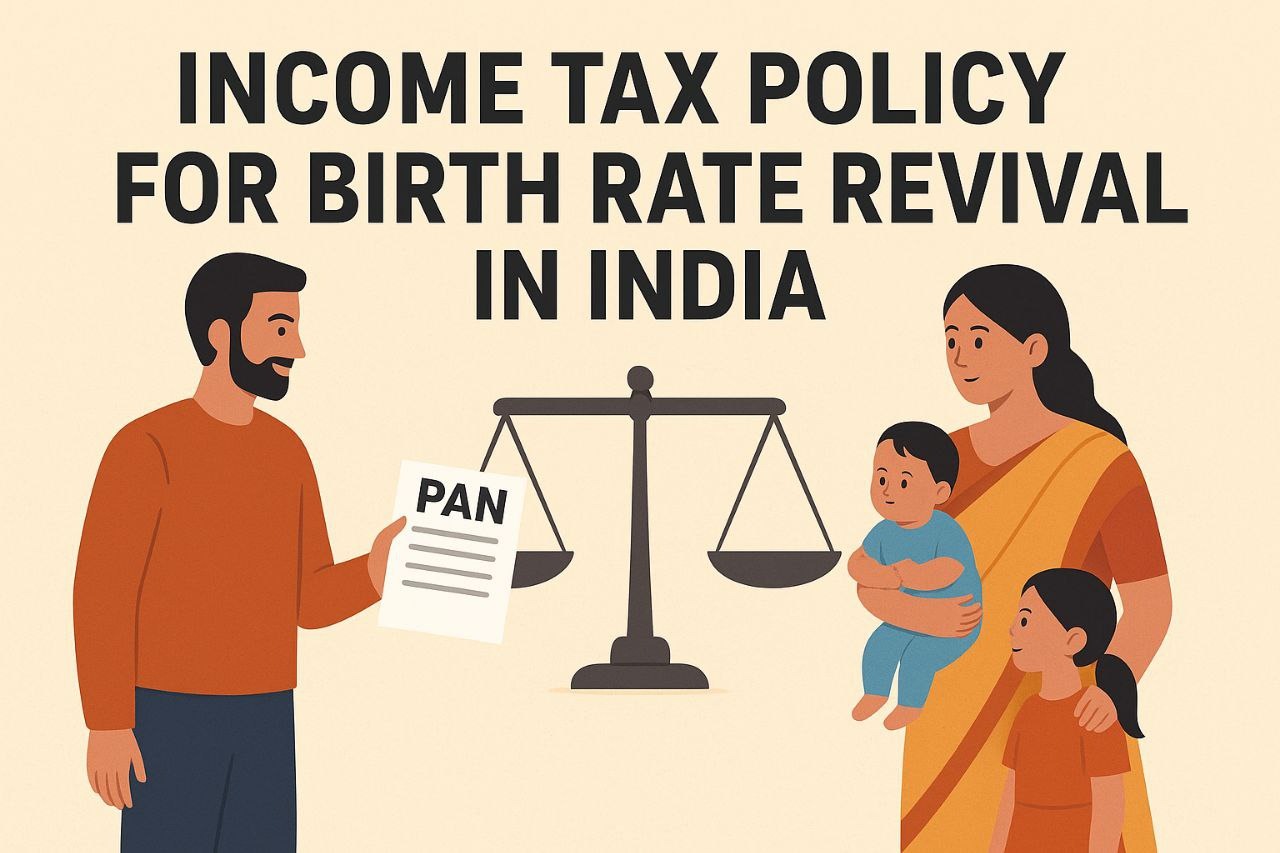
Policy Proposal: PAN-Linked Homemaker Deduction
The solution can be brilliantly simple.
When filing taxes:
👉 Include spouse’s PAN
👉 If spouse’s income is < ₹10 lakh
👉 The earning partner receives ₹2 lakh additional deduction
Advantages:
👉 Recognizes homemaking formally
👉 Encourages childbirth
👉 Reduces single-income household burden
👉 Respects traditional family roles without enforcing them
This is not about forcing anything, only leveling a biased field.
Extended Policy Enhancements (Optional but Powerful)
1️⃣ Child-Based Deductions
₹2 lakh deduction for first child
₹3 lakh deduction for second child
₹5 lakh deduction for third child
This reverses the demographic slide.
2️⃣ Homemaker Pension Credits
The government contributes to PF or NPS, respecting unpaid labor.
3️⃣ Tax Splitting
Household incomes can be split across spouses for tax purposes, used in multiple developed countries.
4️⃣ Education & Healthcare Tax Relief
Parents of children under ten receive additional relief, supporting early development.
These measures create long-term demographic stability.
Historical Indian Wisdom About Family Economics
Ancient Indian texts revered the householder:
Manusmriti describes the Grihastha as “the pillar supporting all other stages”.
Arthashastra taxation was tied to household productivity, not individual consumption.
Dharmashastras prioritized lineage, continuity, and family duties.
Indian civilization understood that:
👉 Children are not economic liabilities
👉 They are economic multipliers
Today’s policy merely forgot.
When Civilizations Ignore Birth Rates
Civilizations across history declined not from war, but from demographic erosion:
👉 Roman Empire (low birth rates → reliance on mercenaries)
👉 Byzantine decline (falling family size)
👉 European aristocracies (hereditary collapse)
The birth rate is the quiet heartbeat of survival.
Why This Matters to India’s Future
India’s youth bulge is declining. Every year:
👉 Fewer children are born
👉 More elders require care
👉 Fewer workers enter the economy
By 2050:
👉 India will have millions of elderly requiring pensions and healthcare
👉 With fewer young taxpayers to pay for it
This is exactly the crisis Japan faces. We can avoid it, if taxation becomes pro-family.
Cultural Continuity Requires Children
India’s spiritual traditions do not survive abstractly.
They require:
👉 Parents transmitting values
👉 Grandparents teaching wisdom
👉 Homes acting as schools
Homemakers are the custodians of culture. If that role disappears, cultural memory dies.
Why Homemaking is a Civilizational Act
Raising children requires:
👉 Patience
👉 Emotional labor
👉 Skill
👉 Wisdom
👉 Time investment
It is not unproductive. It produces human capital, more valuable than machines or buildings.
“Machines build infrastructure, mothers build civilization.” ~ Adarsh Singh
The Scientific Value of Early Childhood Care
Studies in developmental psychology show:
👉 80% of brain development occurs before age five.
👉 Attachment patterns determine adult behavior.
👉 Childhood neglect leads to aggression and anxiety.
Homemakers create stable attachment.
That stability prevents:
👉 Crime
👉 Addiction
👉 Loneliness
👉 Mental illness
Preventive social care begins in the living room.
Taxation as Social Architecture
Every tax decision communicates a cultural message:
👉 What we honor
👉 What we discourage
👉 What we value
Currently:
👉 We value consumption
👉 We ignore natality
👉 We tax nurturing
This can be reversed.
The Civilizational Advantage India Still Holds
Unlike Europe or East Asia:
👉 Marriage is culturally respected
👉 Family support networks exist
👉 Homemaking is socially valued
👉 Intergenerational bonding is normal
We must institutionalize these strengths, not erode them.
Respecting Women’s Choice - All Sides
This proposal is not anti-career or pro-traditionalism enforcement.
It simply states:
👉 Career women should be free to excel.
👉 Homemakers should be free from penalties.
True empowerment means:
👉 Paid contribution recognized
👉 Unpaid contribution respected
Economic Returns of Higher Birth Rates
Higher fertility yields:
👉 Larger workforce
👉 Higher tax revenue
👉 More innovation
👉 Balanced dependency ratio
Countries with stagnating populations eventually import labor, dilute culture, and lose geopolitical influence.
A Warning from History
Civilizations seldom collapse dramatically.
They fade slowly:
👉 Empty cradles
👉 Silent schools
👉 Lonely elders
Tax incentives cannot be neutral on this issue.
Family Stability and Social Harmony
Studies show child-free couples have:
👉 Higher divorce rates
👉 Lower psychological fulfillment
👉 Greater isolation in old age
Children create bonds that anchor marriages and society.
The Ethical Dimension
A society is judged by how it treats its nurturers.
When taxes penalize homemakers:
👉 Motherhood becomes costly
👉 Children become liabilities
👉 Fertility declines
This is not a personal problem. It is a systemic bias.
“When motherhood becomes a luxury, civilization becomes fragile.” ~ Adarsh Singh
India’s Demographic Future is Being Decided Today
Policy has inertia. Behavioral patterns have momentum.
We must nudge society toward family formation before the decline begins.
Designing a Future Where Families Thrive
Income tax is more than numbers. It is a statement of what we honor.
By simply allowing:
👉 Spouse PAN inclusion
👉 Deduction if spouse income < ₹10 lakh
India can:
👉 Support homemakers
👉 Encourage childbirth
👉 Balance dual-income biases
👉 Strengthen its demographic foundation
Beyond GDP, beyond consumption, beyond individualism, families are the true wealth of civilization.
If we fail to protect them, no economic growth can save us.
“The true GDP of a civilization is measured not in currency, but in children, culture, and continuity.” ~ Adarsh Singh
{{DATE}}
 Launch your Graphy