The Great Illusion of Growth: How Taxation, Venture Capital, and the Culture of Burn Are Shaping India’s Startup Destiny
A profound exploration of incentives, psychology, and the hidden architecture of modern entrepreneurship
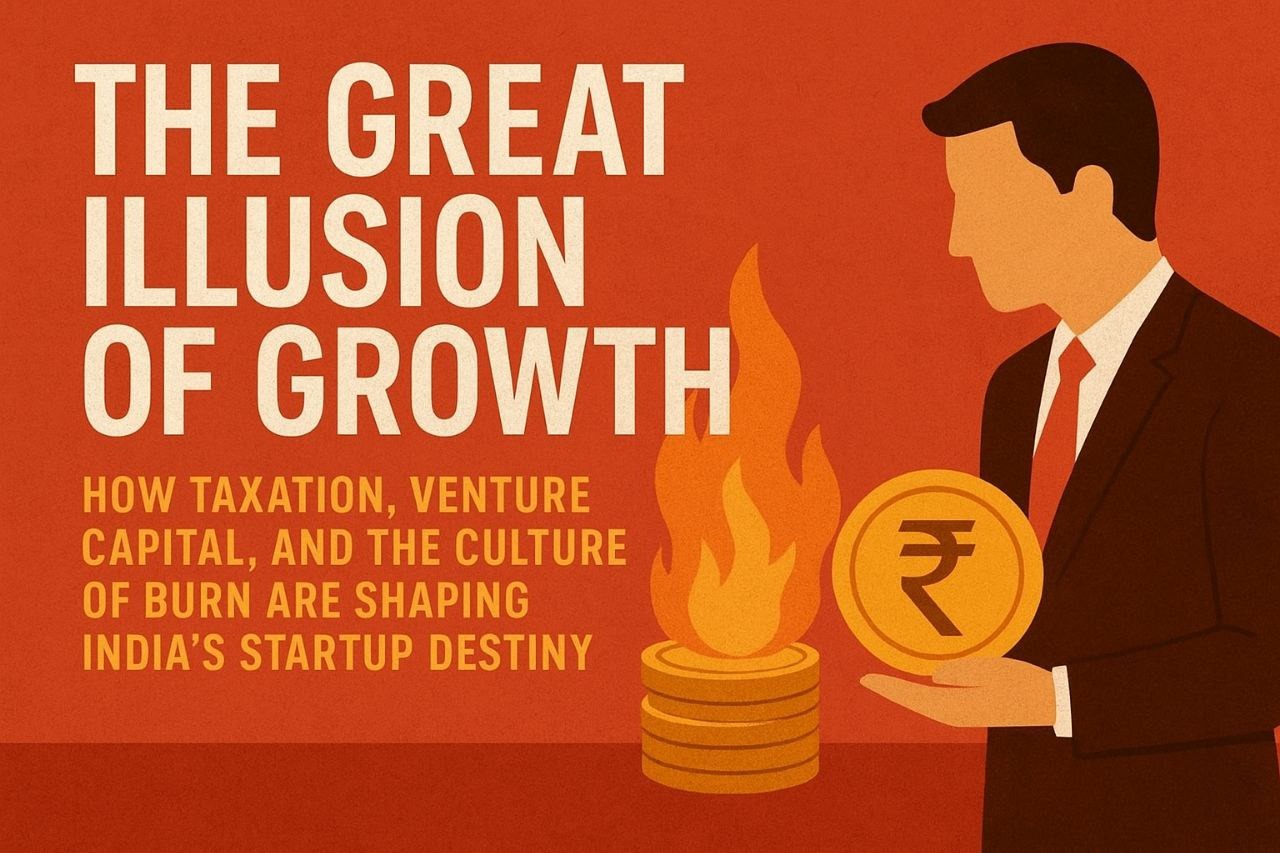
{A} When Growth Becomes a Belief System
Modern India often celebrates startups as engines of transformation, vessels of innovation, courage, disruption, and economic awakening.
But beneath the glossy surface of valuations, unicorn badges, and fundraising headlines lies a deeper truth: the way startups grow today is not merely economic; it is philosophical.
It is shaped by incentives, tax structures, investor psychology, market expectations, and the dynamics of ambition.
One of the most powerful, yet least discussed, forces shaping startup behavior in India is the stark difference in how profits and capital gains are taxed.
If a company distributes profits as dividends, the combined burden of corporate tax plus personal tax often reaches 52%. But if the same wealth is extracted through capital gains, particularly via an IPO, the total tax drops to around 14.95%.
This single differential silently dictates how founders build, how VCs invest, how valuations inflate, and how the entire ecosystem behaves.
Most people see startups burn as ambition. Very few see it as tax arbitrage wrapped inside ambition.
“Money does not shape behavior. Incentives do. And incentives shape an entire ecosystem.” ~ Adarsh Singh
{B} The Invisible Hand Behind Startup Behavior
The Architectural Difference: Dividends vs. Capital Gains
At its core, India’s tax structure makes one thing abundantly clear:
✽ Distribute profits → lose half to taxes
✽ Grow valuation → pay a fraction in tax
This instantly births a system where:
✽ Profits become undesirable
✽ Losses become strategic
✽ Burn becomes mandatory
✽ Growth at all costs becomes logical
✽ IPOs become the holy grail
The rulebook for founders becomes inverted.
Instead of:
✽ Build a profitable company → distribute value → reward owners
It becomes:
✽ Raise money → burn money → grow valuation → exit with minimal tax
The outcome is not accidental. It is engineered.
{C} When Incentives Replace Vision
A startup is often born with a vision, a problem the founder wants to solve. But over time, something else takes over: the logic of tax-efficient wealth extraction.
A founder may want to build a great business. But the system whispers:
✽ Profits are punished. Valuation is rewarded.
And slowly, new priorities emerge:
✽ Scale faster
✽ Show bigger losses
✽ Keep taxes low
✽ Push valuation high
✽ Prepare for an exit
This shapes not just companies, but culture. The Indian startup ecosystem today is less a marketplace of ideas and more a theatre of incentives.
“People don’t follow what is right; they follow what is rewarded.” ~ Adarsh Singh
{D} The VC Playbook: Growth Over Everything
Venture capitalists operate on global logic:
✽ You can fix losses. You cannot fix slow growth.
✽ If you grow fast enough, your valuation multiplies.
✽ If your valuation multiplies, investors make money.
✽ If investors make money, founders become wealthy.
✽ In this system, burn is not a mistake, It is a deliberate strategy.
The steps become predictable:
✽ Show high losses to minimize tax.
✽ Spend aggressively on customer acquisition.
✽ Paint a future narrative of exponential scale.
✽ Raise valuations at every round.
✽ Exit via IPO where capital gains tax is minimal.
VCs do not invest in today, they invest in the narrative of tomorrow. And to make that narrative believable, companies often spend far beyond their natural capacity.
{E} Burn Is Not Innovation, It Is a Wall
The mythology around startup burn often frames it as the cost of innovation, R&D, or disruption. But real R&D in India remains painfully low, around 0.7% of GDP.
Most burn is directed toward:
✽ Discounts
✽ Marketing
✽ Customer acquisition
✽ Market expansion
✽ Growth metrics
✽ Barrier creation
This burn does not create knowledge. It creates entry barriers. It ensures that no small competitor can sustainably survive. Burn becomes the moat. And the moat becomes the monopoly.
“When money becomes a weapon, competition becomes war.” ~ Adarsh Singh
{F} The Illusion of Value: Growth Without Profits
A strange paradox governs modern valuations:
✽ A profitable company growing steadily is valued at 3-5x revenue.
✽ An unprofitable company burning cash but growing 100% annually is valued at 10-15x revenue.
Why?
✽ Because valuations reward speed, not stability.
✽ A company that grows profitably is predictable.
✽ A company that grows unprofitably is magical.
✽ And magic attracts capital.
This inverted logic forces founders to chase unsustainable growth. They become servants of valuation. And valuation becomes the new deity.
So, the culture shifts from:
“Build something meaningful” to “Build something fundable”
{G} The Psychology of IPOs: When Dreams Become Exit Gates
By year 7 or 8, venture funds must return capital to their investors. And because India’s M&A market is small, IPOs become the only real route of exit.
This leads to a pressure cooker:
✽ Even if the company isn’t ready
✽ Even if the model isn’t sustainable
✽ Even if the business hasn’t stabilized
✽ It is pushed into the public market.
The IPO becomes a rite of passage, not for the company, but for the investors. A founder once builds. But later, the founder is built by the investors.
{H} Did the Government Intend This?
Perhaps the government wanted:
✽ More spending
✽ More job creation
✽ Faster GDP movement
✽ Larger economic momentum
And indeed, this system has led to:
✽ Rapid startup creation
✽ Faster capital flow
✽ Big-ticket IPOs
✽ Global investor participation
But the side effects are real:
✽ Fragile companies
✽ Unsustainable economics
✽ Perpetual losses
✽ Dependency on funding cycles
✽ Collapsing post-IPO valuations
The policy created growth, But also vulnerability. It birthed giants, But giants on glass legs.
{I} The Domino Effect: When One Burns, All Must Burn
If a single well-funded startup burns aggressively, competitors face two choices:
✽ Burn with them or die slowly.
This creates systemic instability where:
✽ Everyone burns
✽ Nobody profits
✽ Everyone rises
✽ Everyone risks collapse
✽ It creates an arms race of irrationality.
Imagine a battlefield where survival requires shooting constantly, not because the enemy is attacking, but because your investor demands the sound of gunfire.
This is the modern startup battlefield.
{J} A Philosophy of Dependency
When burn becomes culture, companies forget how to operate without it.
Customers expect discounts. Markets expect subsidies. Employees expect exponential scale. Investors expect snowballing valuation.
A single economic winter, a funding slowdown, a global recession, or a tightening liquidity wave can break the cycle.
Because the business was never built for stability. It was built for speed. Speed is glorious, until the road ends.
“A business built only for speed cannot survive the bends of reality.” ~ Adarsh Singh
{K} The Spiritual Lens: A Nation's Karma of Growth
India is a civilization that believes deeply in balance, the balance of effort, wealth, intention, and consequence.
But the modern startup era often celebrates imbalance:
✽ Growth without profitability
✽ Valuation without value
✽ Speed without sustainability
✽ Burn without wisdom
This is ironic in a country where ancient wisdom teaches:
✽ What grows too fast often collapses too soon.
✽ The incentives do not reflect our cultural philosophy. They reflect global financial psychology.
✽ We are importing ambition. But exporting stability.
✽ We are building fireworks. Not furnaces.
Fireworks shine brightly, but briefly. Furnaces last. They forge nations.
{#} A Moment of Collective Introspection
India stands at a philosophical crossroads:
✽ Should we continue rewarding speed? Or begin rewarding sustainability?
✽ Should we incentivize burn? Or incentivize innovation?
✽ Should we celebrate valuations? Or value creation?
✽ Should founders build for investors? Or for India?
The tax structure, the VC model, the IPO pressure, the growth obsession, they are not just economic forces. They are philosophical forces shaping a generation of entrepreneurs.
And the time has come to ask:
✽Growth for whom?
✽Growth at what cost?
✽Growth toward what future?
“The world worships growth, but only wisdom can sustain it.” ~ Adarsh Singh
The ultimate truth is:
“A civilization rises not when companies grow fast, but when they grow strong.” ~ Adarsh Singh
{{DATE}}
 Launch your Graphy