The India Moment: From Civilizational Power to Superpower Potential
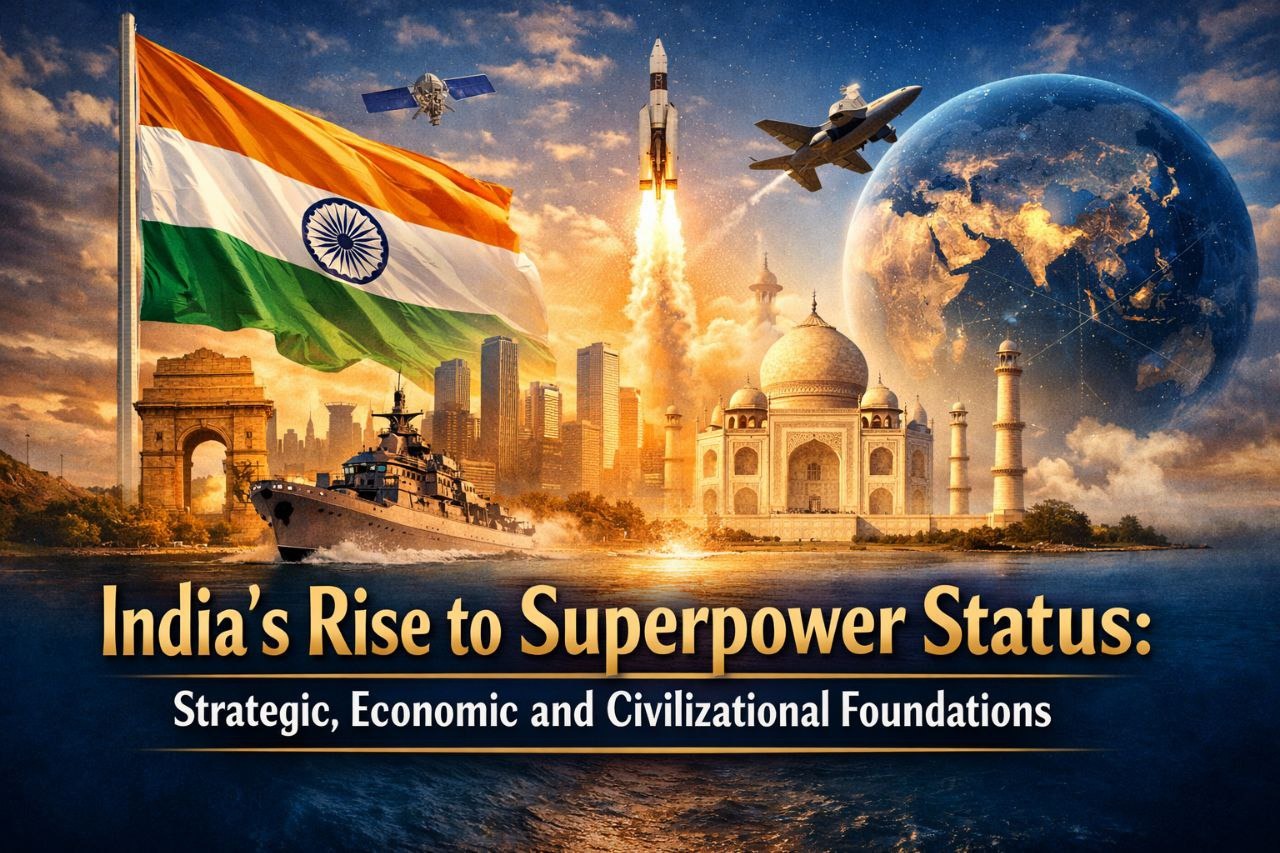
A Nation at an Inflection Point
History does not move in straight lines. It unfolds in cycles, of rise, consolidation, stagnation, and renewal. Today, India stands at a rare inflection point where demography, geopolitics, technology, and civilizational confidence converge.
The question is no longer whether India matters.
The real question is whether India is structurally positioned to become a superpower.
A superpower is not merely a large country. It is a system-shaping force. It influences global rules, secures its interests beyond borders, exports ideas, shapes markets, projects military strength, and commands moral as well as economic authority.
India’s journey toward that status is neither accidental nor guaranteed. It rests on deep structural foundations, demographic momentum, economic scale, digital architecture, military capability, diplomatic strategy, civilizational soft power, and strategic geography.
“Power is not claimed by declaration; it is earned through capability, consistency, and civilizational confidence.” ~ Adarsh Singh
This blog explores, comprehensively and without omission, every structural factor working in India’s favor.
Demographic Dividend: The Engine of Long-Term Power
Demography shapes destiny when aligned with productivity.
India possesses one of the youngest populations among major economies. With a median age under 30, the country’s workforce expansion will continue for decades. While several advanced economies face demographic contraction and aging crises, India’s labor pool is still expanding.
Contrast this with aging societies where shrinking workforces strain pension systems, healthcare infrastructure, and fiscal balances. India’s demographic window offers a historic opportunity, provided it translates youth into skill.
The country produces millions of graduates annually, particularly in science, technology, engineering, and mathematics. Its large English-speaking population gives it a unique comparative advantage in global services, diplomacy, academia, and cross-border commerce.
If demographic energy converts into human capital excellence, India’s growth runway extends far longer than most major economies.
“Demography is raw potential; education and discipline convert it into destiny.” ~ Adarsh Singh
Economic Scale and Growth Momentum
A superpower requires economic gravity.
India is among the world’s largest economies and continues to rank among the fastest-growing major nations. Unlike export-dependent economies, India’s growth is increasingly supported by domestic consumption, driven by a rising middle class and expanding urbanization.
The size of its internal market provides resilience. A large consumption base attracts foreign direct investment, fuels entrepreneurship, and reduces vulnerability to external shocks.
India’s structural reforms in taxation, insolvency frameworks, digital governance, and financial inclusion have created a more formalized economic environment. Financial inclusion has expanded dramatically, bringing millions into the banking system and accelerating digital payments.
Moreover, global supply chains are recalibrating. Geopolitical tensions and risk diversification strategies have created opportunities for manufacturing relocation. India stands as a major beneficiary of this “China+1” shift.
Economic power, however, is not merely GDP size. It is about depth, manufacturing sophistication, technological independence, innovation capacity, and capital formation. India is progressively strengthening each of these pillars.
Digital Public Infrastructure: Governance at Scale
India has pioneered one of the world’s most ambitious digital public infrastructures.
The combination of biometric identity systems, real-time digital payments architecture, and scalable public service platforms has created a governance model capable of operating at continental scale.
This digital backbone enhances financial inclusion, reduces corruption leakage, increases efficiency, and builds state capacity. It also provides a replicable governance model that developing nations can adopt.
Digital governance is not merely administrative convenience, it is strategic leverage. Nations that master digital infrastructure at population scale create structural efficiency advantages and technological influence.
India’s fintech ecosystem, startup environment, and software services industry further reinforce this digital strength.
“Technology becomes power when it democratizes opportunity at scale.” ~ Adarsh Singh
Strategic Geography: The Indian Ocean Advantage
Geography is silent but decisive.
India sits at the heart of the Indian Ocean Region, a critical artery for global trade and energy movement. A significant percentage of global oil shipments and maritime commerce passes through nearby sea lanes.
Control, influence, and naval presence in this region translate into strategic leverage. As the Indo-Pacific emerges as the primary theatre of 21st-century geopolitics, India’s geographic centrality becomes increasingly valuable.
Unlike nations geographically constrained or surrounded by hostile waters, India’s peninsular structure offers natural maritime access and defensive depth.
Geography does not guarantee dominance, but it provides opportunity. When combined with naval modernization and maritime diplomacy, it becomes a multiplier.
Military Capability and Strategic Deterrence
A superpower requires credible deterrence.
India is a nuclear-armed state with a functional triad capability. It maintains one of the largest standing armed forces globally and possesses extensive experience across varied terrains, from high-altitude borders to maritime operations.
The emphasis on indigenous defense manufacturing and modernization under self-reliance initiatives signals long-term intent. Missile programs, satellite surveillance systems, and expanding air and naval capabilities enhance deterrence credibility.
Space capability further strengthens strategic autonomy. Cost-efficient satellite launches, lunar exploration, and planetary missions demonstrate technological sophistication beyond mere symbolic achievement.
Military power, however, must integrate with diplomatic strategy. India’s doctrine emphasizes strategic autonomy, engaging multiple global powers without formal alignment dependence.
Diplomatic Multi-Alignment and Strategic Autonomy
Few nations balance relationships across competing blocs with the flexibility India demonstrates.
India engages deeply with Western economies, maintains historical defense ties with Russia, strengthens partnerships in West Asia, collaborates within Indo-Pacific frameworks, and maintains leadership visibility among developing nations.
Membership in key global forums, from the G20 to BRICS to regional security dialogues, places India at negotiating tables that shape economic and geopolitical architecture.
This diplomatic multi-alignment provides maneuverability. It reduces overdependence on any single power center and enhances negotiation leverage.
Strategic autonomy is not neutrality; it is calibrated engagement.
“The strongest nation is not the one that chooses sides blindly, but the one that shapes outcomes independently.” ~ Adarsh Singh
Civilizational Depth and Soft Power
Power is not only material, it is cultural.
India represents one of the world’s oldest continuous civilizations. Its philosophical traditions, spiritual systems, literature, art forms, and social frameworks have endured millennia.
Yoga, meditation, Ayurveda, and holistic wellness practices have global reach. International recognition of yoga reflects soft power that transcends politics.
India’s film industry, music, cuisine, and diaspora networks amplify cultural influence across continents.
Soft power reduces resistance to influence. It builds affinity before diplomacy begins.
Civilizational confidence also shapes internal cohesion. Nations aware of their civilizational continuity often demonstrate strategic patience and resilience.
Diaspora Influence: Global Multipliers
India’s diaspora spans technology leadership, academia, entrepreneurship, and political systems worldwide.
Remittances contribute significantly to economic stability. More importantly, diaspora influence strengthens bilateral ties and knowledge transfer.
Diaspora networks often act as informal ambassadors, bridging innovation ecosystems, facilitating investment, and shaping global narratives.
No superpower rises in isolation. Diaspora capital, both intellectual and financial, accelerates momentum.
Infrastructure Expansion and Energy Strategy
Rapid highway expansion, port modernization, airport development, freight corridors, and renewable energy projects reflect a nation investing in its physical backbone.
Energy diversification, particularly in solar and renewable capacity, positions India within global climate diplomacy frameworks.
Infrastructure is productivity made visible.
Without logistics efficiency, economic scale stalls. India’s accelerated buildout strengthens competitiveness and long-term resilience.
Technological Ambition and Innovation Ecosystem
India’s IT services dominance laid the foundation for a broader innovation ecosystem.
The startup landscape spans fintech, health tech, deep tech, artificial intelligence, and software-as-a-service platforms. Increasing semiconductor ambitions reflect awareness of supply chain sovereignty.
Research and development investments must expand further, but the institutional framework and entrepreneurial momentum are visible.
In the 21st century, technological sovereignty determines strategic independence.
Democratic Legitimacy and Institutional Continuity
India operates under a stable constitutional framework with regular electoral transitions.
Democratic legitimacy enhances global credibility. While governance challenges remain, institutional continuity provides predictability.
Political stability over decades enables long-term policy planning, essential for superpower trajectories.
Global Structural Trends Favoring India
The global system is shifting from unipolar dominance toward multipolar equilibrium. Aging populations constrain growth in advanced economies. Supply chains diversify. The Global South seeks new leadership voices.
India’s demographic youth, market scale, strategic geography, and diplomatic flexibility align with these shifts.
It increasingly positions itself as a bridge, between developed and developing worlds, between East and West, between tradition and technology.
Psychological Momentum and National Confidence
National confidence influences economic risk-taking, entrepreneurial ambition, and diplomatic posture.
Visible infrastructure transformation, global summit hosting, space achievements, and economic reforms contribute to collective optimism.
Confidence, however, must remain disciplined, not complacent.
The Conditions for Superpower Status
To transition from emerging power to superpower, India must sustain:
• High long-term GDP growth
• Manufacturing deepening
• Technological independence
• Military modernization
• Institutional reform depth
• Education quality expansion
• Research intensity increase
• Per capita income growth
Superpower status is not a moment, it is a multi-decade execution discipline.
The India Moment
India possesses the ingredients of superpower potential:
• Demography.
• Geography.
• Democracy.
• Digital infrastructure.
• Diplomacy.
• Defense capability.
• Diaspora strength.
• Civilizational continuity.
• Economic scale.
• Entrepreneurial momentum.
Yet ingredients do not cook themselves.
The coming decades will test institutional execution, social cohesion, technological ambition, and strategic clarity.
If India converts potential into sustained productivity, balances growth with governance reform, and aligns civilizational confidence with technological sophistication, it will not merely participate in the global order, it will help shape it.
And ultimately,
“Superpower status is not about dominating the world; it is about becoming indispensable to it.” ~ Adarsh Singh
{{DATE}}
 Launch your Graphy