The Manufactured Myth of a “Kingmaker”: Dissecting the Electoral Reality of Prashant Kishor
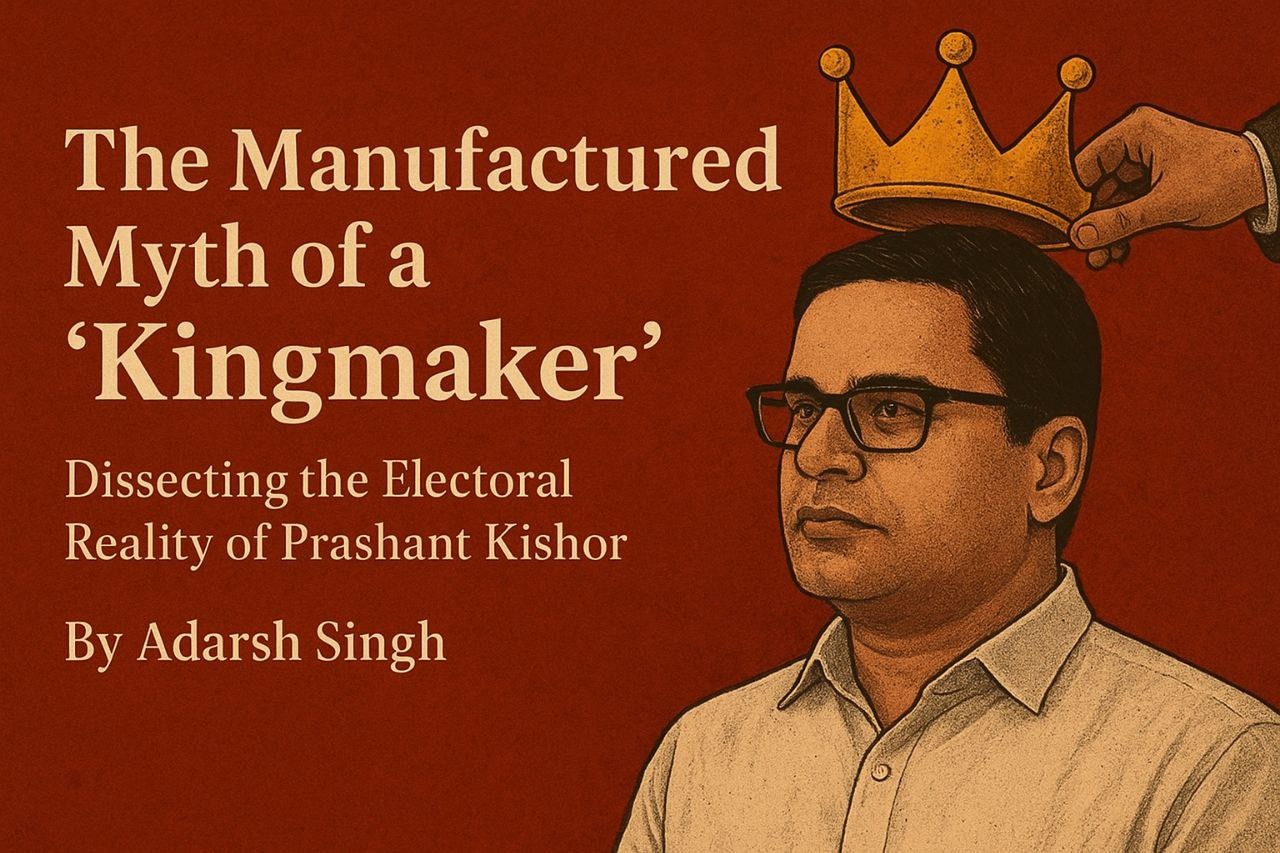
For more than a decade, a strange phenomenon has gradually crept into the Indian political mindscape. A narrative, carefully lubricated by media enthusiasm, consultancy storytelling, and echo-chamber amplification, has portrayed one man, Prashant Kishor, as a mystical electoral force, a calculus-breathing genius capable of sculpting victories from thin air. This mythology grew louder with every election cycle, often overshadowing inconvenient facts, grassroots realities, and the simple, brutal truth of Indian politics: parties win elections, not consultants.
Somewhere in the middle of this frenzy, a dangerous assumption began circulating, that elections in India can be hacked with PowerPoint decks and clever slogans. That voter emotion can be gamified. That performance on the ground is secondary to optics, and that political consultants, not leaders, are the primary architects of electoral success.
But when we peel away the smoke and mirrors, what remains is deeply underwhelming.
“Hype can impress journalists, but it can never replace the hard muscle of grassroots politics.” ~ Adarsh Singh
This blog is not an obituary. It is a performance audit. A long-overdue scrutiny of a narrative that has been aggressively sold but rarely examined.😊
The Illusion Factory: What Makes the Media Love Such Stories?
Indian media thrives on personalities more than processes, stories more than structures. Elevating a strategist as a kingmaker fits perfectly into this behavior. It creates drama, suspense, a sense of insider spectacle. It gives panelists something to gossip about. It suggests that democracy is not messy and unpredictable, but quantifiable and formulaic.
Political consultancy, therefore, is often packaged as wizardry. And in this spectacle, Prashant Kishor emerged as the protagonist of a myth the system wanted to believe.😎
“When narratives lack evidence, they depend heavily on repetition and applause.” ~ Adarsh Singh
But Indian democracy is stubborn. It resists shortcuts.
The Gujarat Assembly Elections, 2012: Success Without the Strategist
Narendra Modi had already carved his electoral dominance in Gujarat well before any consultant entered the frame. His administrative performance, personal charisma, and political organization yielded victory cycles that predated consultant involvement. The so-called kingmaker was, at best, an accessory.
Gujarat did not become a laboratory of consultancy magic. It was a testimony to ground governance, ideology, and organizational depth.
Consultants often try to retro-paint their relevance onto victories that would have happened anyway.😇
The Parliamentary Elections of 2014: A Tidal Wave Beyond Consultancy
If ever there was a moment in Indian politics defined by raw national emotion, it was 2014. The country demanded change. Narendra Modi’s candidacy was a grassroots phenomenon, organic, spontaneous, electric. Voters were not persuaded; they were compelled by hope and fatigue.
Prashant Kishor handled just one small campaign segment, “Chai Pe Charcha.” Meanwhile, a massive advertising ecosystem and several legendary creative minds shaped the narrative.
History records only two Indian leaders who were organically demanded by voters: Atal Bihari Vajpayee and Narendra Modi.⚡
No consultant can take credit for this rare electorate psychology.
Even Kishor himself publicly acknowledges Modi’s unmatched experiential blend of 45 years: RSS Pracharak + Party Organizer + Administrator.
Consultants don’t create waves. They ride them.
The Bihar Assembly Elections, 2015: A Dented Victory
Nitish Kumar hired Kishor. The outcome? JD(U) fell dramatically from 115 seats to 71. Meanwhile, RJD surged, capitalizing on its own cadre machinery and caste mobilization. JD(U)+RJD may sound stronger on paper, but the strategist could not convert that strength into a bigger mandate.
A strategist who reduces his client’s seats is hardly a kingmaker.😃
“When strategy disconnects from sociology, it collapses like a fragile script.” ~ Adarsh Singh
Punjab Assembly Elections, 2017: Misread Terrain, Mistaken Interpretation
Punjab’s electoral landscape was already shifting due to anti-incumbency against SAD and AAP’s emergence. Congress won, not because Kishor added value, but because AAP fractured SAD’s vote bank. Congress’s vote share actually dropped compared to 2012.😁
And then came 2022: Captain Amarinder Singh hired Kishor again, for Re. 1, symbolically. He lost comprehensively.😆
The state rejected both leader and strategy.
Uttar Pradesh Assembly Elections, 2017: A Strategic Disaster
Congress, grasping for relevance, hired Kishor. Gimmickry followed:
👉 Brahmin daughter projection(Sheila Dikshit)
👉 Cots-based street symbolism(Khaat Pe Charcha)
👉 An inflated alliance slogan(UP Ke Do Ladke)
None of it resonated.
Congress collapsed to 6.25% vote share (down 5.4%) and just 7 seats (down 21 seats). Strategy drowned under sociopolitical weight that Kishor failed to understand.😀
UP requires caste-deep organizational machinery. Consultants cannot substitute that with branding.
Andhra Pradesh Assembly Elections, 2019: Victory By Fragmentation
Jagan’s victory was thrust upon him by an unintended coalition split. TDP lost BJP and Pawan Kalyan, its 2014 partners. Kishor was simply present when anti-TDP energies converged.
In 2024, when TDP, BJP, and Pawan reunited, Jagan fell.
Luck masqueraded as strategy.
“Luck is not a skill. It merely waits to be exposed by time.” ~ Adarsh Singh
Maharashtra Assembly Elections, 2019: Strategy That Broke Alliances
UBaTHa hired Kishor with ambitions that spiraled into internal power conflicts, particularly with dynastic projections. The result?
👉 Alliances splintered
👉 Ambition surfaced prematurely
👉 Seat performance dropped
Strategic advice accelerated organizational decay. That is not mastery. That is a misjudgment.
Delhi Assembly Elections, 2020: Regression Disguised as Retention
AAP went from 67 seats without Kishor in 2015 to 62 seats with him in 2020. Vote share dipped. This was not growth.
Delhi’s social service delivery and local brand loyalty, not consultancy, powered AAP.
Consultants frequently take credit for things already baked into the electorate.
Tamil Nadu Assembly Elections, 2021: The Alternation Pattern
TN politics traditionally alternates between DMK and AIADMK. In 2011, without Kishor, DMK performed similarly well. In 2021, AIADMK was weakened by internal conflict and the absence of Jayalalithaa.
Strategists did not tilt history. History repeated its cycle.
Tamil Nadu resists external “design.” Dravidian politics lives in emotional DNA.
West Bengal Assembly Elections, 2021: The Opponent Gained More
AITC’s performance in 2021 marginally improved from 211 to 215 seats over 294. But the shock was BJP’s growth, from 3 to 77 seats.
When your opponent benefits more than you, what does strategy actually achieve?
The strategist took credit for containment, forgetting the explosion of the alternative.
“Growth of the opponent is the silent audit of your strategy.” ~ Adarsh Singh
Andhra Pradesh Assembly Elections, 2024: A Collapse of Activities
Despite numerous IPAC activities, Jagan’s party collapsed. Event management cannot override anti-incumbency, governance fatigue, or coalition chemistry.
Activities do not equal votes.
Parliamentary Elections in West Bengal, 2024: Marginal Shifts
AITC gained marginally. The BJP retained strong ground. The narrative of strategy supremacy drowned under the reality of demographic constraints, voter consolidation patterns, and security concerns.
No dramatic strategy imprint exists here.
Delhi Assembly Elections, 2025: Losing the Leader’s Seat
Multiple IPAC activities preceded AAP’s worst performance. Arvind Kejriwal lost his own MLA seat. No narrative can soften that blow.
Bihar Assembly Elections, 2025: Strategic Hesitation
Prashant Kishor created Jan Suraaj, only to avoid contesting personally. He granted tickets to individuals with existing follower bases.
If one truly believes in strategy, one contests. One enters the arena.
A kingmaker who refuses the battlefield courts suspicion.
“Those who choreograph battles from rooftops rarely understand the mud beneath real boots.” ~ Adarsh Singh
The Anatomy of Myth-Driven Credibility
So how does such a persona survive?
1. Media Needs Characters
Political journalism often prefers faces over facts. Newsrooms adore consultants, they sound technical, polished, cosmopolitan.
2. Consultancy Glamour
Youthful technocratic aura sells. “Data strategist” sounds elite. It flatters urban imagination.
3. Narrative Theft
Victories powered by ideology, caste arithmetic, welfare delivery, and leadership often get retro-credited to consultants.
But on the ground, voters respond to:
👉 Community identity
👉 Local development
👉 Trust cycles
👉 Delivery of promises
👉 Leadership charisma
Consultants respond to presentation layers.
4. Selective amnesia
Defeats vanish quietly from performance portfolios.
What Actually Wins Elections in India?
1. Organizational muscle
2. Booth management
3. Caste and community consolidation
4. Leader trust
5. Brand recall
6. Welfare scheme credibility
7. Narrative credibility
8. Cadre penetration
Consultants cannot fabricate these elements.
India’s electoral machine is brutally local. The hyper-national headline confuses outsiders.
“Ground politics is not a spreadsheet. It is the slow, stubborn negotiation of trust.” ~ Adarsh Singh
Political Consultancy: A Marketing Industry, Not a Movement
This industry thrives on:
👉 Exaggerated claims
👉 Selective credit harvesting
👉 Post-facto narrative engineering
It is less about results and more about perception.
Like advertising agencies, consultants inflate their role. But unlike advertising, elections are not products; they are emotional civilizational decisions.
A strategist can help you sharpen a microphone, but he cannot make voters listen.
Why Media Overstates Such Figures
Because:
👉 Drama sells
👉 Insider gossip excites
👉 Consultants provide curated leaks
The illusion of control fascinates audiences
The media loves the idea that election outcomes can be “designed.” It simplifies complexity.
Democracy, however, is chaos wrapped in sociology.
The Voter: India’s Most Overlooked Genius
The Indian voter sees through gimmicks. They divine intent. They sense authenticity. Consultants underestimate their instinct.
To believe a strategist can manipulate millions is to insult democracy’s oldest virtue: Discernment.
Jan Suraaj: The Strategic Retreat
When Prashant Kishor formed his own political outfit, many expected a grand personal contest. Instead, he avoided direct electoral confrontation.
A strategist who believes in his vision should demonstrate it on the ground.
Avoidance reveals anxiety.
So What Is the Verdict?
After analyzing:
2012 Gujarat
2014 Parliamentary Elections
2015 Bihar
2017 Punjab
2017 Uttar Pradesh
2019 Andhra Pradesh
2019 Maharashtra
2020 Delhi
2021 Tamil Nadu
2021 West Bengal
2024 Andhra Pradesh
2024 West Bengal parliamentary
2025 Delhi
2025 Bihar formation
…a pattern emerges:
👉 Negligible influence on victories.
👉 Visible association with losses.
👉 No consistent value addition.
👉 No demonstrated kingmaking capability.
Consultancy narratives are brittle. Performance exposes them.
“Reputation without results is a bubble waiting to burst.” ~ Adarsh Singh
The Great Chameleon
Strategies changed with employers.
👉 Ideologies shifted.
👉 Allegiances rotated.
👉 Opportunism disguised itself as neutrality.
The consultant morphed with each state’s political chemistry.
In politics, consistency is character. Elasticity is opportunism.
Ground Politics vs. Consultant Optics
Ground politics requires:
👉 Blood
👉 Sweat
👉 Doorsteps
👉 Caste councils
👉 Panchayat negotiations
👉 Long memories
Consultants require:
👉 Invoices
👉 Presentations
👉 Projections
The gulf between the two worlds is unbridgeable.
The Myth Ends Here
Facts, figures, and patterns dismantle the kingmaker mythology. The evidence is not emotional, it is empirical.
Strategy cannot replace decades of governance legacy. Consultants cannot simulate charisma. The media cannot breathe life into hollow narratives.
Nitish Kumar’s legacy is built on twenty years of administrative impact. Narendra Modi’s legacy is built on grassroots evolution.
Prashant Kishor’s legacy is built on branding rhetoric.
Democracy Exposes Pretenders
India does not reward surface-level maneuvering. Time audits everyone. Electoral cycles punish opportunism. Voters test authenticity fiercely.
Political consultants can enhance messaging, but they cannot manufacture movement.
Mythologies collapse when measured against consistent performance.
“History is not written by strategists whispering in backrooms; it is written by leaders sweating on the ground.” ~ Adarsh Singh
{{DATE}}
 Launch your Graphy