The Myth of Progress: Why GDP Is Failing Humanity and Misunderstanding Civilization
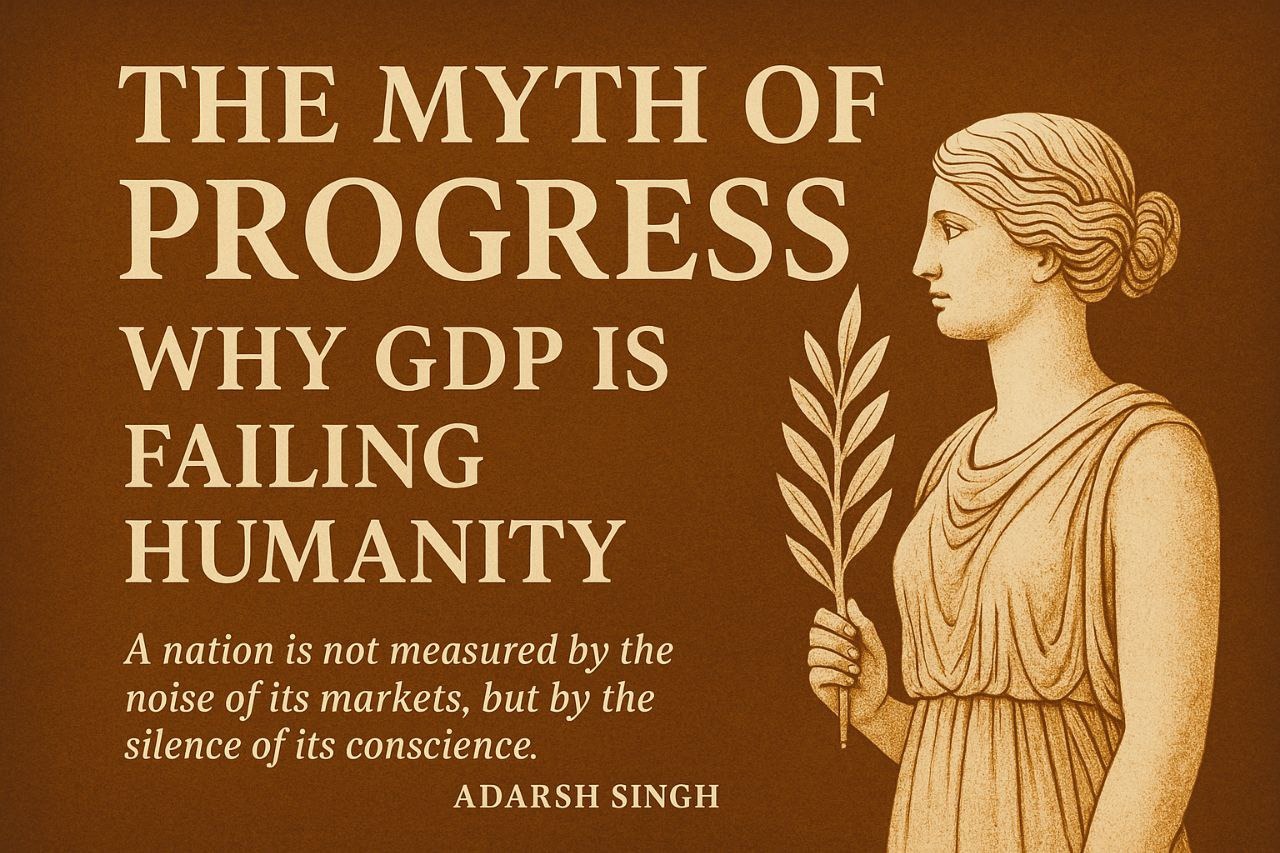
Progress, for far too long, has been measured by the loud clatter of markets, the frenzy of consumption, and the relentless churn of economic transactions. Across the modern world, Gross Domestic Product (GDP) has been exalted as the singular, sacred metric of national power and success.
It has become a global chant: Grow GDP, grow prosperity. But beneath this obsessive chorus lies a profound philosophical emptiness.
GDP, as designed and propagated in the industrial-colonial West, was never intended to measure human flourishing, cultural integrity, civilizational depth, or spiritual well-being. It was engineered to measure activity within markets, primarily for war-time planning and taxation. And yet today, it stands at the center of global economic discourse: blind, narrow, artificial, and fundamentally incomplete.
"When value is confused with price, civilization begins to decay." ~ Adarsh Singh
Let's explore the deeper dimensions of what GDP ignores, why it distorts our understanding of development, how it punishes cultural and ecological wisdom, and why civilizational societies like India must evolve beyond its shallow arithmetic.
The Seduction of Numbers
Humanity loves numbers because they seem objective. They appear definitive, measurable, real.
👉 Politicians boast percentages.
👉 The media celebrates quarterly upticks.
👉 Economists argue decimal points.
But no number can capture:
👉 Social harmony
👉 Cultural continuity
👉 Spiritual maturity
👉 Psychological well-being
👉 Moral character
👉 Ecological balance
👉 Family cohesion
GDP ignores all of this. It is a glorified calculator tallying transactions, indifferent to context, meaning, and consequence.
The result?
A narrow definition of progress that rewards destruction.
When Disaster Looks Like Growth
GDP rises when:
👉 People fall sick (more pharmaceutical spending)
👉 Cars crash (repairs, insurance)
👉 Marriages fail (legal fees, separate housing)
👉 Polluted rivers need cleanup contracts
👉 Forests are cut and sold
👉 Citizens outsource cooking, cleaning, parenting
This is not wisdom. It is an economic pathology.
When society breaks, GDP smiles.
"Growth without goodness is merely an expansion of chaos." ~ Adarsh Singh
GDP cannot distinguish between:
👉 Healing and harm
👉 Costs and consequences
👉 Efficiency and waste
In its logic, more money spent means more progress, even if the expenditure arises from social decay or accumulating debt.
The Invisible Wealth That GDP Cannot See
GDP does not account for:
👉 Emotional support between family members
👉 Elderly care done at home
👉 Homemade food
👉 Community bonding
👉 Volunteerism
👉 Informal trade
👉 Barter economies
👉 Self-reliance
👉 Cultural heritage
These are the invisible roots of civilizational strength.
When communities become self-dependent, GDP falls. When families break apart and services are outsourced, GDP rises.
The more helpless the population, the stronger the GDP.
Is that a measure of progress, or surrender?
The Civilizational Blindness
GDP was born in a mindset that understood society as a production unit. It sees citizens as economic agents. Survival as consumption. Relationships as transactions.
Civilizations like India, however, are shaped by:
👉 Dharma (the moral order)
👉 Rasa (emotional richness)
👉 Samskāra (cultural imprinting)
👉 Paramparā (intergenerational wisdom)
👉 Sadhana (inner growth)
These cannot be priced in markets, so GDP silently ignores them.
"What civilization remembers, GDP forgets. What civilization treasures, GDP cannot count." ~ Adarsh Singh
This sets up an epistemic conflict: industrial metrics judging civilizational legacy.
Human Beings Are Not Consumption Engines
GDP assumes that:
👉 More spending = more happiness
👉 More production = more progress
👉 More consumption = more success
But humans are not machines who eat, shop, and excrete economic output. Humans seek:
👉 Purpose
👉 Belonging
👉 Identity
👉 Growth
👉 Meaning
👉 Silence
👉 Contribution
GDP measures the movement of money, not the development of people.
The Psychology of Consumption
GDP thrives on desire without fulfillment. It fuels a mental ecosystem where:
👉 Enough is never enough.
👉 Identity becomes material.
👉 Dopamine replaces contentment.
People lose touch with their inner compass, chasing numbers that do not nourish the soul.
A GDP-obsessed world becomes:
👉 More anxious
👉 More lonely
👉 More competitive
👉 More fragmented
It becomes emotionally bankrupt while appearing financially wealthy.
Nature as a Balance Sheet Asset
When a forest stands quietly, providing:
👉 Oxygen
👉 Purity
👉 Shade
👉 Biodiversity
👉 Soil fertility
👉 Spiritual refuge
GDP records zero.
But when the forest is cut:
👉 Timber revenue
👉 Road projects
👉 Machinery rentals
👉 Land sales
GDP jumps.
GDP rewards destruction and ignores preservation.
"A river is wealth only until someone tries to price it." ~ Adarsh Singh
This is an ecological illusion: killing the tree to count the timber.
Family, Culture, and Community: The Real Economy
The strongest civilization is the one
👉 Whose families are intact,
👉 Whose youth are resilient,
👉 Whose elderly are respected, and
👉 Whose culture provides meaning.
GDP cannot measure:
👉 How deeply connected generations are
👉 How emotionally healthy children are
👉 How stable marriages are
👉 How safe women feel
👉 How purposeful youth are
These are the pillars of national prosperity.
When culture dissolves, GDP remains silent.
GDP and Moral Erosion
👉 If crime increases, police budgets rise, and GDP improves.
👉 If divorce rises, legal fees increase, and GDP improves.
👉 If pollution worsens, water filters sell, and GDP improves.
GDP’s arithmetic is morally blind.
"Prosperity without character is merely decorated poverty." ~ Adarsh Singh
A nation can be rich in wallets and poor in conscience.
Civilization Runs on Values, Not Valuation
GDP cannot measure:
👉 Compassion
👉 Courage
👉 Courtesy
👉 Cleanliness
👉 Cooperation
👉 Discipline
👉 Devotion
These qualities sustain civilizations for centuries while markets rise and fall.
The Roman Empire did not collapse because GDP dropped. It collapsed when values corroded.
India’s Civilizational Lens
India’s traditional economy was not built on GDP logic. It rested on:
👉 Families as economic units
👉 Gurukul education
👉 Community self-reliance
👉 Village crafts
👉 Temple-linked welfare
👉 Farmers as spiritual stewards
Money was only a tool, not a deity.
GDP cannot decode this architecture.
The Economics of Dignity
A wealthy society is one where:
👉 Work has dignity
👉 Elders are revered
👉 Children are protected
👉 Knowledge is sacred
👉 Women are safe
👉 Nature is honored
These create true prosperity.
"Wealth is not what a nation spends, but what a nation becomes." ~ Adarsh Singh
GDP counts spending. Civilization counts becoming.
When Simplicity Is a Threat to GDP
👉 Minimalism reduces consumption.
👉 Healthy diets reduce medical expenditure.
👉 Walking reduces fuel purchases.
👉 Strong families reduce counseling costs.
👉 Contentment reduces shopping.
GDP falls.
Which means: the wiser we become, the poorer GDP perceives us.😛
A ridiculous contradiction.😀
The Tyranny of Quarterly Thinking
GDP is obsessed with quarters, not generations. It cannot imagine:
👉 Intergenerational learning
👉 Legacy
👉 Cultural continuity
👉 Ecological restoration
Civilizations think in centuries. GDP thinks in spreadsheets.
Economic Independence vs. Dependency
Traditional societies trained children to:
👉 Cook
👉 Mend
👉 Grow food
👉 Repair
👉 Build
👉 Heal
Self-reliance meant freedom.
Modern systems want citizens dependent on:
👉 Delivery apps
👉 Processed food
👉 External caregivers
👉 Pharmaceuticals
👉 Paid education systems
👉 Consumer loans
Dependency inflates GDP.
Freedom reduces it.
True Progress Is Silent
GDP measures noise: transactions, purchases, bills.
But progress often sounds like:
👉 Quiet families eating together
👉 Children sleeping peacefully
👉 Villages growing their own food
👉 Forests breathing
👉 Rivers flowing
👉 Mindful citizens reflecting
GDP listens only to cash registers, not to life.
"The harmony of a nation is heard in silence, not in sales figures." ~ Adarsh Singh
The Coming Civilizational Shift
Humanity is awakening. People are asking:
👉 Why am I always stressed?
👉 Why does life feel rushed?
👉 Why is meaning missing?
👉 Why is the planet collapsing?
Because GDP was never designed to protect:
👉 Health
👉 Ecology
👉 Humanity
👉 Spirituality
It was designed to count war-time production.
It is a colonial ghost still haunting the global imagination.
What Should We Really Measure?
👉 Not indexes.
👉 Not acronyms.
👉 Not market movements.
We should measure:
👉 Mental fitness
👉 Moral clarity
👉 Cultural rootedness
👉 Ecological harmony
👉 Meaningful work
👉 Family cohesion
👉 Youth confidence
👉 Elderly dignity
👉 Social trust
👉 Civic responsibility
These create civilizations that survive millennia.
The Economics of Consciousness
A civilization is truly wealthy when:
👉 Success does not corrupt
👉 Wealth does not blind
👉 Freedom does not isolate
👉 Individuality does not dissolve community
GDP has no vocabulary for this.
"Civilization advances not by what it consumes, but by what it awakens." ~ Adarsh Singh
We are entering the era where consciousness becomes capital.
India’s Role in Redefining Prosperity
India has the philosophical depth to propose:
👉 Meaning over materialism
👉 Community over consumption
👉 Dharma over debt
👉 Balance over burnout
Not as romantic nostalgia, but as rational necessity.
If purely economic growth defined the future, the richest countries would be the happiest, which they are not.
Civilizational nations must lead.
The Poverty of Measurement
What cannot be measured is often dismissed. GDP has trained generations to think:
👉 If culture cannot be priced → it is not development.
👉 If families cannot be monetized → they are irrelevant.
👉 If forests cannot be sold → they are idle assets.
This is the mathematics of madness.
The Real GDP: Growth of Dharma & People
Let us redefine GDP as:
👉 Growth of inner peace
👉 Development of character
👉 Prosperity of values
This is the wealth that remains when markets fall.
Toward a New Civilizational Economics
GDP is not evil. It is simply incomplete. It is a wrench trying to measure poetry. A ruler trying to weigh sunlight. A thermometer trying to judge music.
It can help measure economic motion, but not moral direction.
The future belongs to civilizations that prioritize:
👉 Values over velocity
👉 Meaning over materialism
👉 Consciousness over consumption
Human progress is not in how much we accumulate, but in how deeply we elevate.
"The destiny of a nation is not written in accounting books, but in the character of its people." ~ Adarsh Singh
{{DATE}}
 Launch your Graphy