The Nine Gates of Departure: How the Soul Leaves the Body
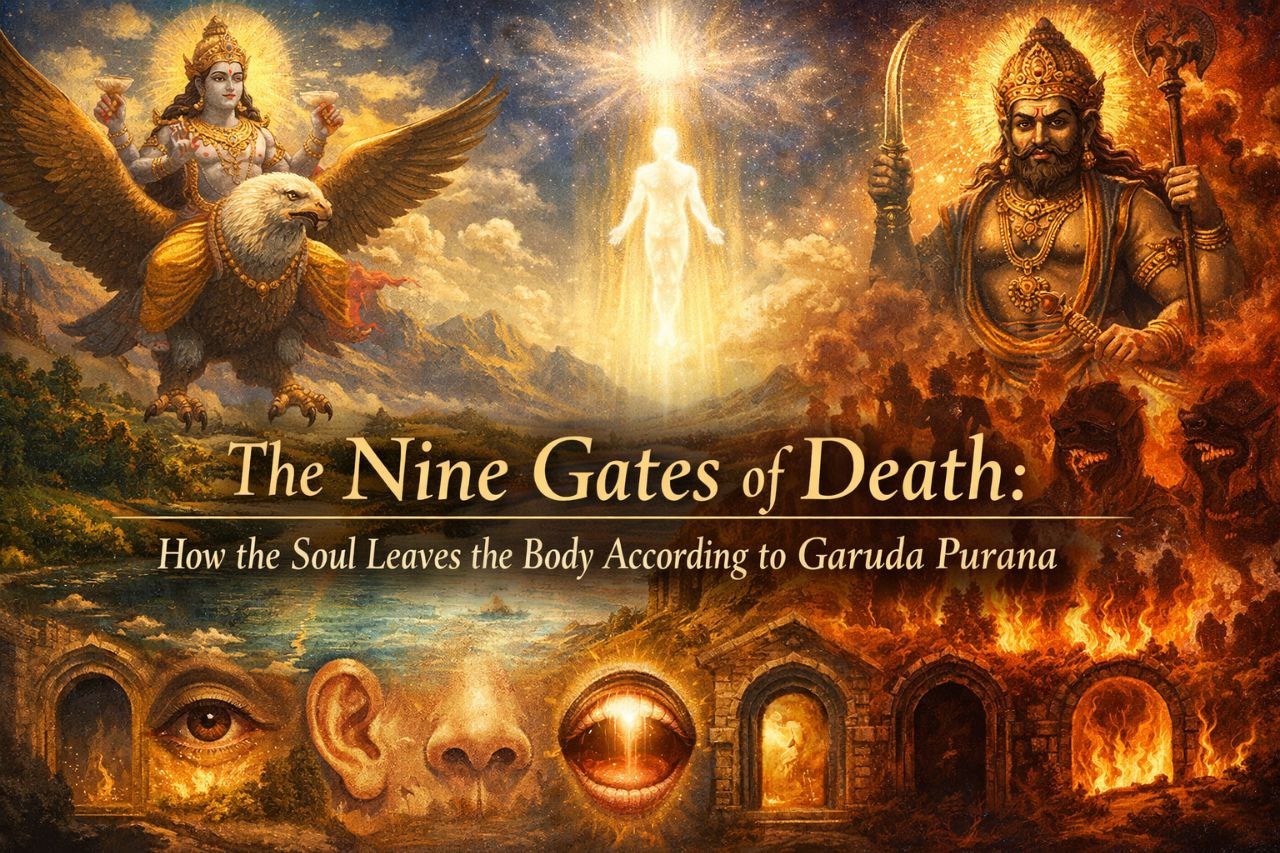
Death Is Not the End, It Is a Revelation
Death has always fascinated humanity, not merely as an event, but as a mystery of consciousness.
Across civilizations, sages, mystics, philosophers, and scriptures have attempted to decode what truly happens when life leaves the body.
In the Hindu spiritual tradition, death is not viewed as annihilation, but as a transition, a passage, and above all, a mirror of how one has lived.
Among all sacred texts that explore this subject, the Garuda Purana stands apart. It does not romanticize death, nor does it reduce it to fear. Instead, it presents death as a cosmic audit of consciousness, where every thought, intention, attachment, and action finds expression, even in the very exit point of the soul.
"Death does not judge you. It only reveals what you have been nurturing within." ~ Adarsh Singh
Let's have a deep, contemplative, and expansive exploration of this sacred knowledge, integrating Garuda Purana, yogic philosophy, karmic law, and spiritual psychology, to understand how the way we live determines the way we leave.
The Garuda Purana: A Scripture of Ultimate Truths
The Garuda Purana is one of the eighteen Mahāpurāṇas and is structured as a dialogue between Lord Vishnu and Garuda, his divine vehicle and devoted disciple. While many Purāṇas focus on cosmology, devotion, and Itihāās, the Garuda Purana dares to explore what most avoid, death, afterlife, judgment, and rebirth.
Its purpose is not to frighten, but to awaken responsibility.
It teaches that:
✽ Life is preparation
✽ Death is transition
✽ Karma is continuity
✽ Liberation is a possibility
Unlike modern perspectives that see death as a medical failure, the Garuda Purana sees death as a spiritual culmination.
"The body dies once, but ignorance dies many times, if you allow wisdom to live." ~ Adarsh Singh
The Concept of the Nine Gates (Nava Dvāra)
According to the Garuda Purana, the human body is a sacred city with nine gates, through which consciousness interacts with the world, and eventually exits it.
The nine gates are:
✽ Two eyes
✽ Two ears
✽ Two nostrils
✽ The mouth
✽ The anal passage
✽ The urinary passage
At the time of death, prāṇa exits through one of these gates, and the chosen gate is not accidental.
It reflects:
✽ Dominant tendencies (Vāsanās)
✽ Karmic orientation of the soul
✽ Level of attachment or detachment
✽ Spiritual maturity of the individual
Death, in this sense, becomes the final expression of one’s inner life.
Prāṇa: The Bridge Between Body and Soul
Prāṇa is not merely breath. It is the life‑intelligence that animates the body and carries karmic memory.
Prāṇa is:
✽ The force that binds soul and body
✽ The carrier of impressions (Saṁskāras)
✽ The vehicle through which consciousness exits matter
As long as prāṇa circulates harmoniously, life continues. When prāṇa withdraws, the body becomes inert. Where prāṇa exits determines the direction of the soul’s journey.
"Prāṇa does not leave in chaos. It leaves following the map you have drawn with your life." ~ Adarsh Singh
Nostrils (Nāsikā): The Most Auspicious Departure
The Garuda Purana considers the exit of prāṇa through the nostrils as highly auspicious.
This occurs when a person has:
✽ Lived a life of devotion and surrender
✽ Performed duties with sincerity and detachment
✽ Maintained purity of thought and intention
✽ Cultivated inner discipline and humility
Such souls do not resist death. Their breath withdraws gently, and prāṇa exits naturally.
This indicates:
✽ Minimal karmic residue
✽ A higher realm of rebirth or spiritual ascent
✽ Grace rather than struggle
The Mouth: A Departure of Dharma and Balance
When prāṇa exits through the mouth, it reflects a life lived in moral equilibrium.
These individuals:
✽ Followed righteousness
✽ Respected social and familial responsibilities
✽ Lived honestly and ethically
✽ Were grounded in values, even if not deeply mystical
This is why many bodies are seen with an open mouth after death.
"A righteous life gives the soul the dignity of a peaceful farewell." ~ Adarsh Singh
Eyes: The Exit of Attachment and Unfinished Longing
When prāṇa exits through the eyes, it signifies strong emotional attachment.
Such individuals:
✽ Were deeply attached to family, possessions, or identity
✽ Desired to continue living intensely
✽ Found it difficult to accept impermanence
The Garuda Purana states that such souls do not willingly leave. Their eyes often remain open or turn upward, reflecting inner resistance.
"Attachment is not love; it is fear wearing the mask of affection." ~ Adarsh Singh
Lower Gates: The Fall of Consciousness
The most distressing exit described in the Garuda Purana is when prāṇa leaves through the anal or urinary passages.
This occurs when a person has:
✽ Lived selfishly and greedily
✽ Been dominated by lust, power, or wealth
✽ Shown no compassion or service
✽ Ignored dharma entirely
Such deaths are marked by fear, loss of control, and inner collapse.
"When life is lived only downward, the soul finds no upward door at death." ~ Adarsh Singh
Beyond the Nine Gates: The Yogic Secret of the Sahasrāra
Yogic scriptures reveal a tenth gateway beyond the physical nine, the Sahasrāra Chakra, located at the crown of the head.
When prāṇa exits through Sahasrāra:
✽ Death becomes Mahāsamādhi
✽ The cycle of rebirth weakens or ends
✽ Consciousness merges into Brahman
This is not death, it is a conscious dissolution.
"The highest death is not an ending, but a return to the source of all beginnings." ~ Adarsh Singh
Normal Death vs Yogic Death
Normal death is unconscious and reactive. Yogic death is aware and intentional.
In normal death:
✽ Prāṇa is pulled out
✽ Ego resists
✽ Consciousness fragments
In yogic death:
✽ Prāṇa is guided
✽ Ego dissolves
✽ Consciousness expands
Living in a Way That Prepares the Right Exit
The Garuda Purana does not ask us to fear death. It asks us to live consciously.
Preparation includes:
✽ Reducing attachments
✽ Practicing self‑awareness
✽ Serving without expectation
✽ Remembering impermanence daily
"Do not ask where your soul will go after death. Ask where your consciousness is living right now." ~ Adarsh Singh
Death Is the Final Truth‑Teller
Death is not random.
Your final breath will speak your life’s truth.
The question is not how long you live, but how aligned you live.
"Live so consciously that even death bows to your awareness." ~ Adarsh Singh
{{DATE}}
 Launch your Graphy