The Paradox of Protest: When Ideology Eats Its Own Logic
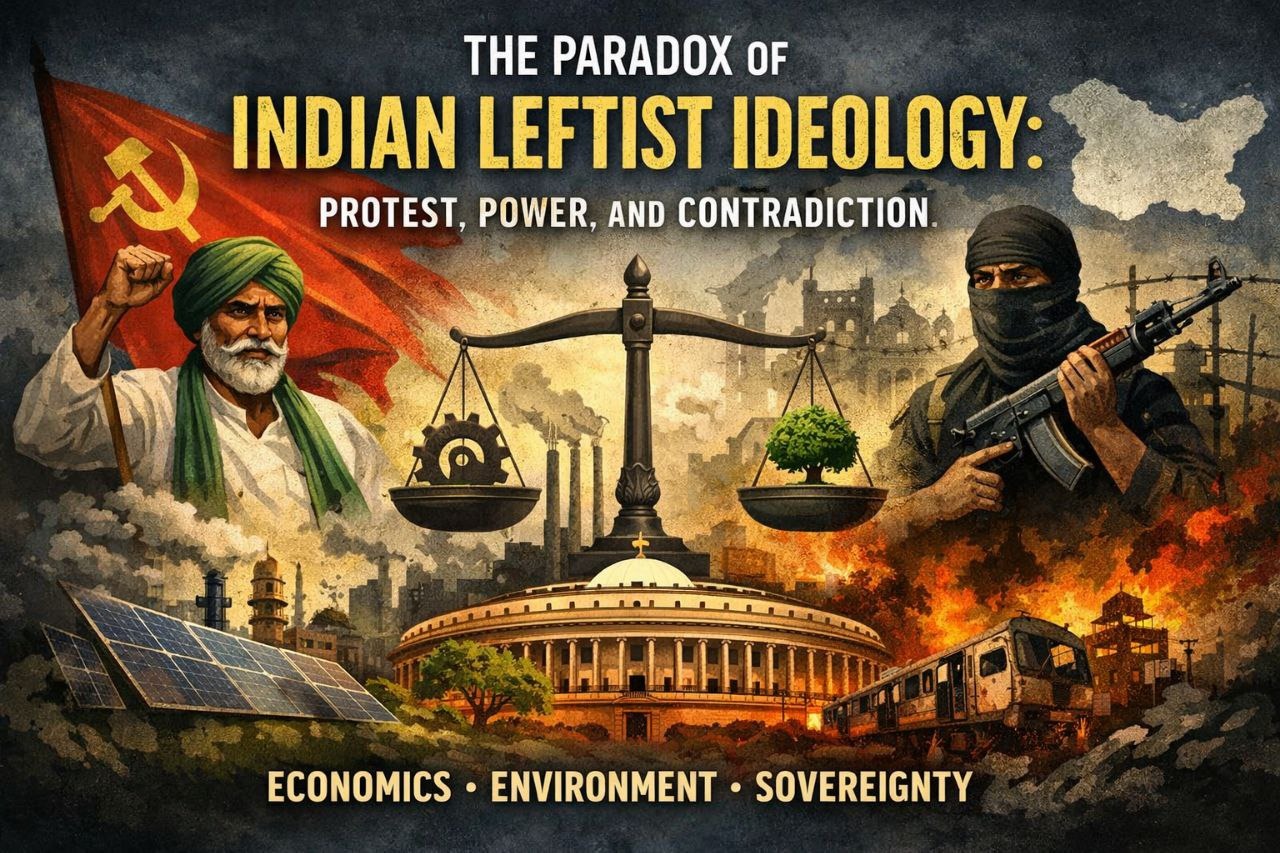
“An age of activism should be an age of clarity. Yet today, noise often replaces nuance, and contradiction masquerades as conviction.” ~ Adarsh Singh
The Theatre of Modern Dissent
Dissent is the conscience of democracy. It is meant to question power, challenge injustice, and protect the moral health of society. India, with its rich intellectual and political traditions, has long respected dissent as a vital democratic force.
However, in the age of social media, especially platforms like Twitter/X, dissent has increasingly become performative.
☛ Outrage travels faster than understanding.
☛ Slogans replace solutions.
☛ Moral positioning overtakes moral reasoning.
This is not a rejection of leftist ideals, nor an attack on protest itself. It is an honest examination of internal contradictions that quietly erode credibility from within.
“A movement collapses not when it is opposed, but when it forgets to question itself.” ~ Adarsh Singh
The Stated Moral High Ground
Contemporary Indian leftist discourse claims to be anchored in noble intentions:
➤ Standing with the marginalized
➤ Advocating social justice
➤ Defending constitutional values
➤ Protecting the environment
➤ Resisting unchecked capitalism
These are essential pillars of a humane society. The problem does not lie in these goals, but in the failure to reconcile them with each other.
When multiple causes are pursued simultaneously without addressing their real-world trade-offs, contradictions emerge, not imposed by opponents, but generated internally.
Farmers: The Symbol of the ‘Real
Farmers, particularly from Haryana and Punjab, have become the moral centerpiece of protest narratives. Their struggles are portrayed as pure, unquestionable, and beyond scrutiny.
Yet agriculture today faces deep structural issues:
➤ Fragmented landholdings
➤ Unsustainable subsidy dependence➤ Inefficient supply chains➤ Environmental degradation due to overuse of water and fertilizers
Supporting farmers without discussing reform turns empathy into romanticism. True advocacy must include modernization, diversification, and integration with broader economic systems.
“Compassion without realism is sentiment; realism without compassion is cruelty. Wisdom lies in balance.” ~ Adarsh Singh
Workers and the Informal Economy: A Real Crisis
The plight of informal workers is real and urgent:
➤ Low wages
➤ Job insecurity➤ Exploitation➤ Absence of social protection
Leftist discourse rightly demands worker emancipation through regulation and state intervention. But here begins a critical contradiction.
Regulation Without Industry: An Economic Impossibility
Workers need jobs. Jobs are created by enterprises. Enterprises require:
➤ Capital investment
➤ Infrastructure
➤ Ease of doing business
➤ Scalable manufacturing
Yet the same ideology that demands worker protection often opposes industrial expansion itself.
This creates a paradox:
➤ You cannot protect workers without creating jobs
➤ You cannot demand higher wages without productivity growth
➤ You cannot regulate industries that never come into existence
Over-regulation without industrial growth does not empower workers, it pushes them deeper into informality.
“You cannot regulate what does not exist, and you cannot distribute what has not been created.” ~ Adarsh Singh
Environmentalism vs Industrial Growth: A False Binary
Environmental protection is non-negotiable. Pollution crises like Delhi’s demand urgent action. But environmentalism has increasingly been framed as anti-development rather than sustainable development.
This framing ignores key realities:
➤ Green manufacturing is possible
➤ Cleaner technologies exist
➤ Poverty cannot be eliminated without growth
Rejecting industrialization outright risks becoming elitist, protecting comfort for a few while denying livelihoods to millions.
“A poor nation cannot afford purity politics; survival itself becomes its first pollutant.” ~ Adarsh Singh
Economic Growth: The Unacknowledged Dependency
There is a constant demand for:
➤ Welfare schemes
➤ Public infrastructure
➤ Healthcare and education
➤ Social safety nets
All of these depend on economic growth.
Yet simultaneously:
➤ Industrialization is opposed
➤ Private capital is demonized
➤ Manufacturing expansion is resisted
Growth is desired, but its engines are rejected. This turns economic discourse into aspiration without execution.
Naxalism: Romanticizing the Anti-State
Support for Naxal movements is often framed as solidarity with the oppressed.
What is overlooked is that Naxalism involves:
➤ Armed insurgency
➤ Rejection of constitutional processes
➤ Destruction of public infrastructure
➤ Civilian displacement
To support the Constitution while endorsing violent anti-state movements is not radical, it is incoherent.
“Revolution that destroys institutions before building alternatives leaves only ruins, not justice.” ~ Adarsh Singh
The Constitution: Symbol or Substance?
The Indian Constitution is frequently invoked as a moral shield. Yet contradictions arise when constitutional values are celebrated while movements rejecting constitutional authority are defended.
The Constitution allows dissent, reform, and protest within its framework. Selective allegiance weakens its moral force.
Kashmir and the Question of Sovereignty
Human rights concerns in Kashmir are real and deserve serious engagement. But when advocacy shifts into endorsing secession while simultaneously defending constitutional supremacy, a logical rupture occurs.
You cannot uphold constitutional unity while advocating territorial disintegration without addressing the contradiction.
“Selective nationalism is as dangerous as blind nationalism; both abandon reason.” ~ Adarsh Singh
The Digital Echo Chamber
Social media rewards outrage over nuance. Algorithms favor emotional absolutism. Over time, ideology turns into identity, and self-critique becomes betrayal.
This is where discourse dies.
Why These Contradictions Matter
These inconsistencies lead to:
➤ Policy paralysis
➤ Loss of public trust
➤ Weakening of genuine movements
➤ Erosion of moral credibility
An ideology riddled with contradictions becomes easy to dismiss, not because its goals are wrong, but because its reasoning appears unserious.
Toward Ideological Maturity
True progress demands:
➤ Internal critique
➤ Intellectual honesty
➤ Acceptance of trade-offs
➤ Willingness to evolve
Standing with the marginalized must also mean enabling economic engines, strengthening institutions, and proposing viable alternatives.
“Ideology must evolve from protest to proposal, from resistance to reconstruction.” ~ Adarsh Singh
Choosing Coherence Over Comfort
The future of meaningful dissent in India lies not in louder outrage, but in deeper thinking.
An ideology that refuses self-examination may win trending hashtags, but it will lose history’s respect.
“When ideology chooses comfort over coherence, it stops changing the world and starts entertaining itself.” ~ Adarsh Singh
{{DATE}}
 Launch your Graphy