 Launch your Graphy
There are no items in your cart
Add More
Add More
| Item Details | Price | ||
|---|---|---|---|

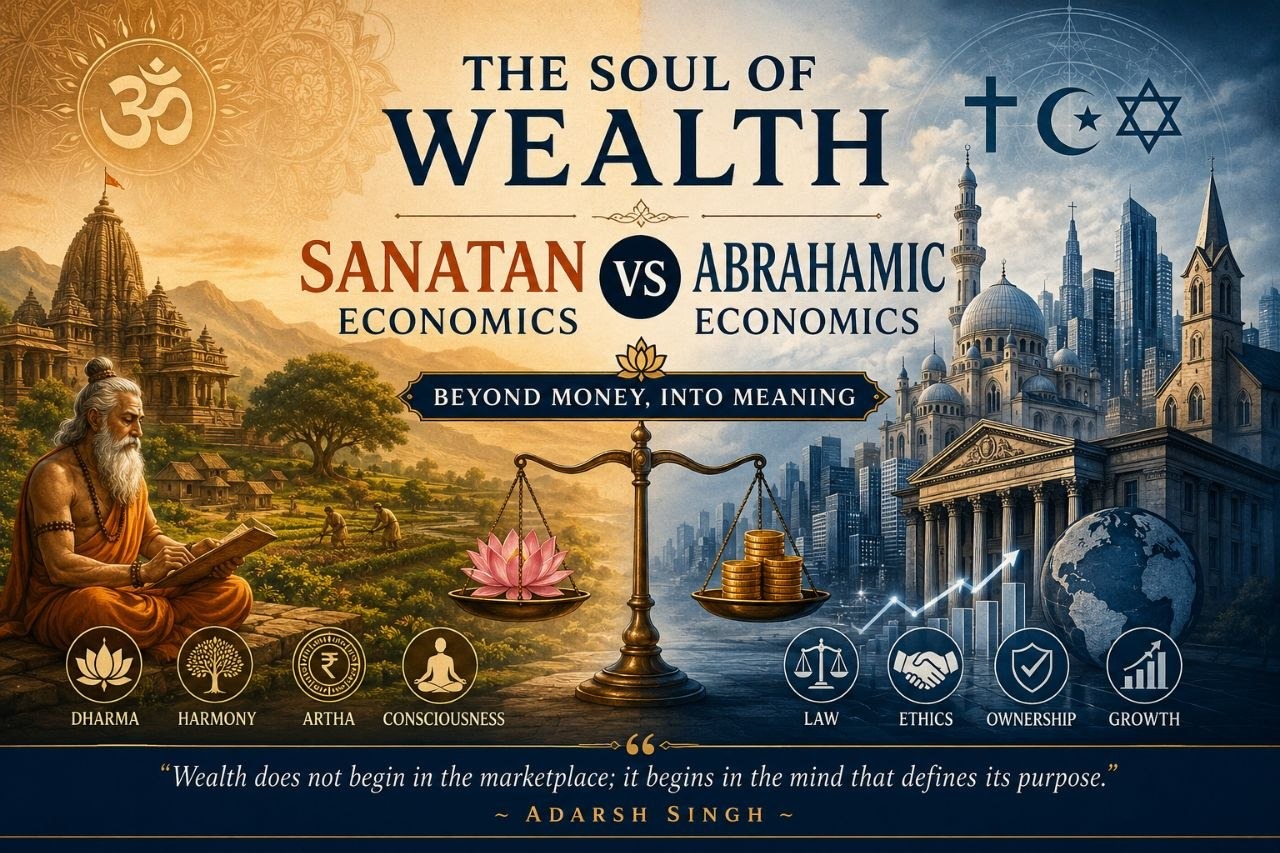
Economics, as it is commonly understood, deals with production, distribution, and consumption. It speaks the language of markets, capital, demand, and supply. Yet, beneath these visible mechanisms lies an invisible architecture; one shaped by philosophy, belief, and consciousness.
Every civilization builds its economic system not merely on resources, but on its understanding of life itself.
Sanatan Economics and Abrahamic Economics are not just two economic models. They are two distinct civilizational expressions of how human beings relate to wealth, power, responsibility, and ultimately, existence.
To compare them is to compare two ways of seeing reality; one rooted in cosmic harmony, the other in divine command.
"Wealth does not begin in the marketplace; it begins in the mind that defines its purpose." ~ Adarsh Singh
At the deepest level, every economic system rests on a metaphysical assumption about reality.
Sanatan Economics, emerging from Sanatan Dharma, views existence as cyclical, infinite, and interconnected. Time does not move in a straight line; it flows in cycles. Creation is not a one-time event but an ongoing process of manifestation, dissolution, and re-manifestation.
In this worldview, nothing is isolated. Every action generates consequences that ripple across time and space. Economics, therefore, cannot be divorced from ethics, ecology, or spirituality.
It becomes a living system, guided by Dharma; the principle that sustains balance in the universe.
In contrast, Abrahamic Economics arises from a linear conception of time and existence. The universe is created at a definite point, governed by a singular divine authority, and moves toward a final judgment.
This creates a fundamentally different psychological orientation:
➤ A beginning and an end
➤ A defined moral path
➤ A sense of urgency and direction
Economics, in this framework, becomes a structured domain governed by divine law.
"Where one system flows with existence, the other aligns with authority." ~ Adarsh Singh
In Sanatan thought, wealth, Artha, is not merely material accumulation. It is a form of energy, a tool that enables life to function meaningfully.
It is one of the four Purusharthas, yet it is never independent. It must always operate within Dharma.
This creates a subtle but powerful discipline: wealth is pursued, but not at the cost of balance.
The pursuit of wealth becomes an art of alignment.
In Abrahamic traditions, wealth carries a strong moral undertone. It is often seen as a test of character, a measure of how faithfully one lives according to divine expectations.
Wealth can elevate or degrade, depending on its use. It becomes a field where obedience, humility, and responsibility are constantly evaluated.
Thus, while Sanatan Economics treats wealth as instrumental, Abrahamic Economics treats it as evaluative.
"The value of wealth is not in what it builds outside, but in what it preserves within." ~ Adarsh Singh
Ownership is one of the most defining aspects of any economic system.
Sanatan Economics introduces a profound psychological insight:
➤ Ownership is ultimately an illusion.
➤ Everything that exists is part of a larger cosmic order.
➤ The individual is not an owner, but a participant and custodian.
This does not eliminate possession, it transforms its meaning. Wealth is held temporarily, to be used responsibly, shared wisely, and released gracefully.
This idea gave rise to the concept of trusteeship, later articulated in modern times as a moral economic philosophy.
In Abrahamic systems, ownership is more concrete. It is defined, protected, and legitimized.
Property rights form the backbone of economic stability. Individuals have the right to acquire, build, and transfer wealth.
However, this right is not without accountability. Ownership exists within a moral framework where actions are judged by divine standards.
Thus, Sanatan Economics dissolves ownership into conscious responsibility, while Abrahamic Economics formalizes it into ethical entitlement.
"True ownership begins where the illusion of possession ends." ~ Adarsh Singh
Both systems recognize the importance of economic activity, but they diverge sharply in how they address desire.
In Sanatan Economics, desire itself is not condemned. It is acknowledged as a natural force. However, unchecked desire, Lobha (greed), is seen as destructive.
The emphasis is on inner mastery.
Profit is acceptable, even necessary, but it must not disturb inner equilibrium. The goal is not suppression, but refinement of desire.
In Abrahamic traditions, desire is often framed within moral boundaries defined by divine law. Certain forms of profit, especially those involving exploitation, are explicitly prohibited.
The system relies on clear external guidelines to regulate behavior.
The distinction is subtle but significant:
➤ One cultivates discipline from within
➤ The other enforces discipline from without
"Profit expands life; greed consumes it." ~ Adarsh Singh
The way a society distributes wealth reveals its deepest values.
In Sanatan Economics, giving, Daan, is an expression of consciousness. It arises naturally when an individual recognizes the interconnectedness of life.
There is no compulsion, because the system assumes that awareness leads to generosity.
Giving becomes a spiritual act, purifying the giver as much as it benefits the receiver.
In Abrahamic traditions, distribution is institutionalized. Mechanisms such as mandatory charity ensure that wealth circulates within society.
This creates a structured safety net, reducing inequality through defined systems.
The difference lies not in the act of giving, but in its source:
➤ One flows from inner awakening
➤ The other is ensured through external obligation
"When giving flows from the heart, it purifies; when it flows from obligation, it stabilizes." ~ Adarsh Singh
Time shapes behavior more than we realize.
Sanatan thought views time as cyclical. This creates a mindset of patience, continuity, and sustainability.
Decisions are made with awareness of long-term consequences, often spanning generations.
Economic activity becomes rhythmic rather than aggressive.
In contrast, Abrahamic thought views time as linear. This introduces urgency, direction, and a sense of mission.
Economic systems influenced by this view tend to prioritize growth, expansion, and measurable progress.
This has historically contributed to rapid industrial and technological development.
Thus, one system nurtures endurance, while the other drives acceleration.
"Cycles teach wisdom; lines demand speed." ~ Adarsh Singh
The relationship between economy and nature is one of the most critical questions of our time.
In Sanatan Economics, nature is sacred. It is not merely a resource, it is a manifestation of the divine.
This creates a natural restraint on exploitation. Economic activity must align with ecological balance.
In Abrahamic traditions, nature is often viewed as a creation meant for human use, accompanied by the responsibility of stewardship.
This can lead to responsible management, but it also opens the possibility of over-exploitation when stewardship is misunderstood.
The difference is one of perception:
➤ Sacredness inspires restraint
➤ Utility enables expansion
"When nature is sacred, economics becomes gentle." ~ Adarsh Singh
The ultimate aim of life determines the structure of economic behavior.
In Sanatan thought, the goal is Moksha; liberation from the cycle of birth and death. Economics is a supporting tool in this journey, not the destination.
In Abrahamic traditions, the goal is salvation. Economic actions contribute to a moral record that influences one’s final destiny.
Thus, economics becomes part of a cosmic evaluation system.
One system seeks transcendence, the other prepares for judgment.
"What you seek at the end defines how you earn at the beginning." ~ Adarsh Singh
These philosophical differences have shaped the evolution of entire civilizations.
Sanatan-influenced societies historically emphasized balance, sustainability, and spiritual integration. Economic growth was present, but not pursued at the cost of harmony.
Abrahamic-influenced societies developed strong institutional frameworks, legal systems, and structured economies. This enabled scalability, organization, and rapid expansion.
Modern capitalism, in many ways, reflects this structured, goal-oriented mindset.
However, it has also led to challenges such as overconsumption, environmental degradation, and psychological stress.
At the same time, purely consciousness-driven systems can struggle with consistency and scalability in large, complex societies.
"Every strength, when isolated, becomes a limitation." ~ Adarsh Singh
The future of economics lies not in choosing one system over the other, but in integrating their strengths.
A truly evolved economic model would combine:
➤ The inner awareness of Sanatan wisdom
➤ The structural clarity of Abrahamic systems
It would create a framework where:
➤ Wealth is generated ethically
➤ Distribution is both conscious and structured
➤ Growth is balanced with sustainability
➤ Individuals evolve while institutions remain strong
Such an economy would not only create prosperity, it would create meaning.
"The next evolution of economics will not be about more wealth, but about better wisdom." ~ Adarsh Singh
India today stands at a rare inflection point; demographically young, technologically capable, and civilizationally rooted. The question is not whether India can grow, but how it chooses to grow.
A Dharmic Economic Model does not reject markets, capital, or globalization. It reorients them around Dharma, ensuring that growth remains aligned with balance, responsibility, and long-term wellbeing.
"A nation prospers not when wealth increases, but when wisdom governs wealth." ~ Adarsh Singh
Dharma-Aligned Policy Making
Public policy must be evaluated not only on efficiency, but on ethical coherence and long-term harmony. Regulatory frameworks should integrate environmental sustainability, social equity, and cultural continuity.
Artha with Accountability
Wealth creation must be encouraged, but linked with responsible deployment. Corporate success should be measured not only by profit, but by contribution to society.
Decentralized Prosperity
Inspired by traditional village economies, India can promote localized economic ecosystems, empowering districts and clusters to become self-sustaining while remaining globally connected.
Spiritual Literacy in Economic Thinking
Education systems should integrate value-based economic understanding, ensuring that future leaders balance ambition with awareness.
"When economics forgets ethics, growth becomes extraction." ~ Adarsh Singh
A. Policy and Governance Layer
Incentivize sustainable industries through tax benefits and regulatory support
Strengthen frameworks like ESG (Environmental, Social, Governance) with Dharmic benchmarks
Encourage ethical compliance beyond legal minimums
B. Corporate and Institutional Layer
Move from shareholder capitalism to stakeholder consciousness
Embed trusteeship principles in corporate governance
Align executive incentives with long-term value creation rather than short-term gains
C. Grassroots and Community Layer
Revive local crafts, agriculture, and traditional knowledge systems
Promote cooperative models and community ownership structures
Enable financial inclusion with ethical microfinance frameworks
D. Individual Consciousness Layer
Encourage mindful consumption
Promote financial discipline rooted in balance, not fear or greed
Integrate meditation and self-awareness practices into leadership development
"A conscious individual is the smallest unit of a powerful economy." ~ Adarsh Singh
Agriculture
Shift toward natural and regenerative farming models. Align food systems with health, ecology, and sustainability rather than pure yield maximization.
Finance
Develop financial instruments that discourage speculative excess and encourage productive, value-creating investments.
Technology
Leverage digital infrastructure for inclusion, transparency, and efficiency; while ensuring it does not disconnect humans from reality.
Urban Development
Design cities that balance infrastructure with livability, culture, and environmental harmony.
"Progress that disconnects us from life is not progress, it is acceleration without direction." ~ Adarsh Singh
A Dharmic Economic Model must avoid two extremes:
Pure idealism without structure
Pure structure without consciousness
India’s opportunity lies in creating a hybrid system where:
Laws ensure minimum ethical standards
Consciousness inspires higher standards
This creates both stability and evolution.
The world today faces crises of inequality, environmental degradation, and psychological stress.
A Dharmic approach offers:
➤ A sustainable growth paradigm
➤ A balance between material and spiritual wellbeing
➤ A framework for conscious capitalism
India, by aligning its economic model with its civilizational roots, can offer a new global template.
"The future will not belong to the richest economies, but to the most balanced ones." ~ Adarsh Singh
After a deep and unbiased exploration, a critical realization begins to surface:
Sanatan Economics is not merely different; it is fundamentally more complete as a framework for long-term human and planetary wellbeing.
This is not a dismissal of Abrahamic systems, which have provided structure, discipline, and institutional strength. However, when evaluated across deeper dimensions; sustainability, psychological harmony, ecological balance, and spiritual evolution, Sanatan Economics demonstrates a broader and more integrated vision.
"Superiority is not in domination, but in depth, balance, and timeless relevance." ~ Adarsh Singh
1. Alignment with Natural Law
Sanatan Economics is rooted in Dharma, which represents universal balance. It does not impose order, it discovers and aligns with it.
Abrahamic systems, while morally structured, often operate through imposed commandments. This creates compliance, but not necessarily understanding.
Sanatan Economics therefore produces organic harmony, whereas Abrahamic systems often produce regulated order.
2. Sustainability Over Extraction
Because nature is sacred in the Sanatan worldview, exploitation is inherently limited. Economic activity is guided by restraint and reverence.
In contrast, the Abrahamic interpretation of nature as a resource, though moderated by stewardship, has historically enabled large-scale extraction when misapplied.
Sanatan Economics is thus inherently aligned with long-term ecological sustainability, making it more relevant in today’s environmental crisis.
"What you revere, you protect. What you use, you eventually exhaust." ~ Adarsh Singh
3. Inner Regulation vs External Control
Sanatan Economics is built on self-regulation through consciousness. It aims to elevate the individual so that ethical behavior becomes natural.
Abrahamic Economics relies more heavily on external rules and enforcement.
While external control can maintain order, it cannot guarantee inner transformation. Without inner evolution, systems remain dependent on supervision.
Sanatan Economics reduces this dependency by cultivating self-governing individuals.
4. Integration of Material and Spiritual Dimensions
Sanatan thought seamlessly integrates Artha (wealth) with Dharma and Moksha. This ensures that material success does not come at the cost of spiritual decline.
Abrahamic systems often maintain a subtle tension between material pursuit and spiritual aspiration, requiring continuous moral negotiation.
Sanatan Economics resolves this by placing wealth within a larger existential framework, rather than isolating it.
5. Long-Term Civilizational Stability
A system driven by balance, restraint, and awareness is inherently more stable over long periods.
Systems driven by expansion and urgency, while powerful in the short term, can create cycles of boom, excess, and correction.
Sanatan Economics fosters continuity and resilience, making it more suitable for sustainable civilization-building.
"Speed builds empires; balance sustains civilizations." ~ Adarsh Singh
6. Psychological Wellbeing and Fulfillment
Sanatan Economics does not equate wealth with happiness. It recognizes the limits of material accumulation and emphasizes inner contentment.
This reduces stress, comparison, and perpetual dissatisfaction.
In contrast, systems focused on achievement and accumulation can inadvertently fuel anxiety, competition, and identity tied to wealth.
Sanatan Economics therefore supports holistic human wellbeing, not just financial success.
7. Universality and Timelessness
Because Sanatan principles are based on universal laws rather than historical events or specific commandments, they are inherently adaptable across time and context.
This makes Sanatan Economics timeless and universally applicable, rather than context-bound.
"That which aligns with truth does not age." ~ Adarsh Singh
Sanatan Economics and Abrahamic Economics are not competing ideologies. They are complementary insights into the human condition.
One teaches us how to align with existence. The other teaches us how to organize within it.
The real transformation will come when humanity moves beyond division and embraces synthesis.
When structure is guided by wisdom, and wisdom is supported by structure, a new kind of civilization becomes possible.
A civilization where wealth is not merely accumulated, but elevated into a force for collective evolution.
"When wealth serves wisdom, civilization rises; when wisdom serves wealth, civilization falls." ~ Adarsh Singh
{{DATE}}
{{AUTHOR}}
A Lifelong Seeker/believer of......
Sanatan Dharma | Spirituality | Numerology | Energy Healing, Ayurveda, Meditation |Mind & Motivation | Money & Markets | Perennial Optimist | Politics & Geopolitics
Founder of iSOUL ~ Ideal School of Ultimate Life
Adarsh Singh empowers individuals to live purposefully by integrating timeless wisdom with practical tools. With 21+ years in finance and a deep connection to spirituality, his teachings blend Mind, Matter, Money and Meaning to help people create a truly fulfilling life.