Time Beyond Time: How Sanātan Dharma Sees the Flow of Kāla Across Lokas
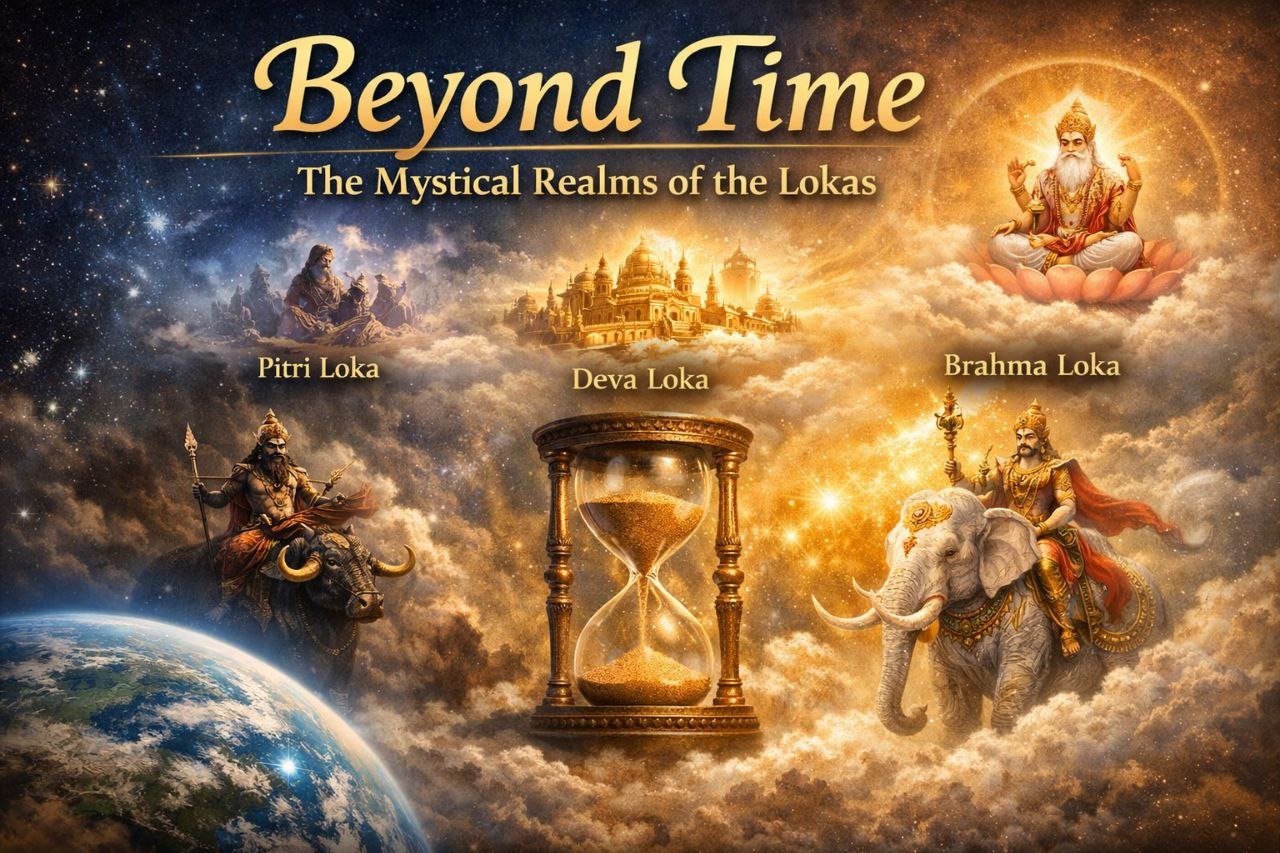
Time is one of the greatest mysteries humanity has ever tried to understand. We measure it with clocks, divide it into seconds and years, complain about its scarcity, and yet rarely pause to question its true nature. Is time absolute? Does it flow uniformly everywhere? Or is time a living principle that changes its rhythm depending on the plane of existence?
Sanātan Dharma offers one of the most profound and expansive answers ever conceived. In its cosmology, time, Kāla, is not merely a mechanical sequence of moments, but a cosmic intelligence that operates differently across realms of existence. What appears as centuries in one realm may pass as a single day in another. What feels like an entire lifetime to humans may be just a fleeting instant for higher beings.
“Time does not bind the universe; it reveals the level of consciousness experiencing it.” ~ Adarsh Singh
Let's explore the Purāṇic understanding of time across lokas, Manuṣya, Pitṛ, Deva, and Brahmā, and then extends far beyond, into the philosophical, spiritual, and existential implications of this timeless wisdom.
Kāla: The Living Principle of Time
In Sanātan thought, time is not an accident of physics. It is Kāla Purusha, a cosmic principle that governs creation, preservation, and dissolution. Kāla is neither cruel nor compassionate; it is precise, rhythmic, and perfectly aligned with cosmic order (ṛta).
Time is described as cyclical, not linear. Creation emerges, sustains itself, dissolves, rests, and then arises again. This rhythm is not uniform across all planes of existence. Just as gravity behaves differently in space than on Earth, time behaves differently in different lokas.
Modern science has only recently begun to touch this truth through relativity theory. Sanātan Dharma articulated it thousands of years ago, not through equations, but through lived cosmic insight.
Manuṣya Loka: The Human Experience of Time
Human beings live in Manuṣya Loka, where time feels rigid, urgent, and irreversible. Days pass into months, months into years, and years into a lifetime that feels painfully short.
In this realm, time is experienced psychologically as much as physically. Joy seems to shorten it, sorrow stretches it unbearably, and awareness alters it completely. Yet from a cosmic perspective, human time is merely a reference unit, a baseline against which other realms are understood.
Humans are uniquely positioned. Though bound by time, they possess the capacity to transcend its psychological grip through awareness, meditation, and wisdom.
“Human life is short not because time is limited, but because awareness is.” ~ Adarsh Singh
Pitṛ Loka: Where Time Breathes in Seasons
Pitṛ Loka, the realm of ancestors, operates on a fundamentally different temporal rhythm. In Purāṇic understanding, one full human year equals a single day and night in Pitṛ Loka.
The daytime of the Pitṛs corresponds to Uttarāyaṇa (the Sun’s northern course), while their night corresponds to Dakṣiṇāyaṇa (the southern course). This is why ancestral rites are deeply connected to solar movement and seasonal cycles.
To the Pitṛs, our decades pass as brief phases. To us, their existence feels distant and timeless. This asymmetry is not symbolic, it is literal within Sanātan cosmology.
This understanding transforms how we view death. The departed are not frozen in eternity; they are living within another rhythm of time.
“Death is not the end of time, it is the end of our attachment to one scale of it.” ~ Adarsh Singh
Deva Loka: Time as Expansion of Joy
Deva Loka, often called Svarga, functions on an even more expanded time scale. One human year equals one day for the Devas. Three hundred and sixty such human years form one Deva year.
Twelve thousand Deva years together constitute a Mahāyuga, the cycle of Satya, Tretā, Dvāpara, and Kali Yugas. What humans experience as vast epochs are merely cycles within Deva timekeeping.
Life in Deva Loka is not immortal in the absolute sense, but it is extraordinarily prolonged. Pleasure, harmony, and refined experience stretch time itself, making existence feel spacious and abundant.
Yet even Devas are bound by time. Their merit exhausts itself. Their joy is finite. Their fall is inevitable.
“Even heaven is temporary when consciousness mistakes comfort for liberation.” ~ Adarsh Singh
Beyond Svarga: The Higher Lokas
Above Deva Loka lies subtler realms: Mahar Loka, Jana Loka, Tapa Loka, and Satya Loka. Here, time becomes increasingly abstract. Existence is less physical, more luminous, and profoundly awareness-based.
In these realms, time is not measured by movement of celestial bodies, but by states of consciousness. Change happens, but without decay. Duration exists, but without urgency.
Sages residing in these lokas witness the rise and fall of universes as passing phenomena. What humans call eternity is, to them, a long afternoon.
Brahmā Loka: Where Universes Breathe
At the pinnacle of manifest existence lies Brahmā Loka, also known as Satya Loka. Here, time reveals its most staggering proportions.
One day of Brahmā, called a Kalpa, equals 4.32 billion human years. One night of Brahmā is of equal length. Three hundred and sixty such days form a year of Brahmā. One hundred such years define the lifespan of Brahmā himself.
During Brahmā’s day, universes manifest. During his night, they dissolve into unmanifest potential. Creation and dissolution are not catastrophic events; they are routine breaths of cosmic existence.
Even Brahmā, the creator of the universe, is not eternal.
“When even the creator has a lifespan, humility becomes the highest wisdom.” ~ Adarsh Singh
The Cyclical Nature of Time
Sanātan Dharma rejects the idea of a single creation or a final end. Time moves in cycles: Yugas, Manvantaras, Kalpas, and Mahāpralayas.
Civilizations rise and fall. Species emerge and disappear. Worlds manifest and dissolve. Nothing is accidental; nothing is permanent.
This cyclical view frees the mind from both nihilism and obsession. There is meaning, but no finality. There is purpose, but no permanence.
Consciousness as the Ultimate Timekeeper
The most revolutionary insight of Sanātan Dharma is this: time is experienced, not imposed. Consciousness determines the experience of time.
In deep meditation, a few minutes can feel like hours or vanish altogether. In suffering, seconds feel unbearable. In love, years disappear unnoticed.
Liberation (mokṣa) is not about escaping the universe. It is about transcending time by realizing the timeless Self (Ātman).
“The one who knows the Self no longer asks what time it is.” ~ Adarsh Singh
Why This Wisdom Matters Today
In a world obsessed with productivity, deadlines, and speed, Sanātan cosmology offers a radical recalibration. It reminds us that urgency is a psychological condition, not a cosmic law.
Understanding cosmic time humbles ego, dissolves fear of death, and restores patience. It places human ambition in perspective without diminishing human potential.
We are not insignificant, we are situated. We are not powerless, we are participants in a vast, intelligent rhythm.
Living in Alignment with Kāla
To live wisely is not to defeat time, but to align with it. Action in the right moment (kāla-yoga) becomes effortless. Resistance to time creates suffering; harmony with it creates grace.
When we honor cycles, of rest and action, silence and speech, creation and withdrawal, we move closer to cosmic intelligence.
“Wisdom is knowing when to act; enlightenment is knowing when not to.” ~ Adarsh Singh
Beyond All Clocks
Sanātan Dharma does not ask us to abandon the world, nor does it hypnotize us with heaven. It invites us to see existence from a cosmic altitude where fear dissolves and perspective is restored.
Time is not our enemy. It is our teacher. And beyond time stands the timeless, waiting not at the end of existence, but at the center of our own awareness.
“When you stop running from time, you discover that eternity is always within you.” ~ Adarsh Singh
{{DATE}}
 Launch your Graphy