Touching the Universe: The Sacred Science of Eating With Hands in Sanātan Dharma
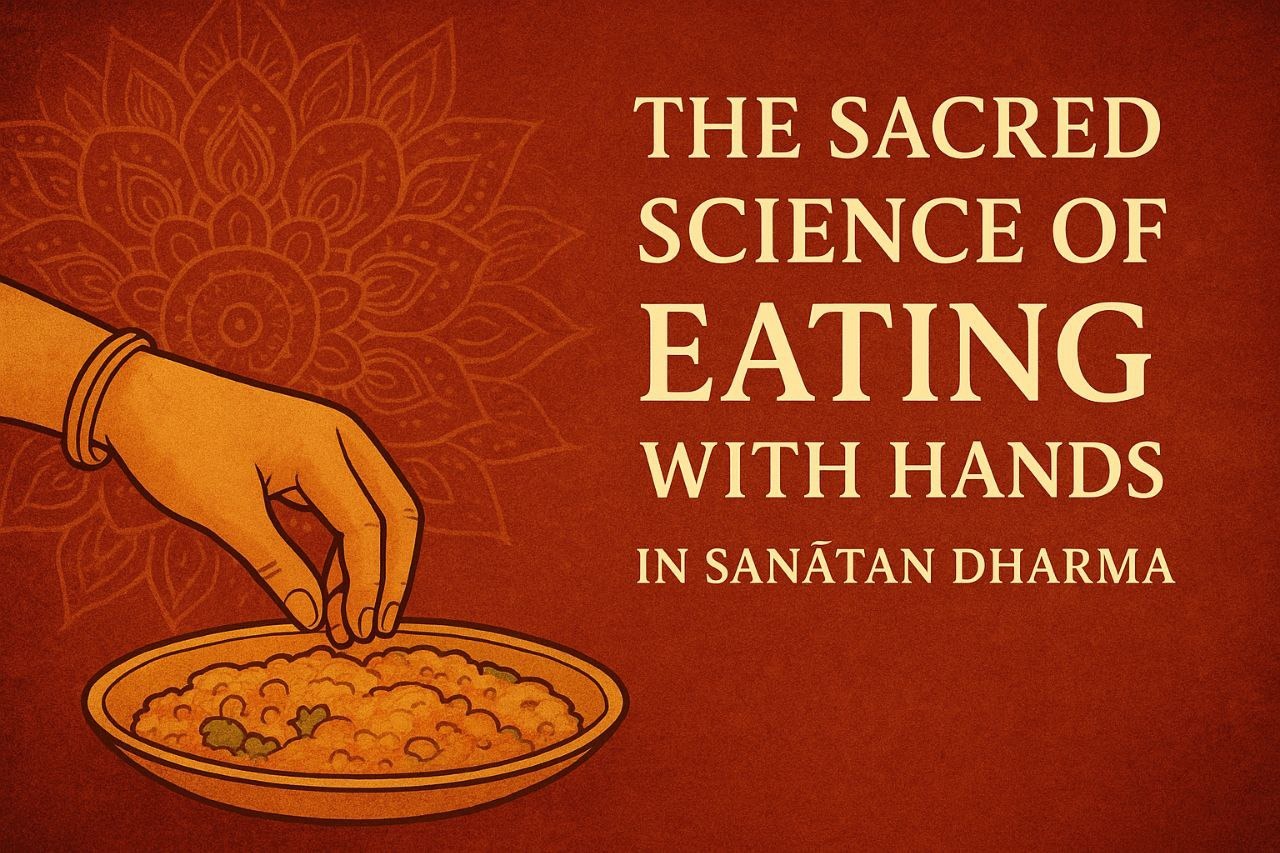
“When you touch your food with your five fingers, creation itself touches you back.” ~ Adarsh Singh
Eating is the most universal act of human life, but in Sanātan Dharma, it is far more than feeding the body.
It is a yajña, a sacred exchange between the human being and the cosmos. It is a spiritual conversation carried out not through words, but through touch, fragrance, warmth, and awareness.
For thousands of years, Hindu civilization has taught that one should eat with one’s hands, not out of habit, but out of profound cosmic alignment.
Each finger corresponds to one of the Panchamahābhūtas, the five great elements that compose the universe; and when they touch anna (food), they awaken the five Jñānendriyas, preparing the whole being, body, prāṇa, mind, and ātmā, to receive nourishment in its highest form.
Let's dive deep into the scriptural basis, the Ayurvedic wisdom, the philosophical significance, and the energetic science behind this ancient practice, expanding it across dimensions rarely discussed in modern times.
{1} Eating as a Sacred Yajña in Hindu Thought
In the worldview of Sanātan Dharma, the human body is not merely biological, it is a temple, and every act that sustains it is sacred.
The Vedic vision is beautifully summarized in the Upanishadic declaration:
“Annam Brahma” - Food is the Divine. (Taittirīya Upaniṣad, Anandavalli)
If food is Brahman, then receiving it must be an act of reverence, not mechanical consumption.
Eating is considered a yajña, a sacred offering
The Yajurveda and the Gṛha Sūtras refer to daily eating as a continuation of the morning and evening fire rituals. Just as the priest offers ghee into Agni, we offer food into our internal fire, Jatharāgni, the digestive sacred flame.
Thus, the act of lifting food with bare hands becomes analogous to lifting an offering to the cosmic fire within.
“The hand is the original ladle of the human yajña.” ~ Adarsh Singh
This symbolic depth forms the foundation for why Hindu Dharma emphasizes eating with the hands.
{2} Manusmṛiti: Eating with Hands is the Natural, Pure Method
Few people know that the practice is directly mentioned in one of the foundational texts of Dharma Śāstra, the Manusmṛiti.
Manusmṛiti: हस्तेनैव अश्नीयात् ~ “One should eat with the hand.”
हस्तेनैवाश्नीयाद् भुक्तं शुद्धिं गच्छति देहिनाम्।
करकृतं हि भोजनं सद्यः शुद्धिकरं स्मृतम्॥
मनुष्य द्वारा हाथ से खाया गया भोजन पवित्र माना जाता है और शरीर को शुद्ध करता है।क्योंकि हाथ से किया गया भोजन तुरंत शुद्ध करने वाला बताया गया है। {The food eaten with one’s own hand is considered pure and brings purification to the body. For the meal taken with the hand is remembered as immediately purifying.}
The instruction is simple but profound: the hand is the natural instrument for receiving food. No intermediary, no metal, stone, or manufactured tool, should interrupt the intimate connection between the eater and the eaten.
Why? Because the human hand is not just a biological structure, it is a spiritual instrument designed for awareness.
{3} Ayurveda: Eating With Hands Activates the Jñānendriyas
Ayurveda, humanity’s oldest and most complete health science, advocates hand-eating for reasons both subtle and scientific.
Charaka Saṃhitā (Sutrastana) teaches:
Food should be eaten with the hands, not with instruments, because the hands awaken the senses and prepare the body for digestion.
According to Ayurveda:
✽ Touch activates the Jñānendriyas
The five senses come alive simultaneously when we eat with hands:
✽ Touch of temperature and texture
✽ Smell of rising aroma
✽ Sight of colors
✽ Taste of the first morsel
✽ Subtle hearing of crunch or softness
This multisensory preparation signals the body to:
✽ Release digestive enzymes
✽ Activate saliva
✽ Balance agni (digestive fire)
✽ Harmonize prāṇa Vāyu
✽ Hands communicate with the gut-brain axis
Modern science confirms that sensory awareness before eating improves:
✽ Digestion
✽ Metabolism
✽ Satisfaction signals
✽ Mindful eating patterns
Ayurveda knew this thousands of years ago.
{4} The Panchamahābhūtas Mapping: Fingers as Elements of the Cosmos
In Sanātan Dharma, the body is a miniature universe (microcosm), and nowhere is this symbolism more explicit than the human hand.
Tantric and yogic texts such as:
✽ Mudra Śāstra
✽ Shiva Saṃhitā
Hatha Yoga Pradīpikā explains that each finger corresponds to one of the five great elements.
The Pancha Mahabhuta Correspondence
✽ Thumb – Agni (Fire)
Controls heat, digestibility, transformation.
✽ Index Finger – Vāyu (Air)
Controls movement, circulation, sensory awakening.
✽ Middle Finger – Ākāsha (Ether)
Controls space, expansion, subtle perception.
✽ Ring Finger – Pṛithvī (Earth)
Controls stability, grounding, nourishment.
✽ Little Finger – Jala (Water)
Controls cohesion, fluidity, emotional balance.
This elemental mapping is well-established in yogic mudra science.
When these five fingers touch food:
✽ The Agni of the thumb awakens digestive fire
✽ The Vāyu of the index brings prāṇa into the act
✽ The Ākāsha of the middle finger creates space in the mind
✽ The Pṛithvī of the ring finger grounds the body
✽ The Jala of the little finger preserves fluid harmony
This is why eating with hands balances the doshas
It naturally regulates:
✽ Vata
✽ Pitta
✽ Kapha
The hand is nature’s original Ayurvedic tool.
“Your fingers are not just fingers, they are the five elements remembering who you are.” ~ Adarsh Singh
{5} Food Becomes Prasādam When Touched by the Elements
The moment your fingers touch food, and your senses awaken, something sacred happens:
Food becomes Prasādam.
Not because it is offered in a temple, but because it is received with awareness, respect, and elemental harmony.
✽ Touch itself is an act of consecration.
✽ Awareness itself is a form of blessing.
✽ The hand itself is a mudra of gratitude.
Modern life has turned eating into a mechanical act, but in Sanātan Dharma, it is a sacred invitation into the present moment.
{6} Upanishads: The Subtle Psychology of Eating With Awareness
The Upanishads consider food the foundation of life and consciousness.
Taittirīya Upaniṣad (Annamaya Kosha teaching)
Human beings exist in five layers:
✽ Annamaya - food body
✽ Prāṇamaya - energy body
✽ Manomaya - mind body
✽ Vijñānamaya - wisdom body
✽ Ānandamaya - bliss body
Eating with hands nourishes all five koshas because:
✽ Touch awakens prāṇa
✽ Aroma awakens mind
✽ Awareness awakens buddhi
✽ Gratitude awakens bliss
That is why the Upanishads repeat:
✽ Food is the first teacher.
How we treat our food reflects how we treat our life.
{7} Gṛha Sūtras: Eating as a Continuation of the Daily Yajñas
The Apastamba and Baudhāyana Gṛha Sūtras describe Bhojana Vidhi, the ritual of eating.
They classify eating as: An act of purity
✽ A sacred continuation of the morning fire ritual
✽ A moment of awareness
✽ A duty to the self
The hand (Kara) is repeatedly mentioned as:
✽ The receiver of blessings
✽ The giver of offerings
✽ The mediator between human and divine
Thus, using the hand for eating is consistent with the entire Vedic ritual framework.
{8} The Science of Touch: Why Hands Are Energetic Sensors
Modern neuroscience reveals something astonishing:
The fingertips contain some of the highest nerve endings in the entire body.
This means:
✽ The hand learns food before the mouth does
✽ The body prepares for digestion through sensory forecasting
✽ Temperature sensitivity prevents overeating or indigestion
✽ Texture awareness builds mindful eating habits
Even modern dieticians now recommend:
✽ Slowing down
✽ Touching your food
✽ Eating with awareness
What Sanātan Dharma intuited intuitively and spiritually is now validated scientifically.
{9} Eating with Hands and Mindfulness: The Yogic Connection
Yoga is not just about postures, it is a philosophy of awareness.
When we eat with our hands, we enter the yogic state of:
✽ Ekāgratā - single-pointed attention
✽ Saucha - internal purity
✽ Santosha - contentment
✽ Pratyāhāra - withdrawal of senses into mindful engagement
The hand becomes a yogic tool for:
✽ Grounding
✽ Slowing down
✽ Feeling the textures
.....receiving nourishment consciously
This is mindful eating in its original, ancient form.
{10} Why Eating with Hands Nourishes the Ātmā
Beyond body and mind, eating with hands nourishes the core of our being.
It builds:
✽ Gratitude
✽ Humility
✽ Presence
✽ Connection
✽ Intimacy with nature
✽ Spiritual grounding
When we eat with our hands, we transform the act of survival into an act of devotion.
“The simplest act becomes divine when done with presence.” ~ Adarsh Singh
{11} Cultural Continuity: Why Hindu Dharma Alone Preserves This Wisdom
No other civilization has preserved the cosmic symbolism of eating the way Hindu Dharma has.
In Hindu tradition:
✽ Eating is a ritual
✽ Food is sacred
✽ The hand is a sacred tool
✽ The five elements participate in the act
Other traditions may speak of mindful eating or gratitude before meals, but only Sanātan Dharma sees eating itself as a dialogue with creation.
This is why it must be preserved and taught to the next generation.
{12} Teaching Children: Reviving a Sacred Tradition
Our children today are growing up in a world of screens, rushing, and disconnection. Teaching them to eat with their hands is not just cultural, it is psychological and spiritual grounding.
It teaches them:
✽ To feel their food
✽ To eat slowly
✽ To be grateful
✽ To be present
✽ To honour the body
✽ To respect nature
It gives them a deeper connection with heritage, health, and consciousness.
Eating With Hands Is A Return to Wholeness
✽ Eating with our hands is not “traditional”, it is timeless.
✽ Not “primitive”, but primordial.
✽ It is not just about culture it is about cosmic alignment too.
It reminds us that we are made of the five elements, and so is our food, and so is our world.
When the five fingers meet the food, the universe meets itself.
“To touch your food is to touch your origin. To eat with awareness is to eat with the universe.” ~ Adarsh Singh
Sun Nov 23, 2025
 Launch your Graphy