When a Statesman Becomes a Civilization: The Unfolding Legacy of Narendra Modi
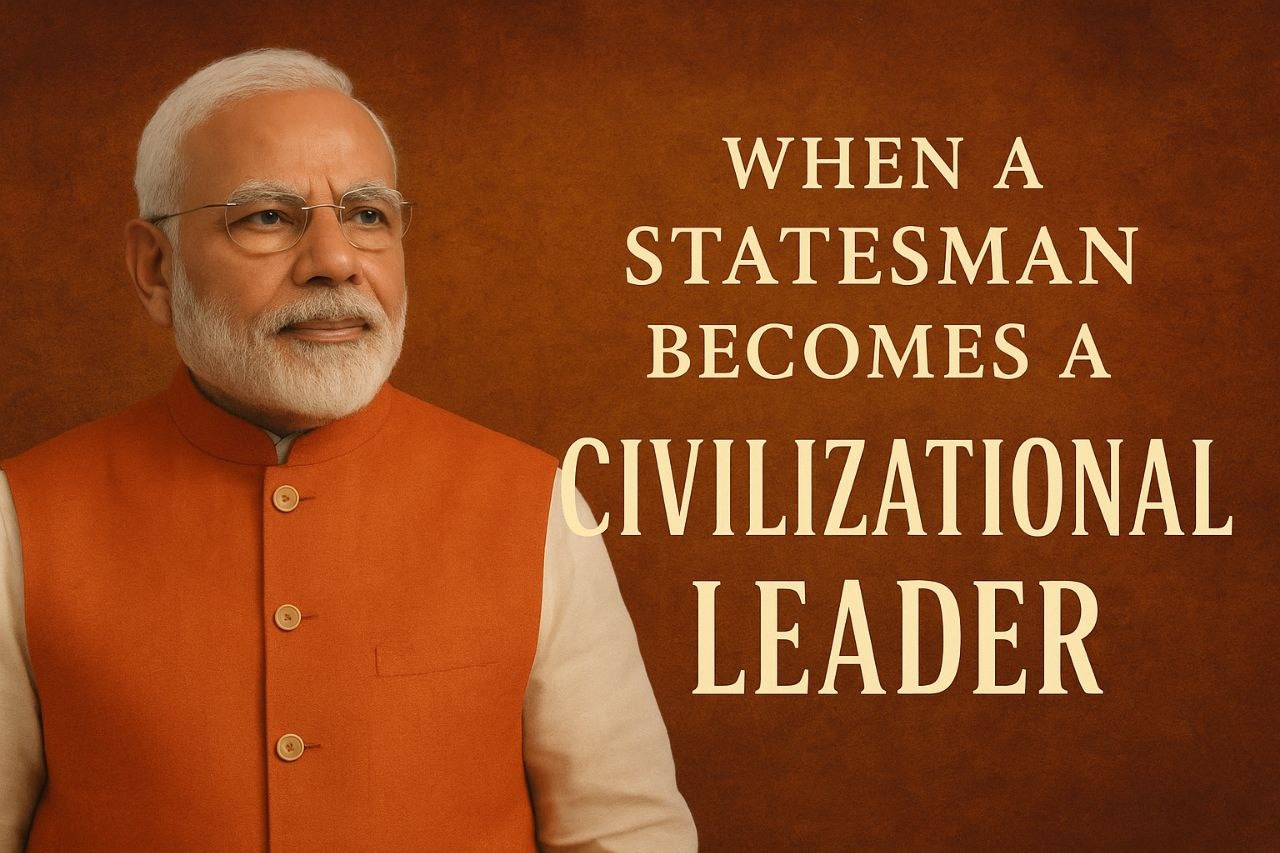
Leadership is often defined by tenure, elections, and cabinet decisions. Civilizational leadership, however, transcends time, eclipses mere policy, and realigns the destiny of a people. India today stands at a rare intersection of geopolitics, cultural renaissance, and a rekindling of civilizational consciousness. And at the helm of this energetic, evolving, ancient yet futuristic nation is a leader who has not merely governed but reawakened something deeper.
Narendra Modi will retire from active politics someday. But his imprint will not fade like the final note of a political speech, nor dissolve into the footnotes of dusty archives. Instead, he will be etched into the broader tapestry of India’s civilizational memory, the swelling wave of cultural pride, strategic confidence, economic assertion, and global stature that reorients history itself.
“Political terms expire, but civilizational awakenings echo through centuries.” ~ Adarsh Singh
To understand this transformation, one must journey through the layers of governance, identity, symbolism, economics, geopolitics, cultural revival, spiritual energy, psychological renewal, and the bold reclamation of civilizational destiny.
This is not just politics. It is a story of reclamation, of a civilization rediscovering its own voice.
I. The Civilization That Slept, and the Leader Who Knocked
For centuries, India functioned as a nation in remembrance rather than a nation in realization. Colonialism fractured continuity, intellectual structures were disrupted, and generations were raised not to own their civilizational identity, but to apologize for it. Post-independence governance, while foundational, often retained this apologetic tone.
Narendra Modi’s leadership challenged this psychology.
He pierced through the veil of inherited shame and invited Indians to look into the mirror without flinching, to see not the fractured colonized identity, but the civilizational force that once shaped philosophy, mathematics, spirituality, trade, architecture, agriculture, diplomacy, metallurgy, and astronomy.
“A civilizational leader does not merely win votes. He teaches a wounded nation how to see itself again.” ~ Adarsh Singh
The shift was psychological first, political second.
II. The Architecture of Identity: Symbols and Their Silent Power
Modern commentators often dismiss symbolism, but civilizations run on symbols. A flag, a temple, a ceremony, these stitch the collective subconscious. Modi understood that symbols are not aesthetic decorations; they are tools of continuity.
The reconstruction of sacred heritage sites, infrastructural facelift of pilgrimage circuits, and cultural festivals are not “cultural optics.” They are civilizational connective tissue.
The Ram Mandir in Ayodhya is not a building. It is a reclamation of historical dignity. Kashi Vishwanath corridor is not urban architecture; it is the restoration of spiritual centrality. The renovation of Somnath, Kedarnath, and Mahakal is not tourism, it is civilizational geography retuned.
“When civilizations forget their sacred geography, they drift. When they restore it, destiny re-aligns.” ~ Adarsh Singh
Through symbolism, Modi reprogrammed memory.
III. Economic Re-Imagining: From Survival to Global Ambition
Civilizational leadership must be supported by material strength. Pride without economic muscle is pageantry. Under Modi’s leadership, India shifted from a tentative market participant to a bold global contender.
Infrastructure, manufacturing incentives, digital transformation, fintech explosiveness, startup ecosystems, logistics pipelines, and global investment positioning were not isolated policies, they were strategic nodes.
India began preparing not for the next election, but for the next century.
The rise of UPI, ONDC, JAM trinity, Aadhaar, space exploration, defense manufacturing, and semiconductor aspirations reflect not administrative tinkering but civilizational engineering.
“Economics fuels civilization; vision steers it.” ~ Adarsh Singh
When a leader engineers the economic architecture of a thousand years, history takes note.
IV. The Psychological Re-Calibration of a Nation
For decades, Indians wore humility like a self-imposed burden. Colonial residue taught us to shrink our identity, to whisper our pride, to doubt our abilities.
Modi’s speeches, gestures, diplomacy, and emotional vocabulary introduced something radical, unapologetic pride.
His articulation was simple:
👉 We are an ancient civilization with a modern capacity.
👉 We are not spectators of global history; we are contributors.
👉 We are not consumers of ideology; we are creators of philosophy.
This shift cannot be measured on spreadsheets.
“A civilization does not rise when GDP grows. It rises when its people stop apologizing for who they are.” ~ Adarsh Singh
Modi did not just speak to the ear. He spoke to the civilizational spine.
V. Foreign Policy: The Return of Strategic Confidence
Civilizational leadership is incomplete without geopolitical posture. Modi’s foreign policy is not transactional diplomacy, it is the re-insertion of India into global narratives. Multi-alignment, not non-alignment. Partnerships without servitude. Assertiveness without aggression.
India now votes, negotiates, and speaks with a sovereign voice.
We no longer bend. We balance.
“Civilizational diplomacy is when a nation negotiates not as a market, but as a memory.” ~ Adarsh Singh
Global respect was not demanded. It was earned.
VI. The Social Fabric: Inclusivity Through Development
Civilizational leadership is not just about temples, philosophy, and symbolism, it is about social equity. Modi’s governance model focused on last-mile delivery, rural empowerment, sanitation, women’s dignity, electricity, roads, gas cylinders, healthcare, digital identity, and financial inclusion.
This is not welfare politics. It is dignity politics.
He recognized that a civilization rises when its poorest stand, not kneel.
“A leader who lifts the weak lifts the civilization itself.” ~ Adarsh Singh
The social foundation strengthened the cultural renaissance.
VII. Youth Energy: Dreams Without Apology
A leader becomes civilizational when he alters youth psychology. India’s youth today no longer dream of escaping the country. They dream of building within it. The psychological migration has reversed.
Startups are not accidental. They are psychological expressions of possibility.
The youth are hungry, not to immigrate, but to innovate.
“When youth choose creation over migration, a civilization begins to sprint.” ~ Adarsh Singh
Modi did not merely speak to youth. He rewired them.
VIII. The Return of Dharma Consciousness
Civilizational leadership revives not religion, but dharma, the principle of cosmic order, balance, duty, alignment. Under Modi, India’s spiritual heartbeat regained audibility. Not in dogma, but in dignity.
Festivals are celebrated with confidence. Rituals are observed publicly. Spiritual discourse is mainstream. This is cultural oxygen returning to the lungs of society.
“Civilizations breathe through culture; when breath returns, destiny awakens.” ~ Adarsh Singh
Spirituality was not imposed. It was revived.
IX. Narrative Sovereignty: The Battle for Intellectual Control
For centuries, India’s stories were told by outsiders, colonizers, missionaries, foreign academics, ideological gatekeepers. Modi’s era challenged this monopoly.
New knowledge ecosystems emerged:
👉 Indigenous discourse
👉 Indic scholarship
👉 Uncensored debate
👉 Alternative media
👉 Civilizational research
India began telling its own story again.
“Narrative is the weapon of history. Lose it, and you lose memory. Take it back, and you reclaim destiny.” ~ Adarsh Singh
Civilizational sovereignty begins in the classroom.
X. Cultural Memory as Statecraft
Civilizations are not accidents. They are nurtured through ritual continuity.
The revival of:
👉 Sanskrit research
👉 Traditional arts
👉 Indigenous sports
👉 Classical music circuits
👉 Yoga ecosystems
👉 Ayurveda institutions
👉 Kumbh organization
👉 Vedic philosophy conferences
…are not cultural extravagances. They are civilizational investments.
“Modern nations invest in markets; civilizations invest in memory.” ~ Adarsh Singh
Modi positioned culture not as entertainment but as heritage infrastructure.
XI. The Infrastructure Revolution as Civilizational Plumbing
Highways, airports, trains, metros, expressways, ports, logistics corridors, river-linking, digital grids, this is not urban beautification. It is India preparing for population density, manufacturing, climate stress, and future cities.
Civilizational states must scale.
Technology, mobility, energy, architecture, these are the nerves of a civilization. Modi built not just structures, but continuity pathways.
“Before civilizations soar, they first build their arteries.” ~ Adarsh Singh
Infrastructure is not concrete. It is destiny in tangible form.
XII. Digital Civilization: The Great Leap
India’s digital transformation under Modi is civilizational because it democratizes power.
👉 UPI is a digital dharma: fair, equal, accessible.
👉 JAM trinity is identity sovereignty.
👉 Aadhaar is a population infrastructure.
👉 Digital governance removes corruption, not through fear, but through transparency.
Civilizational states survive through technological futurism.
“Civilizations that refuse to digitize slowly dissolve into irrelevance.” ~ Adarsh Singh
Modi prepared India not for 2024, but 2047.
XIII. The Leader as Archetype
Civilizational leaders become archetypes, templates of aspiration.
In Modi’s case:
👉 His story represents mobility,
👉 His speech represents conviction,
👉 His discipline reflects dharma,
👉 His decisions reflect continuity.
He did not emerge from privilege but from patience, purpose, and perseverance. His persona becomes a itihaas of effort.
“Civilizational leaders are forged in struggle, not privilege.” ~ Adarsh Singh
A leader becomes a symbol when his journey becomes a lesson.
XIV. The Silent Axis: Order, Stability, Continuity
Civilizations do not rise through chaos. They rise through order. Modi’s governance brought administrative coherence, disciplined fiscal priorities, and structural reforms.
This consistency allowed long-term planning, a hallmark of civilizational thinking.
“A civilization accelerates when leadership aligns the coming decades, not the coming elections.” ~ Adarsh Singh
👉 The era of short-termism weakened India.
👉 Long-termism is civilizational maturity.
XV. The Feminine Civilizational Energy
Women’s empowerment under Modi is civilizational because women are the custodians of cultural memory. Gas cylinders, sanitation, menstrual awareness, entrepreneurship schemes, property incentives, these are not welfare policies; they are civilizational corrections.
👉 Empowered women preserve tradition.
👉 Educated women evolve it.
“Empower a woman, and you empower the archive of civilization.” ~ Adarsh Singh
When women thrive, civilizations stabilize.
XVI. Rural Civilization and the Village Spine
India’s civilization lived in villages long before it lived in cities. Modi’s policies did not dismiss rural India as underdeveloped but positioned it as a cultural asset. Rural roads, toilets, health centers, electrification, they fortified India’s cultural spine.
Villages are not backward. They are repositories of continuity.
“Progress is not urbanization; it is the dignification of rural heritage.” ~ Adarsh Singh
Civilizational revival must include rural dignity.
XVII. Patriotism as Cultural Glue
Modi redefined patriotism from outdated nationalism to cultural pride anchored in contribution.
Waving the flag is not enough. Building the nation is the real salute.
Millions began identifying not just with religion or caste but with the enterprise of nationhood.
“Civilizational patriotism is when identity expands beyond tribe into contribution.” ~ Adarsh Singh
Unity strengthens identity; identity fuels ambition.
XVIII. The Language Reclamation
Language is civilization’s bloodstream. Hindi, Sanskrit, regional languages, under Modi’s era, are experiencing revival and dignity. English is no longer the gatekeeper of intelligence.
Linguistic dignity is civilizational dignity.
“When a nation stops mocking its mother tongue, it begins to mature.” ~ Adarsh Singh
Language is pride materialized as sound.
XIX. Humor, Mockery, and the War on Self-Esteem
A colonized society laughs at itself. A rising civilization laughs at its problems, not its identity. Modi confronted the deep cultural mockery embedded in academia and entertainment.
Identity ridicule is a soft weapon.
Modi neutralized that psychologically. Suddenly, traditional identity was no longer “regressive.”
"Ridicule is the acid that dissolves civilizational memory.” ~ Adarsh Singh
Civilizational leadership rebuilds dignity through confidence.
XX. Institutional Consciousness
Modern states survive through institutions. Modi’s era witnessed modernization of:
👉 Aadhaar infrastructure
👉 GST architecture
👉 Direct benefit linkages
👉 Digital courts
👉 Electoral reforms
👉 Defense institutions
👉 Space and nuclear ecosystems
Institutions are civilizational machinery.
“Civilizations are not built by charisma alone, but by institutions that outlive charisma.” ~ Adarsh Singh
The scaffolding is now strong.
XXI. Generational Transfer: Planting Invisible Trees
Civilizational leaders plant policies whose fruits they may never taste.
👉 Infrastructure will mature decades later.
👉 Digital ecosystems will evolve.
👉 Cultural revival will amplify.
👉 Defense manufacturing will secure futures.
Planting invisible trees is civilizational statecraft.
“A true leader’s harvest is enjoyed by grandchildren he will never meet.” ~ Adarsh Singh
Legacy is measured in generations.
XXII. Global Indian Identity
Modi altered how Indians are perceived abroad. He projected confidence, dignity, and equal footing. The Indian diaspora gained stature. Global citizens felt renewed alignment with heritage.
This, too, is civilizational psychology.
“Civilizational identity becomes a global currency when dignity backs it.” ~ Adarsh Singh
Pride travels across oceans.
XXIII. Patriotism Without Apology
The post-colonial world taught us to be suspicious of patriotism. Modi redefined it as contribution, creation, and cultural memory.
Nationhood must never be an apology. It must be art, architecture, innovation.
“The civilization that apologizes for existing eventually stops existing.” ~ Adarsh Singh
Patriotism is philosophical alignment.
XXIV. The Anti-Entropy Leader
Entropy is decay, fragmentation, disorganization. Modi’s governance reintroduced systemic coherence. Civilization thrives when entropy is resisted.
He simplified systems, digitized bureaucracy, disciplined expenditure, and curbed corruption.
“Civilizations rise by reducing entropy, politically, socially, spiritually.” ~ Adarsh Singh
Order is civilizational oxygen.
XXV. Spiritual Modernism
Modi’s genius is not pushing India backward into ritual, but forwarding into spiritual modernism:
👉 Where yoga meets biomedical research,
👉 Ayurveda aligns with pharmacology,
👉 Temple corridors complement tourism, and
👉 Cultural festivals boost economy.
Spirituality becomes economic power.
“A civilization thrives when its soul funds its body.” ~ Adarsh Singh
Balance anchors destiny.
XXVI. The Emotional Architecture
Civilizational leadership builds emotional architecture: pride, belonging, ambition, continuity.
These emotions fuel investment, innovation, risk-taking, national service.
Emotions are civilizational currency.
“To awaken 1.4 billion dreams is greater than to pass 400 bills.” ~ Adarsh Singh
Modi tapped the subconscious.
XXVII. The Bhagavad Gita Archetype: Karma Yoga in Leadership
Modi embodies the Gita’s doctrine:
👉 Duty without fatigue,
👉 Service without expectation,
👉 Resilience without bitterness.
This karmic framework is civilizational inheritance.
“Leaders who operate on duty, not desire, shape centuries.” ~ Adarsh Singh
Civilizational spiritual frameworks produce durable leadership.
XXVIII. The 100-Year Horizon
Most leaders think in quarters. Civilizational leaders think in centuries.
Modi’s policies align with 2047, India’s centenary of independence. Even further, ecological strategies, digital infrastructure, manufacturing ecosystems, demographic harnessing, are designed for longevity.
Civilization requires time investment.
“The leader who plants for centuries earns the gratitude of those not yet born.” ~ Adarsh Singh
Foresight is civilizational divinity.
XXIX. The Memory of Future Generations
History will not remember Modi as merely a Prime Minister. Textbooks may categorize him in political chapters, but cultural memory will place him in deeper strata, the zone reserved for catalysts, awakeners, archetypal leaders.
Civilizational leadership is not voted; it is recognized by time.
“Political leaders end with history; civilizational leaders begin with it.” ~ Adarsh Singh
Modi’s imprint is civilizational ink.
XXX. Retirement and Continuity
When Narendra Modi retires, India will not return to pre-Modi psychology. Civilizational momentum, once awakened, continues through generations.
Even in retirement, he will remain:
👉 The reference point,
👉 The archetype,
👉 The benchmark,
👉 The originator of the renaissance arc.
He will become a civilizational elder, a guru of national consciousness.
“When a leader finishes leading, the civilization continues walking on the road he illuminated.” ~ Adarsh Singh
Civilizational waves continue after the moon moves on.
The Age of Civilizational Renaissance
India is undergoing a renaissance:
👉 Culturally proud,
👉 Economically assertive,
👉 Spiritually aware,
👉 Strategically confident,
👉 Generationally ambitious.
Narendra Modi did not just change policies. He changed the operating system.
Political leaders govern today. Civilizational leaders govern tomorrow.
Modi will leave politics one day. But he will not leave the civilization.
“A day will come when Narendra Modi retires from politics, but his influence will remain engraved in the civilizational arteries of India. Leaders govern nations; civilizational leaders awaken destinies.” ~ Adarsh Singh
His retirement will mark not an ending but the formal recognition of what he already is: A civilizational force.
{{DATE}}
 Launch your Graphy