When There’s Fire All Around, Even Renunciation Becomes a Form of Selfishness
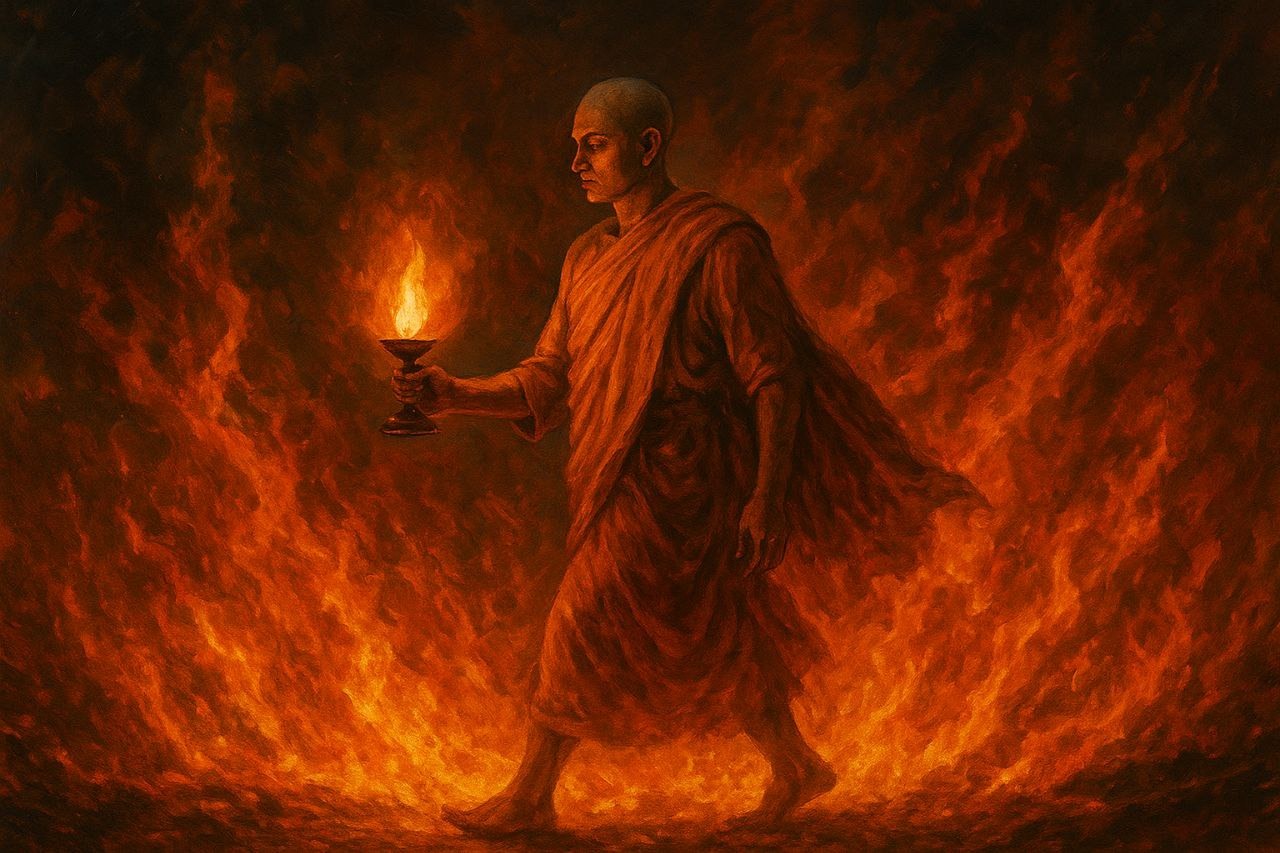
The Fire Around Us
There are moments in human history when silence becomes betrayal. There are times when neutrality is complicity. And there are eras when retreating, however spiritual it may seem, is but a disguised indulgence of self.
“When there’s fire all around, even renunciation becomes a form of selfishness.” ~ Adarsh Singh
This single line carries the weight of centuries. It pierces the illusion of detachment when action is the true dharma. It questions the comfort of isolation when participation is the demand of time.
Renunciation, or sannyāsa, has always held a sacred place in Indian thought, the final āśram, the pursuit of moksha beyond worldly desires. But what happens when the world itself burns? When injustice, corruption, ignorance, and suffering spread like wildfire, does turning away from the world remain holy?
The question is not merely philosophical; it is existential. For we live in an age where silence has become fashionable, and withdrawal is sold as wisdom. But in times of crisis, true spirituality is not an escape, it is engagement.
The Illusion of Purity in Isolation
Many believe that by renouncing the world, one achieves purity. But purity without responsibility is hollow. It is easy to be pure when untouched by the dirt of life.
“A saint untouched by the dust of the road is not holy, he is merely absent.” ~ Adarsh Singh
To live among chaos and still remain centered, that is true mastery. To stand amidst corruption and yet not be corrupted, that is real renunciation.
True renunciation is not of action but of ego. The one who walks away from suffering humanity to protect his own peace has misunderstood both compassion and courage.
When the Buddha left his palace, he did not abandon the world forever; he returned to it after enlightenment to heal its wounds. When Arjuna wished to escape battle in the Bhagavad Gītā, Krishna did not applaud his desire for peace, He called it weakness disguised as virtue.
Thus, detachment is not withdrawal; it is clarity. It means acting without being consumed by action, but not avoiding it altogether.
Dharma in the Age of Fire
When the forest burns, the deer cannot hide behind meditation. The flames will find him. Similarly, when society collapses, no mountain cave or temple gate can offer true refuge.
Dharma is dynamic. It demands presence, not absence. It calls us to participate in the restoration of balance.
“Spirituality is not about leaving the battlefield; it is about becoming light in the battlefield.” ~ Adarsh Singh
In the Mahābhārata, Arjuna’s crisis of conscience mirrors the conflict of our age. He wished to renounce action because action seemed violent. Yet Krishna reminded him, inaction in the face of adharma is the greatest violence.
When the fire is outside, it will eventually reach the inside. And if the wise remain silent, ignorance becomes the loudest voice.
The Modern Fire: Indifference and Comfort
Today, the flames are metaphorical but equally consuming. The fire is of greed, apathy, exploitation, misinformation, and moral decay. It burns in the marketplace, the media, the politics, the mind.
We live in a world where everyone seeks comfort. Comfort in gadgets, comfort in ideology, comfort even in spirituality. “Peace” has become a product. “Detachment” has become an excuse. And “awareness” has been reduced to a slogan.
“When spirituality becomes an escape, it ceases to be spiritual.” ~ Adarsh Singh
Renunciation, in its true essence, is an inner act. But modern renunciation often manifests as social indifference, the refusal to engage with reality because it disturbs our calm.
⚞ We meditate, but we don’t act.
⚞ We pray, but we don’t participate.
⚞ We talk of consciousness, but we ignore conscience.
This selective spirituality is subtle selfishness. It preserves one’s serenity at the cost of collective suffering.
When Fire Demands Action
If a child is drowning and a saint sits nearby in meditation, his silence is sin. The divine would rather he breaks his trance and saves the child.
Action born of compassion is higher than stillness born of self-interest.
“Sometimes, doing nothing is the loudest form of betrayal.” ~ Adarsh Singh
In the Bhagavad Gītā, Krishna says ~ “Action is superior to inaction.”
He didn’t condemn meditation, but he condemned avoidance disguised as detachment.
Spirituality without service is sterile. Awareness without responsibility is arrogance.
When the fire rages, true saints rise, not retreat.
Renunciation vs Responsibility
Let us understand the fine line between renunciation (tyāga) and abandonment (pālāyan).
👉 Renunciation is giving up the attachment to fruits of action.
👉 Abandonment is giving up the action itself.
The former is divine; the latter is cowardice.
When you perform your duty without being enslaved by its outcome, that is renunciation in action. But to refuse to act because you fear impurity or failure, that is abdication of dharma.
“True renunciation is not an escape from duty; it is an escape from ego.” ~ Adarsh Singh
Thus, in times of fire, the world doesn’t need more monks; it needs more awakened warriors.
The Fire as a Test of Evolution
Fire has always symbolized purification. In Vedic rituals, offerings were made to Agni, the divine messenger who transforms and carries prayers to the gods. Fire destroys the false and reveals the essence.
When life surrounds us with fire, it is not always destruction; sometimes it is divine testing. It is life’s way of asking: Will you stand for the truth, or will you save your peace?
“Every era of fire separates the spectators from the saviors.” ~ Adarsh Singh
The purpose of fire is not to burn the goods but to awaken it. The one who claims spirituality must be willing to stand in that fire and still radiate calm.
The New Meaning of Sannyāsa
The age demands a redefinition of sannyāsa.
The renunciant of today is not the one who leaves the world but the one who transforms it.
He does not wear saffron robes; he carries a burning purpose.He does not renounce possessions; he renounces indifference.
“Modern renunciation is not walking away from life, it is walking fearlessly into it.” ~ Adarsh Singh
Such a person meditates not to escape noise, but to understand how to bring harmony into it.
He prays not for peace, but for strength to serve.He walks into the fire not because he loves pain, but because he loves the truth.
This is active spirituality, where contemplation meets courage, and silence meets speech when justice demands it.
Historical Echoes: When Saints Became Warriors
History offers luminous examples of Sanātani warriors who refused to renounce during the crisis, sages who saw no separation between dharma and karma, between meditation and mission.
Bhagwan Parashurāma, the sixth avatar of Vishnu, who rose with his axe not out of hatred but to restore balance when adharma had overrun the earth.
Chhatrapati Shivaji Maharaj, the lion of Bharat, who blended devotion and valor, his sword moved with the rhythm of bhakti and his heart beat for Dharma Raksha.
Swami Vivekananda, who roared, “They alone live who live for others,” awakening the dormant spiritual pride of Bharat.
Swami Dayananda Saraswati, who fought against superstition and degeneration, revived the eternal call, “Back to the Vedas!”
Sri Aurobindo, who evolved from a revolutionary freedom fighter into a yogi, but never abandoned his mission of transforming the collective consciousness.
Each of them stood not apart from the fire but within it, luminous, fearless, and unwavering. They proved that Sanātan Dharma is not passive renunciation but dynamic participation with purity.
“Spirituality that does not protect the world is incomplete.” ~ Adarsh Singh
Their lives teach us that true saints do not escape the world, they elevate it. They do not pray for peace in silence; they create it through awakened action.
The Psychology of Escape
At a deeper level, our desire to renounce often hides fear, fear of failure, rejection, responsibility, or pain.
We say, “I have detached from the world,” when in truth we are avoiding it. We call it peace, but it’s paralysis.
The mind creates spiritual justifications for psychological weaknesses.
It quotes scriptures to defend inaction.
It hides under the veil of higher consciousness while refusing to engage with suffering consciousness.
But the universe sees the intent. And dharma is not deceived by words.
“You can fool people with your silence, but you can’t fool the soul with your absence.” ~ Adarsh Singh
The Silent Complicity of the ‘Peaceful’
One of the most dangerous illusions today is the cult of personal peace.
People say, “I don’t want to get involved in negativity,” and thus allow negativity to rule. They call it balance; it’s merely detachment from reality.
The result is a society where the wicked act freely while the wise meditate quietly. Evil thrives not because it’s strong but because goodness has become passive.
“When good men become silent, darkness doesn’t just rise, it reigns.” ~ Adarsh Singh
Peace, when not anchored in justice, becomes poison. The world needs engaged peace, not indifferent calm.
Spiritual Activism: The New Dharma
The call of this century is for spiritual activism.
It means merging consciousness with conscience, meditation with movement, and wisdom with will.
The yogi must be the warrior. The sage must be the citizen. The monk must be the messenger.
This synthesis is not new, it is the ancient essence of the Gītā.
“To live spiritually today is to fight consciously.” ~ Adarsh Singh
The battlefield has changed, it is no longer Kurukshetra of swords, but Kurukshetra of minds. Yet, the call is the same: rise, act, awaken.
The Fire Within
The outer fire mirrors the inner one. Every human soul has its private blaze, the conflict between peace and participation, between self and service.
Renunciation appears tempting because it promises relief. But relief is not resolution. The inner fire cools only when purpose ignites.
“The only fire that can defeat destruction is the fire of purpose.” ~ Adarsh Singh
When the world burns, we must light our own torch, not to escape, but to illuminate.
Awakening in the Midst of Flames
When there’s fire all around, even renunciation becomes a form of selfishness, because that is when the divine expects us to act, not withdraw.
That is when our silence weighs heavier than our words.
That is when our stillness becomes surrender, not to God, but to fear.
True spirituality does not ask us to abandon the world but to awaken within it.
The enlightened one does not float above the flames; he walks through them: untouched, unwavering, unafraid.
“The measure of your awakening is not how calm you feel in meditation, but how courageous you remain in a crisis.” ~ Adarsh Singh
The fire is not your enemy. It is your invitation, to evolve from seeker to savior, from watcher to warrior, from monk to messenger.
The Call to Awake, Act, and Serve
Renunciation in a burning world is not liberation; it is luxury.
⚞ When injustice spreads, silence is sin.
⚞ When ignorance grows, neutrality is negligence.
⚞ When humanity suffers, detachment is deceit.
The time has come to awaken a new kind of spirituality, one that walks into the fire, not away from it.
To be spiritual today is to be responsibly awake. And to be truly free is to serve fearlessly.
“When the world is burning, be the rain, not the recluse.” ~ Adarsh Singh
Sat Nov 15, 2025
 Launch your Graphy