WHY TIME BEGINS WITH DHARMA, NOT DATES!
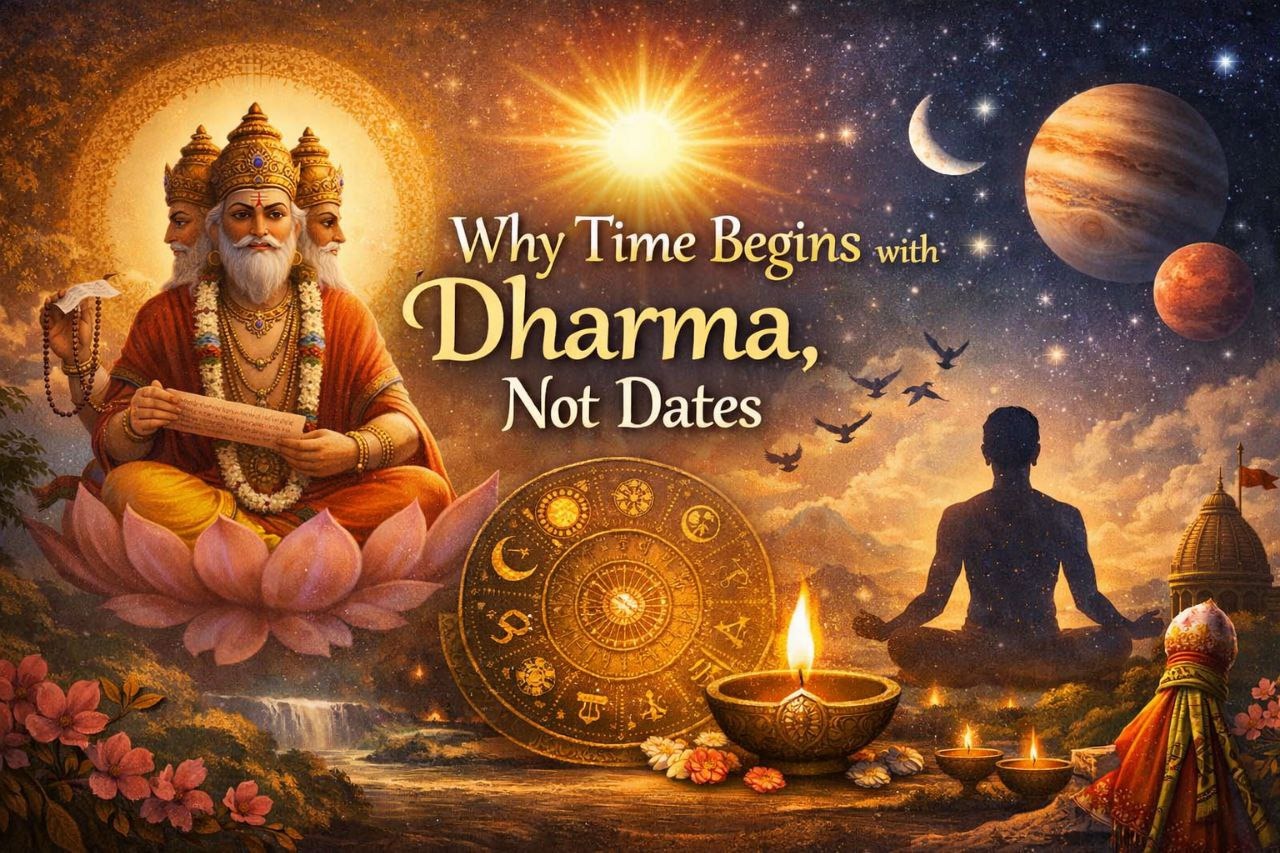
Every year, as the world welcomes 1st January with fireworks, countdowns, and celebrations, an ancient question quietly remains unanswered: is this truly the beginning of a new year, or merely a numerical shift on a calendar?
In Sanātan Dharma, time is not mechanical. It is living, breathing, and conscious. A new year is not declared by human agreement but revealed through cosmic alignment. That is why, for Hindus, 1st January has never been the real New Year.
The Hindu New Year 2026 arrives not with midnight noise but with cosmic precision, guided by the Vedic Panchang, signaling renewal, balance, and spiritual awakening.
Rooted in Sanātan Gyan and ancient Shastra, Nav Varsh is not a date; it is a reset of creation itself.
“Time becomes sacred only when it aligns with truth; otherwise, it is just movement without meaning.” ~ Adarsh Singh
UNDERSTANDING TIME IN SANATAN DHARMA
Sanātan Dharma views time (Kaal/काल) as cyclical, not linear. Unlike the Gregorian calendar, which is administrative and solar-based, the Hindu system integrates solar, lunar, and planetary rhythms.
Time is considered a cosmic intelligence, not a human invention.
In Vedic understanding:
✽ Time governs creation, preservation, and dissolution
✽ Every cycle has a natural beginning and completion
✽ Human life is meant to move in harmony with these cycles
This is why New Year cannot be arbitrary. It must coincide with:
✽ Seasonal balance
✽ Lunar purity
✽ Solar transition
✽ Energetic renewal of nature
The Western calendar begins in winter, when nature is dormant. The Hindu calendar begins in Chaitra, when life awakens.
“A true beginning does not start when the clock changes, but when life begins to rise again.” ~ Adarsh Singh
WHY 1st JANUARY IS NOT THE HINDU NEW YEAR
1st January was established for administrative convenience, not spiritual alignment. It has no correlation with agricultural cycles, lunar phases, or cosmic energies.
In contrast, Sanātan Dharma asks a deeper question: When does nature renew itself?
The answer is Chaitra.
✽ Trees bloom
✽ Crops regenerate
✽ Animals reproduce
✽ The climate becomes balanced
✽ Human vitality naturally increases
A New Year, according to Sanātan Dharma, must:
✽ Support physical health
✽ Enhance mental clarity
✽ Elevate spiritual awareness
This is why Hindu sages rejected artificial beginnings and aligned timekeeping with Rta/रत (संस्कृत ~ ऋतम्), the universal cosmic order.
THE HINDU NEW YEAR 2026: COSMIC DETAILS
The Hindu New Year in 2026 begins on:
Thursday, 19 March 2026/Chaitra Shukla Pratipada/Vikram Samvat 2083
This date marks the first waxing moon of Chaitra, symbolizing growth, expansion, and possibility.
Thursday is ruled by Guru (Jupiter), the planet of:
✽ Wisdom
✽ Dharma
✽ Prosperity
✽ Knowledge
✽ Spiritual guidance
The ruling planetary energy supports:
✽ Learning and teaching
✽ Ethical leadership
✽ Social harmony
✽ Spiritual pursuits
“When a year begins under the gaze of Guru, growth follows wisdom, not chaos.” ~ Adarsh Singh
CHAITRA SHUKLA PRATIPADA: THE BIRTHDAY OF CREATION
According to sacred Shastra, Chaitra Shukla Pratipada is not symbolic; it is cosmological.
It is believed that on this very day:
✽ Lord Brahma initiated the creation of the universe.
The Brahma Purana states:
संवत्सरस्य प्रथमं दिनं चैत्रस्य शुक्लपक्षे।
तस्मिन् दिने जगत्सृष्टिर्ब्रह्मणा समकल्पिता॥
This establishes the Hindu New Year as the moment of universal genesis.
In Sanātan thought:
✽ Creation is not random
✽ Time is intentional
✽ Beginnings are sacred
Thus, celebrating New Year on this day is not tradition, it is in alignment with the moment of creation itself.
NAV VARSH: A SPIRITUAL RESET, NOT A FESTIVAL
Nav Varsh is not about celebration alone. It is about recalibration.
It represents:
✽ Letting go of the old
✽ Purifying intention
✽ Realigning with Dharma
✽ Resetting thought, speech, and action
In ancient Bhāratvarsh, kings, sages, households, and students would:
✽ Review the past year
✽ Correct errors
✽ Renew vows
✽ Begin fresh disciplines
“Nav Varsh is not about welcoming time; it is about correcting how we live within it.” ~ Adarsh Singh
CONNECTION WITH CHAITRA NAVRATRI
The Hindu New Year seamlessly flows into Chaitra Navratri, emphasizing that time renewal requires inner purification.
Navratri invokes the nine forms of Goddess Durga, representing:
✽ Strength
✽ Discipline
✽ Awareness
✽ Transformation
Devi Mahatmya declares:
या देवी सर्वभूतेषु शक्तिरूपेण संस्थिता।
नमस्तस्यै नमस्तस्यै नमस्तस्यै नमो नमः॥
Navratri teaches that:
✽ Power is within
✽ Purity precedes progress
✽ Discipline precedes success
This is why fasting, mantra, and restraint are emphasized, not as rituals, but as energetic cleansing.
REGIONAL EXPRESSIONS, ONE DHARMIC HEART
Across Bhāratvarsh, Nav Varsh is celebrated with regional beauty:
✽ Gudi Padwa in Maharashtra
✽ Ugadi in Karnataka and Andhra Pradesh
✽ Cheti Chand among Sindhis
Despite cultural variations, the core philosophy remains identical:
✽ Gratitude to nature
✽ Respect for time
✽ Commitment to righteous living
Sanātan Dharma allows diversity of expression but unity of essence.
WHAT ONE SHOULD DO ON HINDU NEW YEAR
The first day is believed to set the energetic tone for the entire year.
Traditional guidance includes:
✽ Waking during Brahma Muhurta
✽ Physical and mental purification
✽ Prayer, mantra, and silence
✽ Seeking Guru wisdom
✽ Acts of charity and compassion
The Bhagavad Gita affirms:
यज्ञदानतपःकर्म न त्याज्यं कार्यमेव तत्।
Selfless action, charity, and discipline are non-negotiable pillars of spiritual life.
WHAT ONE SHOULD AVOID
Equally important is restraint.
Avoid:
✽ Tamasic food and habits
✽ Negativity and conflict
✽ Disorder and negligence
✽ Harsh speech and ego-driven actions
“The year listens carefully to how you behave on its first day.” ~ Adarsh Singh
WHY THIS MATTERS IN THE MODERN WORLD
In an age of speed, distraction, and artificial deadlines, Sanātan Dharma offers timeless wisdom:
✽ Slow down
✽ Align with nature
✽ Live consciously
Hindu New Year reminds us that:
✽ Life is not a race
✽ Progress without balance leads to collapse
✽ True success begins with inner order
Nav Varsh is a call to live deliberately, not reactively.
A RETURN TO COSMIC TRUTH AND CONSCIOUS LIVING
Hindu New Year 2026 is not about rejecting 1st January, it is about remembering a deeper truth.
True beginnings arise when:
✽ Nature awakens
✽ Consciousness aligns
✽ Dharma leads action
Rooted in Sanātan Gyan and sacred Shastra, Nav Varsh invites humanity to begin again, not externally, but internally.
“When life aligns with Dharma, every day becomes auspicious, and every beginning becomes eternal.” ~ Adarsh Singh
{{DATE}}
 Launch your Graphy